| WORLD WAR II |

| During World War Two, Schuylkill Haven, just like every small town in America, sent its sons to war. This page honors those veterans with several sections dedicated to those who served and especially to those who made the ultimate sacrifice. |
 |
 |
 |
 |
 |
 |
 |
 |
 |
 |
 |
 |
 |
 |
 |
 |
 |
 |
 |
 |
| JUST ADDED: A series of articles published as "Shots From Camp" in The Call from 1943 and 1944, showing photos and short stories on Schuylkill Haven soldiers and sailors in the war. |

| These are two panels on the Veteran's Memorial at Bubeck Park. Clicking on each provides greater detail on the names of those who made the ultimate sacrifice in World War Two. |
|
SERVICEMAN
DATE OF DEATH
BURIAL LOCATION
| The chart below lists those men from Schuylkill Haven who made the ultimate sacrifice and were buried in American cemeteries in Europe. |
| DIED IN SERVICE TO THEIR COUNTRY |
| Below is a detailed listing of those men from Schuylkill Haven who died while in the service in World War Two. Continuing research will provide more information when possible. |
DECEASED
FAMILY
FATE
DIED
|


| PORTRAITS OF SCHUYLKILL HAVEN'S WORLD WAR TWO DEAD |
Photos from "Welcome Home Celebration" booklet from September 1946.
| CHARLES R. KANTNER DIED SEPTEMBER 14, 1944 |
Charles R. Kantner was a Seaman Second Class serving aboard the USS Warrington, a Somers class destroyer. On September
10, 1944, the Warrington left the Norfolk Naval Yard with the ship Hyades setting course for Trinidad. Two days out of Norfolk,
along the Florida coast, the ships encountered heavy weather. In the afternoon the ship received word they were heading into
a hurricane. They made headway briefly while the radioman tried to reach the Hyades for assistance. 130 knot winds brought
the ship to a standstill while waves pounded her hull to pieces. The storm worsened on the morning of the thirteenth and the
ship began to take water through the vents in the destroyer. The Warrington was forced to It was apparent that the crew could
not win the struggle to save the ship and the order was given to prepare to abandon ship. By 12:50 the crew had left the
Warrington which then sank. Sea water flooded the engine room, cutting off all power and damaging the steering mechanism.
She took a list to starboard and rolled over, sinking stern first about 175 nautical miles east-south-east of Great Abaco Island,
Bahamas Islands. A prolonged search by other vessels resulted in the recovery of only five officers and sixty eight men out of
a total crew of 321 men. Charles Kantner of Schuylkill Haven was one of the 248 men who died that day. His body was never
recovered and his name is listed on the Tablet of the Missing in New York City.
Note: Charles was the brother of Georgine Kantner, whom I and hundreds of other Schuylkill Haven children had as a teacher.
10, 1944, the Warrington left the Norfolk Naval Yard with the ship Hyades setting course for Trinidad. Two days out of Norfolk,
along the Florida coast, the ships encountered heavy weather. In the afternoon the ship received word they were heading into
a hurricane. They made headway briefly while the radioman tried to reach the Hyades for assistance. 130 knot winds brought
the ship to a standstill while waves pounded her hull to pieces. The storm worsened on the morning of the thirteenth and the
ship began to take water through the vents in the destroyer. The Warrington was forced to It was apparent that the crew could
not win the struggle to save the ship and the order was given to prepare to abandon ship. By 12:50 the crew had left the
Warrington which then sank. Sea water flooded the engine room, cutting off all power and damaging the steering mechanism.
She took a list to starboard and rolled over, sinking stern first about 175 nautical miles east-south-east of Great Abaco Island,
Bahamas Islands. A prolonged search by other vessels resulted in the recovery of only five officers and sixty eight men out of
a total crew of 321 men. Charles Kantner of Schuylkill Haven was one of the 248 men who died that day. His body was never
recovered and his name is listed on the Tablet of the Missing in New York City.
Note: Charles was the brother of Georgine Kantner, whom I and hundreds of other Schuylkill Haven children had as a teacher.
| ROBERT E. IMBODEN DIED MAY 12, 1945 |
Robert E. Imboden was a PFC in the United States Marine Corps. He entered the Marines on September 10, 1943 and received
his basic training at Parris Island, SC. He was shipped to the South Pacific in July of 1944. He was a member of an amphibian
tractor unit and had been injured during the Pelelieu operation and was hospitalized at Guadalcanal for two months. Having
received the Purple Heart, he returned to duty. He was in action on Okinawa on May 12, 1945 when he was killed. In news sent
to his family by a buddy, they were informed that he was hit by fragmentations of a bomb that struck the hut in which PFC
Imboden was during a raid and that he died a few minutes after being hit. He was buried in the Marine Corps graveyard with
special combined services on Mother's Day. Robert has attended Schuylkill Haven High School and was employed by a
Schuylkill Haven grocery store before entering the service.
his basic training at Parris Island, SC. He was shipped to the South Pacific in July of 1944. He was a member of an amphibian
tractor unit and had been injured during the Pelelieu operation and was hospitalized at Guadalcanal for two months. Having
received the Purple Heart, he returned to duty. He was in action on Okinawa on May 12, 1945 when he was killed. In news sent
to his family by a buddy, they were informed that he was hit by fragmentations of a bomb that struck the hut in which PFC
Imboden was during a raid and that he died a few minutes after being hit. He was buried in the Marine Corps graveyard with
special combined services on Mother's Day. Robert has attended Schuylkill Haven High School and was employed by a
Schuylkill Haven grocery store before entering the service.
William T. Sterner was the only child of Theodore and Mary (Luckenbill)
Sterner of 511 Columbia Street in Schuylkill Haven. Born January 13, 1924
he was a 1942 graduate of Schuylkill Haven High School. He enlisted in the
Army in March of 1943 and was eventually promoted to Staff Sergeant.
Assigned to an armored division he went overseas in June of 1944. The
story of his service record is well worth noting.
He was first wounded on October 16, 1944 when his back was wounded by
enemy shell fragments near Luneville France. He was again wounded on
November 15, 1944 near Ancerville France and returned to duty on Decem-
ber 20, 1944. His parents later received the following telegram:
The Secretary of War desires me to express his due regret that your son
Staff Sergeant William Sterner has been reported missing in action since
January 20 in France. Further report states he returned to duty December
20 from grievously reported wound. If further detail or other information is re-
ceived you will be promptly notified. J. A. Ulio Adjutant General
William Sterner's fate was later learned by his parents. On January 20, 1945 his unit was defending the Moder River bridgehead
in the vicinity of Drusenheim bas-Rhine France. A German counterattack formed a pincer movement and cut off his unit. It was
later reported that he was taken prisoner with a serious head wound and interned in a POW camp in Lazarett, Baden-Baden,
Germany where he later died of wounds received in action.
The story did not end there as in 1947 his parents received a letter. The letter was posted on October 22, 1947 from Hans
Neunohner of Freiburg Germany. He was a German who had treated William while he was a POW. Parts of his letter written in
German and translated follow:
I guess you are surprised from somebody you don't know from Germany. But I would like to tell you about your son William. I
think it is worth remembering. Your son came to us in the beginning of January when hurt in Vogesen. He was brought to the
hospital in Baden-Baden, the Black Forest. He was hurt very bad. He was wounded in the head and had brain damage. He was
operated on by a specialist but was hurt too bad. He died on February 1, 1945. Whatever he had on that belonged to him I sent
to the Red Cross. I worked with your son. He was mostly unconscious. I am sure he did not feel any pain. We buried your son
with all the military honors. I made some pictures that I send to you today. We did not know if your son was Catholic or
Protestant so we had two priests. Also the American wounded soldiers came to the grave and the Germans put a wreath down.
He also got a gun salute. You can see it in the pictures. Maybe some of the Americans which were with him in the hospital told
you about your son. Maybe you know some in the pictures. I am sorry this is two years late I write this letter but I was in prison
too and I got home to my family not too long ago. I was reading in the paper that the remains from the dead soldiers were sent
back to the states. I hope your son is in the USA. I took your address from your sons papers. Hans Neunohner
Sterner's remains were originally buried in a civilian cemetery near the camp. They were later disinterred and reinterred at the
Lorraine American Cemetery in St. Avold France. His parents were notified that his remains could be shipped home but they
opted to let him rest in peace in France. The final irony is that the German roots of this Sterner family were in fact based in
Baden-Baden where William died.
The pictures, eight in all, sent by the German to his family are also presented here.
Sterner of 511 Columbia Street in Schuylkill Haven. Born January 13, 1924
he was a 1942 graduate of Schuylkill Haven High School. He enlisted in the
Army in March of 1943 and was eventually promoted to Staff Sergeant.
Assigned to an armored division he went overseas in June of 1944. The
story of his service record is well worth noting.
He was first wounded on October 16, 1944 when his back was wounded by
enemy shell fragments near Luneville France. He was again wounded on
November 15, 1944 near Ancerville France and returned to duty on Decem-
ber 20, 1944. His parents later received the following telegram:
The Secretary of War desires me to express his due regret that your son
Staff Sergeant William Sterner has been reported missing in action since
January 20 in France. Further report states he returned to duty December
20 from grievously reported wound. If further detail or other information is re-
ceived you will be promptly notified. J. A. Ulio Adjutant General
William Sterner's fate was later learned by his parents. On January 20, 1945 his unit was defending the Moder River bridgehead
in the vicinity of Drusenheim bas-Rhine France. A German counterattack formed a pincer movement and cut off his unit. It was
later reported that he was taken prisoner with a serious head wound and interned in a POW camp in Lazarett, Baden-Baden,
Germany where he later died of wounds received in action.
The story did not end there as in 1947 his parents received a letter. The letter was posted on October 22, 1947 from Hans
Neunohner of Freiburg Germany. He was a German who had treated William while he was a POW. Parts of his letter written in
German and translated follow:
I guess you are surprised from somebody you don't know from Germany. But I would like to tell you about your son William. I
think it is worth remembering. Your son came to us in the beginning of January when hurt in Vogesen. He was brought to the
hospital in Baden-Baden, the Black Forest. He was hurt very bad. He was wounded in the head and had brain damage. He was
operated on by a specialist but was hurt too bad. He died on February 1, 1945. Whatever he had on that belonged to him I sent
to the Red Cross. I worked with your son. He was mostly unconscious. I am sure he did not feel any pain. We buried your son
with all the military honors. I made some pictures that I send to you today. We did not know if your son was Catholic or
Protestant so we had two priests. Also the American wounded soldiers came to the grave and the Germans put a wreath down.
He also got a gun salute. You can see it in the pictures. Maybe some of the Americans which were with him in the hospital told
you about your son. Maybe you know some in the pictures. I am sorry this is two years late I write this letter but I was in prison
too and I got home to my family not too long ago. I was reading in the paper that the remains from the dead soldiers were sent
back to the states. I hope your son is in the USA. I took your address from your sons papers. Hans Neunohner
Sterner's remains were originally buried in a civilian cemetery near the camp. They were later disinterred and reinterred at the
Lorraine American Cemetery in St. Avold France. His parents were notified that his remains could be shipped home but they
opted to let him rest in peace in France. The final irony is that the German roots of this Sterner family were in fact based in
Baden-Baden where William died.
The pictures, eight in all, sent by the German to his family are also presented here.
| WILLIAM T. STERNER DIED FEBRUARY 1, 1945 |


| This set of rare and unique pictures can be seen in great detail by clicking on them to zoom in. In the set at upper left, note the German officer giving the Nazi salute over William's grave. Also note the Hitler like mustache on the man next to him. In the set,second from left, fellow wounded American soldiers pay their final respects. Many of the men are bandaged. In the set,third from left, another vantage point of the ceremony is shown. In the far right pair, the German honor guard can be seen firing their rifles in the rear and at the bottom, the wreath is placed on the grave. |
| Note: Thank you to Carol Campbell, for providing the story and pictures. She was a cousin of William Sterner. |


| At left is one of the Tablet of the Missing. At right the name of Charles Kantner, son of Schuylkill Haven, is visible when zoomed in. |
| Stories below will detail the fates of the individual soldiers and sailors who died in service to their country. |
Captain Roeder Killed in Action
Given Congressional Medal
Rome March 1 - Captain Robert E. Roeder, whose mother Cora Roeder, lives at Summit Station, Pa. has
been awarded the Congressional Medal of Honor posthumously for his courage and leadership during the
long battle of Mount Battaglia, last September. It was during that battle that the 350th Regiment, to which
Captain Roeder was attached, beat back repeated German counter attacks, despite heavy losses. Major
General Paul W. Kendall, commander of the U. S. 88th Division, who announced the award yesterday, said
the medal would be presented to the captain's mother.
Roeder commanded a company assigned to hold the summit. The first enemy attack came 35 minutes
after the company was in position; but was repulsed along with five others in the ensuing 34 hours.
The 350th's positions were overrun when the Germans attacked a seventh time with flame throwers after
an artillery barrage, but Captain Roeder led his company in a hand to hand fight.
He was wounded by shellfire and carried unconscious to a command post. Regaining consciousness, he
dragged himself to the doorway, braced himself in a sitting position and opened fire on the advancing
Germans with a rifle, killing at least two, while shouting orders to his men. Then a shell burst a few feet
away, killing him. The citation credited Roeder's courage and leadership as responsible for the
American's retaining the strategic heights.
Given Congressional Medal
Rome March 1 - Captain Robert E. Roeder, whose mother Cora Roeder, lives at Summit Station, Pa. has
been awarded the Congressional Medal of Honor posthumously for his courage and leadership during the
long battle of Mount Battaglia, last September. It was during that battle that the 350th Regiment, to which
Captain Roeder was attached, beat back repeated German counter attacks, despite heavy losses. Major
General Paul W. Kendall, commander of the U. S. 88th Division, who announced the award yesterday, said
the medal would be presented to the captain's mother.
Roeder commanded a company assigned to hold the summit. The first enemy attack came 35 minutes
after the company was in position; but was repulsed along with five others in the ensuing 34 hours.
The 350th's positions were overrun when the Germans attacked a seventh time with flame throwers after
an artillery barrage, but Captain Roeder led his company in a hand to hand fight.
He was wounded by shellfire and carried unconscious to a command post. Regaining consciousness, he
dragged himself to the doorway, braced himself in a sitting position and opened fire on the advancing
Germans with a rifle, killing at least two, while shouting orders to his men. Then a shell burst a few feet
away, killing him. The citation credited Roeder's courage and leadership as responsible for the
American's retaining the strategic heights.

Legion to Go to Gap for Roeder
Medal of Honor Presentation
May 10, 1945 - Members of the local post 67 of the American Legion will go to Indiantown Gap Saturday afternoon to participate
in the ceremonies in connection with the presentation of the Medal of Honor posthumously to Captain Robert E. Roeder. The
Medal will be presented to his mother, Mrs. Cora Roeder, Summit Station.
All persons who can furnish cars are requested to contact M. M. Wilson, First Vice Commander, at the Post headquarters as
soon as possible. Cars will assemble at the headquarters between eleven and twelve o'clock.
The program at Indiantown Gap includes a tour of the reservation and a review on Muir Field. The ceremonies will begin at
one o'clock.
The nation's highest military award for heroism above and beyond the call of duty will be presented to Captain Roeder's
mother. He died on Mount Battaglia last September. The successful capture and defense of the hill made possible the Fifth
Army offensive in the Po Valley.
Captain Roeder served in the Army in peacetime, having enlisted June 4, 1936. He went to Hawaii in 1939 and came back March
1942 and entered Officer's Training School, receiving his commission in June 1942, and went overseas in December 1943,
being promoted to captain in Italy. His father died after he went overseas. There is a brother, Sergeant Charles Roeder also in
the Army. Several hundred veterans are expected to go from Schuylkill County.
Medal of Honor Presentation
May 10, 1945 - Members of the local post 67 of the American Legion will go to Indiantown Gap Saturday afternoon to participate
in the ceremonies in connection with the presentation of the Medal of Honor posthumously to Captain Robert E. Roeder. The
Medal will be presented to his mother, Mrs. Cora Roeder, Summit Station.
All persons who can furnish cars are requested to contact M. M. Wilson, First Vice Commander, at the Post headquarters as
soon as possible. Cars will assemble at the headquarters between eleven and twelve o'clock.
The program at Indiantown Gap includes a tour of the reservation and a review on Muir Field. The ceremonies will begin at
one o'clock.
The nation's highest military award for heroism above and beyond the call of duty will be presented to Captain Roeder's
mother. He died on Mount Battaglia last September. The successful capture and defense of the hill made possible the Fifth
Army offensive in the Po Valley.
Captain Roeder served in the Army in peacetime, having enlisted June 4, 1936. He went to Hawaii in 1939 and came back March
1942 and entered Officer's Training School, receiving his commission in June 1942, and went overseas in December 1943,
being promoted to captain in Italy. His father died after he went overseas. There is a brother, Sergeant Charles Roeder also in
the Army. Several hundred veterans are expected to go from Schuylkill County.
| ROBERT E. ROEDER DIED SEPTEMBER 28, 1944 |
| THE HOME FRONT |
| THIS SECTION CONTAINS VARIOUS ARTICLES ON THE "HOME FRONT" DURING WORLD WAR TWO |
| The Pottsville Republican on June 30, 1944 Sixth Over the Top Schuylkill Haven...Quota $325,000---Sold $359,593 Schuylkill Haven Thursday night became the sixth community in Southern Schuylkill County to surpass its Fifth War Loan quota. According to the official figures of Chairman R.R. Sterner and Co-Chairman Charles Manbeck, that community has now sold $359,593.50 in War Bonds, well in excess of the $325,000 it was asked to raise. The announcement was made last night following a War Bond Premiere at the community's Rio Theatre where bond purchasers enjoyed the movie hit,"Gas Light". Sale of $5625 in bonds was realized through the show. |

| The Call of October 2, 1942 SCRAP DRIVE YIELDS SURPRISING AMOUNT OF NEEDED METALS Gigantic Heap Contains an Estimated 50-60 Tons Fine Cooperation Shown An immense pile of junk piled along St. John Street at the bank at the corner of Main Street to the Schuylkill River is the result of a concerted effort of all organizations and individuals in town who joined Wednesday evening in the gigantic scrap drive. Chairman Roy A. Scott Sr. who directed the campaign estimated fifty to sixty tons were collected but it is difficult to estimate due to the nature of the pile. The pile at St. John and Union Streets previously was a drop in the bucket compared to this drive. The whistles blew at 5:15 and trucks manned with men and Boy Scouts combed the town with twenty five trucks. The Civic Club, American Legion, Rotary Club and Lions Club all assisted. An odd assortment was collected including stoves, refrigerators and anything metal. A 1904 Franklin auto was donated by the Schuylkill Haven Body and Fender Works as was an old safe given by Dr. Dechert. A sledgehammer was used to open the safe which revealed records of the Page Lodge in town. The Legion donated four cannons from the Parkway plot. *On October 30, The Call reported that seventy nine tons had been collected and sold for scrap for $1024.20 which will be used for patriotic activities such as sending gifts to soldiers. |
| The Call of July 20, 1943 A second shipment of money belts was shipped last week by the Gifts Committee to men and women of Schuylkill Haven in the armed forces. A total of 178 belts were mailed with a card enclosed explaining that the belt was from the people of town. Money from the scrap drive was used for costs. The first letter of appreciation was received from Albert L. Byerly who is stationed in Minneapolis, Minnesota in the Navy Medical Department. |
| On September 14, 1946, Schuylkill Haven held a celebration honoring those from town who had served in the second World War. The following is an article from the Pottsville Republican of September 16 recording the event. |
| MEMORIAL SERVICE CLIMAX OF SCHUYLKILL HAVEN CELEBRATION The celebration held in Schuylkill Haven on Saturday in honor of all of the boys who served in the late war from Schuylkill Haven and vicinity was a complete success. Starting at 2:30 with the parade, events followed in succession until a late hour when a grand display of fireworks climaxed the day. The veterans and their wives were guests of the community and every possible effort was made to show the service men that their neighbors in the hometown appreciate their sacrifice and service. The celebration was concluded by a memorial service held under the lights at Rotary Field Sunday night for the 33 men who gave their lives during the conflict. The town was brightly decorated for the occasion and people began to arrive early. Among the crowds were many former residents. By 2:30, the sidewalks along the parade route were filled with people. The parade started promptly at 2:30 and moved out of the Fairmount section in six compact and colorful divisions. Members of the civic club, sponsors of the welcome home celebration served as division leaders. The local high school band and vets colors led the parade. They were followed by local, state, and military police followed by the gold star mothers in new cars and the float of the VFW which paid tribute to those mothers, thus giving them the place of honor. Next in line was a band of the Military Police Company, No. 772 of Carlisle PA. The full company of army men followed, marching in close order and giving a thrilling military color to the line. The local post VFW and their float "Thanks" followed. The Baker Post and their band, the Cressona Cornet Band, with the Legion and Auxiliary floats were next in line. The G. Frank Brumm corps led the division of floats. The Tremont High School Band supplied music for the division of bicycles filled with many boys and girls many of whom had spent hours decorating. There was one boy in line driving a goat. The leader of the Orwigsburg Community Band was a tall and angular female impersonator. The Tremont High School Band and the Minersville Drum and Bugle Corps marched in the Firemen's Division. The firemen's division was a noisy one. The following companies had equipment in line: Rainbow Hose, Schuylkill Haven, Liberty Hose of town, the Alerts of Saint Clair, Good Will of Cressona, Good Will of Frackville, Friendship of Orwigsburg, whose equipment included the oldest of the early hand pumpers, Good Will, Humane, American Hose and Phoenix of Pottsville, Rescue of Minersville, Port Carbon Fire Company, Forrestville Hose Company, Yorkville Hose Company, Citizen's of Palo Alto. Modern and highly efficient fire fighting apparatus was shown. The parade required more then an hour and a half to pass any given point and was more then the length of the entire route. At five o'clock supper was served by the committee to all veterans and their ladies on the high school playground. Excellent food was also provided at Baker Post headquarters and the VFW home. The VFW ladies auxiliary served meals in the hall of the Ketner building. Haven Motors Clarence A. Bair, tallest and heftiest fireman in this section, marched with his company, the Rainbows. For the evening, Saturday, the events took place on Rotary Field under the brilliant lights. The high school band gave a concert and were followed by the Van Buren Hale Chorus. 2500 people gathers in the park and another 500 along the hill on East Main Street. An excellent vaudeville show was staged after which the pyrotechnic display took place. On Sunday evening a service for the 33 boys who gave their lives was held. |
| It was apparent that Schuylkill Haven was greatly anticipating the end of the war as is evidenced by this article in the Pottsville Republican on October 10, 1944. The town began planning a victory parade seven months prior to the end of the European war. |
| SCHUYLKILL HAVEN GETS READY FOR ITS VICTORY PARADE At the monthly meeting of Schuylkill Haven Town Council held Monday evening, Chief Burgess Haldeman presented tentative plans for a Victory Parade to be held locally an hour after definite news of victory in Germany is heard. Committees are being appointed by various civic groups and hose companies so that there will be no confusion and an orderly celebration may be held. Willis Bashore and Claude Sausser were appointed by council to assist in formulating final arrangements. In a discussion which followed it was proposed that the fire siren would be sounded and church bells rung to notify residents of the good news. Stores, hotels, and industries may be asked to discontinue work for the remainder of the day. |
| Pottsville Republican of July 7, 1944 ~Buy War Bonds~ WAR LOAN RALLY AT SCHUYLKILL HAVEN More then 500 employees of the Win-Ann Manufacturing Company at Schuylkill Haven, all of whom are investing ten percent and some as high as twenty percent, of their pay in war bonds were entertained at a Fifth War Loan rally at the plant this afternoon. The U. S. Coast Guard Band of Philadelphia and the war heroes who will appear at the Pottsville celebration tonight provided music and inspirational talks from a platform that had been built. Refreshments were served following the program. Joseph Asher is manager of the plant. |
| Pottsville Republican of August 9, 1945 SET UP VFW POST AT SCHUYLKILL HAVEN The first meeting of the VFW in Schuylkill Haven was held on August 7 at Louis Rizzuto's Café with an attendance of over fifty members, composed of World War One vets, persons who were overseas and discharged and others who are still in the service and classified as essential. The meeting was called to order by Acting Commander Ernest Rizzuto who turned the meeting over to John C. Phillips of Minersville, Past District Commander. Mr. Phillips has thus far helped to establish six new posts. The meeting he conducted was interesting and many helpful suggestions were offered. Mr. Phillips has set up the charter of which the following are members: Ernest Rizzuto, William McGlinchey, Ralph Fisher, Gerald Butz, Floyd Brown, Charles Alleman, Edward Coller, Richard Fatkin, Clyde Dewald, George Eiler, Leo Carr, Clifford Mengel, Richard Naffin, John Monsulick, Anthony Kupko, James Renninger, Thomas Rudolph, John Roeder, Robert Roeder, Lucian Lindermuth, Russell Schwenk, Robert Shirey, Kenneth Strouse, Robert Schaeffer and Roy Trumbo. For the installation of officers for the newly formed post, there is a program being provided which will be announced at a later date. Several World War One vets were helpful in establishing the new post and offered suggestions. The next meeting is scheduled for August 21 at the cottage of Ira Hurst located along Route 83. Eligibility for membership is any person who has served beyond the continental limits of the USA and is or was a member of the US armed forces. Application blanks are available. |


| This Roll of Honor board stood next to the old Borough Hall on Dock Street during the war to recognize those in the service of their country. |
| NEWS FROM THE FRONT |


| During World War Two, the front page of the Pottsville Republican and the Schuylkill Haven Call contained listings of the dead, wounded and missing from the county on a daily basis. It also told the progress of men at war. Schuylkill Haven had its share of stories. |
| Pottsville Republican of July 22, 1944 SILVER STAR FOR SGT. PEROCK Sgt. Stanley M. Perock, N. Berne St., Schuylkill Haven has been awarded the Silver Star Medal for gallantry in action in the Euro- pean Theater of Operations. Word has been received by his wife, the former Miss Mildred V. Felty of his citation. The commendation reads as follows: "For gallantry in action during the period May 11 to May 14, 1944 in Italy. During a bitter engagement with the enemy upon a vitally important hill, when his platoon leader had been killed, the squad leader wounded, and numerous casualties suffered by the platoon, Sgt. Perock, acting on his own initiative, took command of a group of six men and held the position. Through three days of intense combat, under heavy artillery and machine gun fire, he led the group in repulsing enemy attacks through the left flank of their company's position. Sgt. Perock's action in leading his small group success- fully defeating the attempts to flank the company reflect the high- est traditions of the military service. |
| May 17, 1945 Sergeant Harold Reber, son of Mrs. Sylvania Reber 50 South Berne Street of Schuylkill Haven, was wounded in action in Italy on April 23. He suffered wounds of the arm and chest according to word received by his wife who is living in Shelby, North Carolina. |
....check back for continuing
additions to this page.....
additions to this page.....
| Pottsville Republican of April 28, 1945 News of Soldiers Sergeant Vincent J. McGlone, 22, 407 Dock Street of Schuylkill Haven, who was in the fight for Iwo Jima, stopped sweating he says when two Japs he had wounded committed hara-kiri right after his rifle jammed. He squeezed the trigger to finish them off but the only response he got was a click. The Japs were close enough to throw a hand grenade at him but all they did was to tap their helmets with grenades, held them to their stomachs and blew themselves apart. |

| March 29,1945 - S/Sgt Leon E. Lins, Schuylkill Haven, only son of Mr. and Mrs. Francis Lins, Leonard Street has been killed in action over Formosa according to a War Department telegram received Wednesday evening. Sergeant Lins entered the service July 13, 1943 received training as a plane mechanic at Keesler Field Mississippi, and graduated from aerial gunnery school at Harlington Texas and then went to March Field in California. He went overseas March 28, 1944, served as a technical engineer on a B-24 and was awarded the Air Medal. He was married to the former Arlene Reed, 26 Williams Street, Schuylkill Haven and they have one son, Leon aged four months. |

| April 26, 1945 - PFC Jack Kremer, 20 year old son of Mr. and Mrs. George "Jack" Kremer, 217 Parkway, Schuylkill Haven was killed in action in Germany April 14th, according to a War Department telegram received by his parents late Wednesday afternoon. He enlisted in the service on February 23, 1943, training at Fort Bliss Texas, Marysville California and Camp Cook California and was in anti-aircraft for fifteen months. Later he was sent to Camp McCoy, Wisconsin and left for overseas last November landing in England and then going through France, Belgium, Luxembourg and Germany. He graduated Schuylkill Haven High School in 1942 and was a member of Grace Evangelical Congregational Church of Schuylkill Haven and had been employed by the Night Comfort Company of Schuylkill Haven. Besides his parents are two brothers, Harry, A S Sampson Naval Training Station, New York and Earl, and a sister Carol at home. Mr. Kremer, the boy's father, a permanent tip staff in the Orphan's Court, is a veteran of World War One, having served 18 months in France with the Engineers. He was also a well known baseball player. |
| April 28, 1945 - T4 Mark H. Fidler, husband of Mrs. Blanche Fidler, 218 Market Street, Schuylkill Haven, was killed in action in Germany on April 15th, official word having been received by his wife on Friday. He was the son of Mr. and Mrs. Horace Fidler, Cressona, and was in service since April 25, 1942. His wife is the former Blanche Peiffer, daughter of Mr. and Mrs. George Peiffer, Schuylkill Haven. Surviving besides his wife and parents are the following brothers and sisters: Mrs. Phaon Aungst, Pine Grove, Mrs. Paul Ney, Sch. Haven, Mrs. Max Pearson, Williamsport, Mrs. Thomas Bair at home, Morris, Easton, Paul, Ithaca New York, Ralph at home and Lee also in the service. |
| April 21, 1945 - Sergeant Charles J. Peel, son of Mr. and Mrs. Thomas Peel, 24 Stanton street of Schuylkill Haven who was reported missing in action in Germany in November 1944 is now reported to have been killed in action in Germany on November 4th. Sergeant Peel was in service for four years and was one of three sons in service. His brother Private Robert and Sergeant Matthew are also in the armed forces. He is survived by his parents, brothers and one sister, Mrs. Michael Drotter. |
| MARK FIDLER |
| CHARLES J. PEEL |

| April 16, 1945 The Cresina brothers of Schuylkill Haven who met on Leyte Island, the first time they had seen each other in two and a half years. Mike has been overseas eighteen months as a technical engineering inspector with the Fifth Air Force "Hawkeye" photo unit while Bill is a member of a recently arrived engineer maintenance company and had been on Leyte more then a month before his brother Mike located him. Mike is in the Army since 1940 and is a Regular Army man, while Bill is in three years. It was a happy day for each of them. A brother Eli is also in the Army. |


| THE TROUT BROTHERS April 25, 1945 The Trout brothers are the sons of Mr. and Mrs. Roy F. Trout, 12 East Liberty Street of Schuylkill Haven. Sergeant Roy is in the AAF, Key Field, Mississippi. He is 24 years old and in the service 39 months. He enlisted January 12, 1942and in June 1943, he married Edwina Clark, Philadelphia, Mississippi where he is stationed. Mrs. Trout is a beautician. He was employed by the Walk-In Shoe factory and attended the Schuylkill Haven schools. S/Sergeant Frank J. Trout entered the service January 25, 1943 taking his training at Camp Phillips, Kansas. He left for overseas in November 1943. He is in the 19th Corps of the Ninth Army Ordnance Auto Maintenance Company and his outfit has recently been cited for bravery by General Simpson. Each of the men received a gold wreath to wear on the right sleeve and they also received a plaque for the company. He is now in Germany and has been overseas 17 of his 27 months in the service. He had been employed at the Aluminum plant in Cressona. He writes to his parents frequently and is waiting patiently for V-E Day since he has seen hard fighting for the past nine months without any time off. He has seen a number of Schuylkill Countians since he is in Germany. Private John J. Trout, 20, is in a Quartermaster Truck Company stationed at Fort Jackson, South Carolina. He entered the service on December 22, 1943 and had been stationed at Fort Lee, Virginia before going to South Carolina. He attended the Auburn High School and was employed by Price Battery Corp, Hamburg. When he first was assigned he was in the Quartermaster Hospital platoon. Lawrence R. Trout, A. S., 18 years old, is at Sampson New York Naval Training Station since February 22, 1945. He graduated from Auburn High School at the age of 17 and was employed at the Price Battery Corporation, Hamburg. |
| April 13, 1945 - Sergeant Hector A. Glotfelter, husband of Mrs. Hilda A. Glotfelter, 404 Parkway Schuylkill Haven, has been reported missing at sea on a routine aircraft flight on a P. D. airplane which took off from Charleston, South Carolina Army Airfield, Wednesday morning. A telegram from the War Department was delivered to his wife Friday morning. Sergeant Glotfelter's plane left the field at 7:09 in a formation flight and the only radio report received was at 10:45 when the formation broke up because of bad weather. The P. D. plane was last seen at 11:40 o'clock at about 2500 feet, climbing approximately 42 miles southeast of the base. A search by the Army Air Force and the Navy is being conducted and his wife has been informed that she will be notified on it's progress. Sergeant Glotfelter is about 28 years of age and is married to the former Hilda Mengle, daughter of Mr. and Mrs. Lynn Mengle, Sch. Haven. They are the parents of two young daughters, Anne Marie 6 and Sharon Lee 2. He entered the service in January 1944, with the air force and was employed at the Cressona plant while his family resided in Sch. Haven, they having moved to Uniontown several years ago. His parents are Mr. and Mrs. William Glotfelter at present living in Uniontown. His wife and two daughters are residing at the Mengle home at 404 Parkway. |
| HECTOR A. GLOTFELTER |
| September 14, 1944 - Missing - PFC Eugene C. Schaffer, son of the late Eugene Schaffer, Schuylkill Haven has been officially reported missing in action on August 26. The telegram from the War Department was received by his aunt, Mrs. Bertha Achenbach, Schumacher Avenue, Schuylkill Haven on Tuesday. PFC Schaffer entered the Army in February 1943 and trained in Texas. He has been overseas since October 1943. He is an only child. |
| EUGENE C. SCHAFFER |

| June 29, 1944 - Word was received by the War Department Tuesday evening by Mr. and Mrs. Edwin J. Phillips, 491 West Columbia Street, that their only son, Ivan R. Phillips of the U. S. parachute infantry was killed in action in France on June 16. Ivan enrolled June 29, 1943, just after his graduation from Schuylkill Haven High School and entered the service July 13. He was sent to Fort Wheeler, transferred to Fort Bennington and then to Fort Meade and finally embarked for England. He was popular with a large circle of friends and took part in many school activities. He had one sister, Phyllis, who survives with his parents. |


| May 21, 1945 - PFC Lewis W. Fidler, son of Jeremiah and Ellen Fidler, Brommerstown is hospitalized somewhere in the European theatre, the War Department has announced. The family was informed that PFC Fidler was hospitalized after he had been returned to military control after previously having been reported missing. He was with the infantry and has been in the service two years and overseas since last July. He was born in North Manheim Township and is a member of the Summer Hill Church. He has the following brothers and sisters, Fay, Ruddy, Grace, Betty, Fern and Mabel, at home, Harry Lewistown Valley. |
| May 28, 1945 - T/SGT Robert S. Miller son of Mr. and Mrs. George Miller, 12 Coal street of Schuylkill Haven, a top turret gunner, who was injured and was taken captive after his plane was shot down over Germany on February 21, 1944 has been returned to military control. The news was contained in a telegram received by his parents on Sunday. The last letter received from Robert was on November 17. He has three brothers also in service. |

| May 18, 1945 - S/SGT Joseph R. Smith, 21, son of Mr. and Mrs. Charles Smith, St. James Street, Schuylkill Haven, who was reported missing in action over Germany since May 27, 1944 and later reported a prisoner of the German government, is now reported to have returned to military control on April 22nd and is hospitalized. Sergeant Smith is a member of the 8th Air Force and was a radio operator on a B-17. He had been awarded three Oak Leaf Clusters and had completed a number of combat missions. He enlisted in the service on November 20, 1942. He is hospitalized in England. He has a brother Harold serving in the Navy. |

| January 23, 1945 - Private Stanley J. Skubish, 20, son of Nicholas and Pauline Skubish, North Manheim Township, Willow Lake was killed January 3 in Luxembourg, according to a telegram received at the Skubish home today. He entered the service in June of 1943 and had been with a Medical Corps unit until recently when he was transferred to the infantry. The family formerly lived in Saint Clair and for a time was located in West Virginia where Private Skubish was graduated from high school. He was a member of SS Peter and Paul's Church in Saint Clair. He has a brother, Edmund, stationed for a long time in Hawaii, now honorably discharged and working at Cressona, and three sisters, Frances, Philadelphia, engaged in government work, Victoria and Eleanor at home and Mrs. Michael Spontak of Pottsville. |
| March 19, 1945 - PFC Earl F. Linder, 21, son of Carl and Edna Linder, Pottsville RD #3, was killed on March 8 at Iwo Jima according to word received by the parents from the War Department. He had been in the service since May of 1943 and overseas since December of 1944. He was born at Cressona and educated in the schools of North Manheim Township. He was a member of the First Reformed Church at Schuylkill Haven. Besides his parents, he is survived by a brother, Willard, Schuylkill Haven, and these sisters; Mrs. Grace Meyers, Fredericksburg and Ruth and Esther at home. |


| Missing Now Prisoner September 27, 1944 PFC Lewis Zweizig, 21, son of Mr. and Mrs. William Zweizig, 21 William Street, Schuylkill Haven who was reported missing in action in France on July 11, is now a prisoner of the German government according to a telegram his mother received from the War Department. He entered the service two years ago and has been overseas since November 1943. He was in the infantry. Lewis, who will be 22 on October 5 has three brothers in service; PFC Robert, somewhere in France, S 2/C Paul at training school in Maryland and S 2/C Kenneth in Rhode Island; two sisters, Mrs. Morton Bittle and Grace Zweizig, both of Cressona and Arthur, Clarence and Lamar at home. |
| Wounded January 24, 1945 Corporal Robert J. Zweizig, 29, son of Mr. and Mrs. William Zweizig, 21 William Street, Schuylkill Haven, was wounded in action in Belgium on January 14, according to a telegram received by his mother from the War Department on Monday. He entered the service on March 20, 1942 and is a member of a tank battalion and has been in service overseas for one year. He has three brothers in service; PFC Lewis, a prisoner of the Germans since July 11, S 1/C Paul and S 2/C Kenneth both on sea duty and the following other brothers and sisters; Mrs. Morton Bittle and Grace, both of Schuylkill Haven and Arthur, Clarence, and Lamar at home. |
| October 19, 1944 Private Harry Reed, 19, son of Mr. and Mrs. Melvin Reed was wounded in Italy on September 26 and has received the Purple Heart. |
| May 5, 1945 Private Robert E. Strause, son of Mr. and Mrs. Paul Strause, Avenue A in Schuylkill Haven was slightly wounded in Germany on April 11. Word has been received through a telegram from the War Department on Tuesday. This is the second time he was wounded having received wounds on July 27, 1944 while in service in France. He entered the service on march 27, 1943 and trained in Louisiana before leaving for duty overseas. |
| October 28, 1944 Sergeant Russell Schwenk, son of Mr. and Mrs. Rufus Schwenk, West Columbia Street, Schuylkill Haven was slightly wounded in action in Holland, according to a War Department telegram received by his parents on Thursday. Sergeant Schwenk, a paratrooper, enlisted in the Army on August 13, 1943 and received his training at Fort Benning Georgia. He participated in the invasion on D-Day and later entered Holland. He is a graduate of the Schuylkill Haven High School and prior to entering the Army was employed at Middletown. He has two sisters, Ann and Betty and one brother, Robert. |
| January 24, 1945 Private Howard Baylor, Schuylkill Haven, a former resident of Kempton, was officially reported to have been slightly wounded in action in Luxembourg on January 7, through a telegram received by Thelma Koch, his fiancée of Schuylkill Haven, from the War Department. He received his basic training at Fort Blanding Florida and has been in service overseas since November 1944. |


| September 16, 1944 - S/2C Willis E. Woomert who entered the Navy on March 17, 1944 is now aboard a destroyer. He is the son of Mrs. Mabel Woomert, Schuylkill Haven RD. He received his basic instruction at Sampson, New York. He is married to the former Thorne Reber, 413 East Main Street, Schuylkill Haven and they are the parents of a daughter, Barbara Ann, aged three and Willis Jr. aged 22 months. He has two sisters, Mrs. Arietta Moyer and Mrs. George Gaydos both of Schuylkill Haven. |

| January 10, 1945 - Shown checking the engine cowling of a plane is Private Marlin H. Bast, 24, of Schuylkill Haven, an Eighth Air Force B-17 Flying Fortress airplane mechanic who recently completed one years service overseas with the 452nd Bomb Group. Private Bast checks more then 25 cables for tension, strength and operation, tests countless instruments and life saving equipment. Oil, gas strainers must be drained and cleaned, gasoline, glycol supplies watched and magnetos and batteries changed when necessary. The mechanic is a member of the Third Bombardment Division- the division cited by the president for its now historic England to Africa shuttle bombing of a Messerschmidt aircraft factory at Regensburg, Germany. The son of Mr. and Mrs. Harold Bast of Schuylkill Haven, he was a truck driver for Hoover Trucking Company of Cressona before the war before entering the AAF in August 1942. |

| October 5, 1944 - Private Harvey G. Heffner Jr., son of Harvey G. Heffner Sr., Schuylkill Haven, was killed in action in France on September 20, a telegram having been received from the War Department on Thursday. He was born in Friedensburg on January 31, 1925 and was inducted into the service on June 5, 1943 and received his basic training at Camp Wheeler, Georgia. He had been stationed in Ireland until June 1944 when he was transferred to France. He was graduated from the Cressona High School in 1943 and was a member of the football team for several years. He made his home for two years with his sister, Mrs. Joseph H. Manbeck, 121 East Liberty Street in Schuylkill Haven. Surviving besides his father are these brothers and sisters: Mrs. Harry Stewart, Harrison N. Y., Harold F. Heffner, Auburn, Mrs. Lybrandt Mease, Friedensburg,Mrs. Joseph Manbeck and Mrs. Charles Croneberger, Schuylkill Haven and Mrs. Cyril Thomas, Auburn. |
| HARVEY G. HEFFNER |
| November 1, 1944 - Private Sterling A. Knarr, 20, son of Mr. and Mrs. John A. Knarr, Fairview Avenue, Schuylkill Haven, was killed in action at Aachen on October 16 according to notification received from the War Department on Tuesday. Private Knarr enlisted from Schuylkill Haven High School on March 24, 1943 and was sent to Camp Polk, Louisiana and Camp Bowie, Texas for training. He was in a tank battalion and left for overseas three weeks after going to Texas. He landed in England on his 19th birthday and saw considerable combat service since that time. He was an active worker in Saint John's Reformed Church and Sunday School. His father was a veteran of World War One. Besides his parents, one brother Orville in the airborne troops in Holland survives. |

| October 1, 1944 - Private Leonard G. McCord son of George A. McCord, Caldwell Street, Schuylkill Haven, a paratrooper has been reported missing in action over Holland on September 25th according to a War Department telegram received on Tuesday. He has been in the service since March 1941 and received his training at Fort Benning Georgia and has been overseas about one year. He has a brother William serving in the Navy and four sisters, Mrs. John McGlone and Mrs. Dallas Miller both of Schuylkill Haven, Mary employed in Washington D. C. and Catherine at home. |
LEONARD G. MCCORD....missing
| March 16, 1945 - Mr. and Mrs. Charles I. Loy of Parkway, Schuylkill Haven, recently received word of the promotion of their son, Dr. Monroe F. Loy, to Major. Major Loy is now stationed at the base hospital in Hollandia, as chief assistant to the head surgeon. After having attended premedical schools and colleges in various parts of the country, and graduating from the Medical Missionary School in Lorna Linda California , he enlisted in the service of his country while an intern at a hospital in Portland Oregon. When called for duty, June 1, 1942, he was head of the medical building of the White Memorial Hospital, Los Angeles, California. In July of the same year, he left for overseas duty, and has seen service in the field hospitals and in laboratory work in Australia. He was promoted to Captain about one year ago. Major Loy was married June 22, 1935, to the former Louise Beatty of Knoxville, Tennessee and they are the parents of a two year old son Steven. Mrs. Loy was a graduate of Lorna Linda College as a dietician. |

| February 14, 1945 - S2/C Charles Robert Kantner, Schuylkill Haven, husband of Mrs. Barbara Louise Kantner, who was previously reported missing in action while at sea when his ship was sunk during a hurricane along the Atlantic coast is now listed by the Navy Department as having lost his life. In word received by his wife Wednesday morning, the Navy Department said no further hope was held for his recovery. He was first reported missing September 13 of last year. Seaman Kantner, son of W. B. Kantner, Schuylkill Haven, was employed in civilian life as agent for the Prudential Insurance Company, Schuylkill Haven and was a former manager of the A & P store. He trained for the Navy at Sampson N. Y. and Bayonne N. J. Besides his wife, the former Barbara Reichert, who makes her home with her father at Orwigsburg, there is a daughter Christine and a sister Georgine, a teacher in the Schuylkill Haven schools. His mother, the late Bertha Kantner, died a few years ago. |

| July 17, 1944 – Harold E. Sterner, a native of Schuylkill Haven and a member of the U. S. Army died at Fort Sill Oklahoma Army hospital July 11. No details of his death were given. Miss Nellie Sterner of East Union Street, Schuylkill Haven, his aunt, who received a telegram Saturday. Harold was a professional nurse and was attached to the hospital corps. Both parents, Mr. and Mrs. Samuel Sterner, are dead. His mother was the former Miss Carrie Deibert, a daughter of Mr. and Mrs. Daniel Deibert. Their home was in Edgewood. They erected and resided in the home now owned by William Reichert. One sister, Mrs. Irvin Laurey, survives. The funeral took place Friday, July 14th at San Francisco. |
| HAROLD E. STERNER |
| July 28, 1944 – Sergeant Harold E. Templin, 23, son of Jesse Templin, Willow Lake is listed by the War Department as dead. He was killed in France June 26 in action according to information revealed in a Western Union telegram delivered to the father late Thursday afternoon. Before entering the service in April 1942, he worked at Schuylkill Haven for the Ebinger Iron Works. After induction he went to New Cumberland then to Camps Wheeler and Gordon and before going overseas last January was stationed for a time in New York. He is a 1938 graduate of Schuylkill Haven High School. His mother, the late Florence Templin, died recently. Besides his father there is a brother, Lieutenant John S. Templin, with the AAF somewhere in England, a brother Kenneth, Orwigsburg and a sister. Dorothy, wife of William Glass, Schuylkill Haven. He was a member of the First Reformed Church and before going into the army lived at home with his father. |
| HAROLD E. TEMPLIN |
| August 3, 1944 – Private Bernard I. Rhodes, 25, son of Mrs. Irvin Raybuck, 519 South Centre Street Pottsville, who a few days ago was reported by the War Department as seriously wounded in action in France on July 10 is now listed as dead. A Western Union telegram delivered to his mother today revealed that he had died from his wounds on July 11. Private Rhodes trained fore the artillery at Camp Polk, Louisiana and had been overseas since December 1943. He was home on furlough last September and had been in service since early 1943. He was born in Schuylkill Haven and educated in the Schuylkill Haven schools. He worked at the Alcoa plant in Cressona before entering the service and was a member of Pottsville M. E. Church. Private Rhodes has a brother, Donald in service at Camp Stewart, Calif and two sisters Helen and Betty, at home. His mother since he had entered the service has remarried. |
| August 7, 1944 – An Eighth AAF Bomber Station, England, Second Lieutenant Russell L. Ney, 9 Penn Street, Schuylkill Haven has been awarded the Distinguished Flying Cross, Eighth Air Force officials announce. Lt. Ney, son of Mr. and Mrs. Isaac Ney, is a bombardier on a B-17 Flying Fortress and a veteran of more then thirty bombing missions to targets in Germany and enemy occupied territory. His award was for extraordinary achievement while serving as a bombardier on these missions. A former chemist for the Calco Chemical Company, Lt. Ney left his job in October 1942 to join the Army as an aviation cadet. He was commissioned in June 1943 after graduating from the bombardier’s school at Childress, Texas. Besides the D.F.C. he wears the Air Medal with three Oak Leaf Clusters. He is a 1941 graduate of Schuylkill Haven High School. |
| August 8, 1944 – Corporal Russell H. Mengle, 23, son of Mr. and Mrs. John Mengle, 9 Eaton Street, Schuylkill Haven was killed on July 25 in action in France. A telegram from the War Department was received by the family Monday evening. Corporal Mengle had been in service over two years and trained for the infantry at Camp Atterbury, Indiana and Breckenridge Georgia. He graduated in 1939 from Schuylkill Haven High School and had been employed at the Bashore Knitting Mill in Schuylkill Haven. Besides his father and mother there are the following brothers and sisters, Corporal John, somewhere in India, PFC Robert, three times wounded in Italy, Charles and Jean at home, Grace wife of Edgar Staniford and Arlene, wife of Robert Moyer, at home. He was a member of the First Evangelical Church, Schuylkill Haven. |
| August 10, 1944 – PFC Ivan Knarr, son of Mrs. Amy Moyer, Main Street, Schuylkill Haven, who made his home with the A. H. Heim family, Auburn R. D. has been killed in action in France on July 19 according to word received by his mother on Wednesday. PFC Knarr enlisted in the service in January 1941 and was trained at Fort Sam Houston, Texas, Camp McCoy, Wisconsin and Camp Breckenridge, Kentucky and left for duty overseas in April. He was a member of an infantry group and had been stationed in England prior to the invasion of France. He was an active member of Saint Paul’s Lutheran Church, Summer Hill and was a member of the Luther League of the Church and a choir member. He is survived by his mother and one step brother, Sterling, serving in the Navy and two sisters, Mrs. Viola Gouldner and Treva. |
| August 17, 1944 – Tech Sergeant John Monsulick, 26, son of Mr. and Mrs. Michael Monsulick, South Manheim Township was reported missing in action over Germany on July 31 in a telegram received at Pottsville and delivered by Mgr. William S. Brobst. He was with a bombing crew as a radio operator and gunner. Sergeant Monsulick entered the service two years ago and trained at Keesler Field, Mississippi. He attended radio and gunnery school in Kentucky, Kansas and New Mexico. He went overseas in May of this year. He was born in Saint Clair and educated in the Saint Clair and Manheim schools. He worked with his father on the latter’ s farm. He was home in April last on a furlough of fifteen days to attend the funeral of a brother Frank, who had been fatally injured at Casper, Wyoming. His last letter was received about three weeks ago. Besides his parents he has five brothers and a sister, Stephen, Spence Field, Moultrie Georgia, George, somewhere in the Pacific, Michael, Andrew and Joseph at home, and Mrs. Mary Kohdic of Frackville. |

| July 28, 1944 – Private Ernest B. Zukauskas is included in the list of soldier deaths announced by the War Department. He died of severe sunstroke at Camp Wolters, Texas this morning. He volunteered and was inducted June 30 and after several weeks in New Cumberland was assigned just recently to Camp Wolters. He is a 1929 graduate of the Pottsville High School where he was an honor student and was graduated in 1933 from Penn State College with a BA in journalism being on the honor list for the four years in college. Upon completion of his college career he was employed for a time by the Republican leaving this work to become manager of the Tower City liquor store for five years, served as assistant manager of the Coaldale liquor store just before entering the service. His father, the late William Zukauskas, died eleven years ago. In addition to his mother, who is now the wife of Barney Kaltauckas, he is survived by his wife, the former Anna Grouge of Mahanoy City, who lives with their five year old son Billy at 204 Centre Avenue, Schuylkill Haven, a sister, Mrs. Gerald Wharton, who lives with her mother here and a brother Herbert, employed by an advertising firm in Pittsburgh and also a State College graduate. Ernest was a member of Saint Ambrose Church, Schuylkill Haven, of the Liederkranz, Pottsville and also of the Liquor Store Clerks Assn. being very active in the latter. Funeral arrangements will be made upon arrival of the body. |


| August 8, 1944 – Sergeant Lester R. Sweigert, son of Mrs. Mary Sweigert, 251 Fairview Street, Schuylkill Haven, was seriously wounded in France, July 18, according to word received by his mother Tuesday afternoon in a Western Union telegram received at Schuylkill Haven. His family had been notified last week by letter. Sgt. Sweigert enlisted for service in September 1942 and trained at Camp Atterbury, Indiana. He is a graduate of Schuylkill Haven High School and had been employed at a Schuylkill Haven shoe factory. He is married to the former Gloria Romano. His father is Merton Sweigert. |

| August 15, 1944 – PFC Joseph J. Crevin and PFC William J. Crevin are sons of John E. Crevin, 300 Caldwell Street, Schuylkill Haven. PFC Joseph is a member of the U. S. Marine Corps and has been in service since October 1, 1942, receiving his training at Parris Island, South Carolina and New River, North Carolina. He had served one year with the 213th Coast artillery at Virginia Beach, Virginia and Camp Stewart, Georgia. He has been overseas for fourteen months and is a veteran of the invasion of Tarawa, the recent Marshall Islands and most recently the campaign at Saipan in the Marianas Islands. PFC William is a paratrooper attached to an airborne command somewhere in Italy and has been in active service in Sicily before going to Italy. He was recently released from a hospital in North Africa returning to his company in Italy. He enlisted in March 1942 and was graduated from paratrooper school at Fort Benning, Georgia receiving his wings in July 1942. Both boys were graduates from Saint Ambrose, Schuylkill Haven. |

| May 3, 1945 PFC Clair W. Reed, son of Mr. and Mrs. Ivan Reed, 310 East Union Street, who was reported missing in action in Belgium on January 5, 1945, and late reported to be a prisoner of war of the Germans, has been liberated and is being returned to the United States in the near future. |
| April 26, 1945 T/5 George Urffer, 23, son of Mr. and Mrs. Rufus Urffer, 120 1/2 Parkway, Schuylkill Haven, who returned to duty on March 25, recovered from wounds received in action previously, is now officially reported to have been wounded a second time while in action in Germany on April 10, through a telegram received by his mother from the War Department on Thursday. He enlisted in the National Guard in 1940 and was stationed in the West Indies for two and one half years, returning to this country, he was stationed at Fort Stewart, Georgia and left for overseas duty in the European area in February 1945. |
| April 24, 1945 Private Daniel Donton, 19, son of Charles and Neida Donton, 318 Saint John Street, Schuylkill Haven, was slightly wounded in action in Germany on April 8th, the War Department announced. He was with the infantry. He was born in Hamburg and attended Hamburg schools. In addition to his parents are the following brothers and sisters: Milt, somewhere in the Pacific, Elmer in France, John, somewhere in the Pacific, Frank in France, Lester, Fort Jackson, Leroy, Schuylkill Haven, Clayton, Pottsville, Paul, Wilma, Verna, Eva and Evelyn, twins at home. |

| May 1, 1945 - Private John J. Fenstermacher, son of Mr. and Mrs. Theodore Fenstermacher, 129 Willow Street, Schuylkill Haven, entered the service on January 21, 1944 and at present is in service in the South Pacific with an antiaircraft battalion. He trained at Fort Eustis, Virginia and had been stationed in San Francisco, California before going overseas. He attended Schuylkill Haven High School and was employed at the Saint Clair car shops. He has a brother Warren, in service in France and a twin brother, James and the following other brothers and sisters, George, Arthur and Helen of Schuylkill Haven and Theodore employed in Philadelphia. |
| May 1,1945 - Seaman 2C Charles L. Frey, son of Mr. and Mrs. Paul Frey, Schuylkill Haven, who entered the Navy on June 3, 1944 is stationed at the Bainbridge Naval Training Station, Maryland where he also received his recruit instruction. He attended the Schuylkill Haven High School. He has the following brothers and sisters: Private Quentin who served with the Rangers at Anzio, now a prisoner of the German government, Betty, Hannalea, Carl and Ruth, all at home. |
| May 1, 1945 - PFC David Schwenk, son of Mr. and Mrs. Herman Schwenk, 3 Pleasant Row, Schuylkill Haven who arrived in China seven months ago, where he is located with the 14th Air Force is a Military Policeman. |


| July 6, 1945- HAVEN BOY DIED IN NAZI PRISON A Schuylkill Haven boy originally listed as missing in action, later as a German prisoner of war, is now officially reported by the War Department to have died in prison. PFC Gustave Frederick Anchorstar, son of Petty Officer and Mrs. Milton Anchorstar, 130 West Main Street, Schuylkill Haven, died on March 30th in a German prisoner of war camp where he had been interned since December 21, 1944, when first reported missing in action in Germany. He entered the service on May 7, 1942 and trained at Camp Shelby, Mississippi, where he qualified for aviation cadet training and was sent to Miami Beach, Florida for training, later going to the Lockbourne Air Base in Columbus, Ohio. While there he was transferred to the infantry and sent to Camp Atterbury, Indiana where he qualified as an expert rifleman. A 1942 graduate of Schuylkill Haven High School, he had been employed by the Wright Aeronautical Company of Paterson, New Jersey. His father is an Aviation Ordnanceman Second Class Petty Officer. |
| GUSTAVE ANCHORSTAR |
| May 22, 1945 Marine PFC Robert E. Imboden, son of Mr. and Mrs. Ira Imboden, 33 Centre Avenue, Schuylkill Haven was killed in action on Okinawa on May 12. the news was contained in a detailed letter from Robert's buddy, Robert Womer of Pennbrook, in which he stated he was hit by fragmentations of a bomb that struck the hut in which PFC Imboden was during a raid and that he died a few minutes after being hit. He was buried in the Marine Corps graveyard with special combined services on Mother's day. He was a member of an amphibious tractor unit and had been injured during the Pelelieu operation and was hospitalized at Guadalcanal for two months, received the Purple Heart and had returned to duty. PFC Imboden entered the Marines on September 10, 1943 and received his basic training at Parris Island, South Carolina. He had been in the South Pacific since July 1944. He attended Schuylkill Haven High School and was employed by a grocery store in Schuylkill Haven before entering the service. Surviving besides his parents are one sister, Marie, wife of Russell Brown of Schuylkill Haven and three brothers, Stanley, Lackawanna, New York, Lawrence, a former member of the Schuylkill Haven High School faculty of Harrisburg and Walter of Wyomissing. |


| November 8, 1944- First Lieutenant John S. Templin, Willow Lake, previously reported missing in action over Germany on September 28 is now a prisoner of war. This was revealed by the International Red Cross through the War Department in a telegram received by his father today. Lieutenant Templin was a pilot of a fighter plane and had been in the service five years. He trained for the Air Corps at Langley and Scott Fields. He was born at Port Carbon and was a 1939 graduate of Schuylkill Haven High School. A brother Harold, who was with the armed forces in France, was killed in action on July 5th. His mother, Mrs. Florence Templin, died about two years ago. Besides his father there is a brother Kenneth of Orwigsburg and a sister, Mrs. Dorothy Glass of Schuylkill Haven. |

| November 17, 1944 Three Sons in Service Three sons of Mr. and Mrs. John R. McGlone of Schuylkill Haven Rd are serving in the military at this time. Private Terrence entered the service on January 6, 1942, and is a member of the Airborne Engineers at present in active service in New Guinea. He received his training at Fort McClellan, Alabama and left for overseas service in June of that year. Prior to entering the Army he was employed at the Glenn Martin Plant, Maryland. PFC Walter left for service on June 8, 1942 and trained at Camp wheeler, Georgia and Fort Ord, California and left for overseas duty from here and is now serving with the infantry in New Guinea. Upon his arrival overseas, he met his brother Terrence, whom he had not seen for nineteen months. Private John entered the Army on May 2, 1944 and is a member of a medical unit stationed at Camp Reynolds, Pennsylvania. He received his basic training at Camp Grant, Illinois. He is married to the former Dorothy McCord and recently spent a furlough with his wife and parents. He was employed at the Glenn Martin Plant, Maryland. They have four sisters: Dorothy, wife of Stanley Crossley; Alberta, wife of Seaman Second Class Reynold F. Borden, in service in the Southwest Pacific for the past six months; Irene, wife of Major Lewis R. Noecker, serving in the European theatre for twenty eight months and Ruth of Schuylkill Haven. |
| November 10, 1944 Private Russell Reidler, son of Mr. and Mrs. Charles Reidler, 17 East Liberty Street, Schuylkill Haven, entered the service in November, 1943 and is a member of a field artillery unit, which has just arrived safely in England. He received his training at Fort Bragg, North Carolina and Camp Pickett, Virginia while in this country. He attended the Schuylkill Haven High School and was employed at a factory there before leaving for the Army. He has two brothers, John P. and Calvin N. at home and one sister, Mrs. Catherine Heiser, Schuylkill Haven. |


| LEWIS ZWEIZIG |
| From the Pottsville Republican of January 13, 1945 PVT COLLER HOME FROM OVERSEAS Private Richard Coller, Schuylkill Haven, who participated in the campaigns in Africa, Sicily, and Italy is home on a furlough. At Salerno, he was wounded when a land mine exploded near him and was in the hospital eleven days suffering from concussion. At Anzio, a sniper's bullet struck him a glancing blow at the helmet line on his forehead causing a slight concussion which sent him to the hospital. He has been awarded the Bronze Star, Purple Heart and the Soldier's Medal. |
| 1945 THE FINAL YEAR |
| HOWARD BAYLOR |

| CLAIR REED |
| HAROLD REBER |
| GRAVES OF SCHUYLKILL HAVEN MEN WELL TENDED BY THE DUTCH |
| Gustave "Fred" Anchorstar was a young man from Schuylkill Haven, graduating from Schuylkill Haven High School in 1942. He entered the Army and was a member of the 106th Division. In December of 1944, at the height of the Battle of the Bulge, he was captured and on December 21 of that year was taken to the prisoner of war camp, Stalag 9B in Bad Orb in Hessen, Nassau, Germany. He was later transferred to the Berga concentration camp where he died in that camp on March 30, 1945, before its liberation by men of the United States 44th Infantry Division. PFC Anchorstar was buried at the Netherlands American Cemetery in Margraten. It is the tradition of the local citizens of that area to adopt the graves of American soldiers and honor those who liberated their country from Nazi dominance. This tradition has spanned the time from the cemetery's formation to this very day. All the soldiers resting in this cemetery are adopted. There is actually a waiting list for those who wish to adopt graves. In Margraten is a large monument listing the many names of American soldiers who were missing in action during battles in that region. Over the years, remains of soldiers are still uncovered. When this occurs, a flower is placed behind their name denoting that they have now been found and placed at rest in the Netherlands or wherever any remaining family decides. Residents of Schuylkill Haven should be honored that the grave of Gustave Anchorstar is one of those adopted graves and is decorated during the year with flowers by Johan Heijkers, a resident of Ell, a small village of about 1500 people in the southern portion of the Netherlands. Johan, his wife Maud and their three year old daughter Rose, dutifully honor the memory of Gustave since they adopted it several years ago. Johan contacted me through this site in search of family members of Gustave, hoping to let them know he is not forgotten. Johan has kindly provided information on this area of Holland and its involvement in World War Two. His interest in the war started with conversations with his grandfather. Hubert Heijkers, a farmer. His farm was first visited by German soldiers who stole food. Later they returned and set fire to some of the buildings to prevent them from being used as shelter by the Americans. When American forces occupied the farm, Germans across the canal from the farm fired on the farm causing some light damage. Johan, Maud and Rose now occupy his grandfather's home. In his village the scars of war still remain with foxhole locations visible and bullet and shell holes still visible on buildings over sixty years after the war. In his youth, Johan used to find war relics near his home. Later, his acquisition of a metal detector increased the number of items he found. The area of Ell is crisscrossed with canals and bridges which resulted in heavy fighting in the area. During one search for objects, Johan discovered the unmarked grave of a British soldier, whose remains were later repatriated to England. There is an annual celebration of the Netherlands liberation by Allied forces. A year after discovering the unmarked British grave, Johan saw a few people near the site. It was the family of the soldier whom he had found. They now keep in contact. This year a friend of Johan erected a monument for airmen whose plane crashed in Ell. A flyover by an original British Lancaster airplane celebrated the event. During my contact with Johan, I mentioned that another Schuylkill Haven soldier, Jack Kremer, was also buried in Margraten. He has been kind enough to provide me with photos of both graves and the cemetery in general. Also pictured below are pictures of the prison camp where Gustave Anchorstar died. While many countries and even Americans have forgotten the sacrifices made to liberate Europe and maintain our freedom, it is refreshing to learn of people like Johan and his family who thank us to this day for what was done for them. |


| In the Margraten Cemetery in the Netherlands are the graves of Gustave Anchorstar on the left and Jack Kremer on the right. Both men are from Schuylkill Haven and were killed in World War Two. |
| These three pictures are from the American cemetery in Margraten. In the center is the main monument. The pictures flanking it are general views of the grounds. |
| More cemetery images from left to right include a monument with reflecting pool, a wall honoring those who rest in unknown graves and the American flag flying over the cemetery. |


| The Heijkers family of Ell, Netherlands have adopted the grave of Gustave Anchorstar. They visit it during the year and place flowers in his memory. At left are Johan and daughter Rose. In the center frame Maud and Rose place flowers on Gustave's grave and at right three year old Rose carries the flowers to be placed on the grave. They also place flowers on the grave of Jack Kremer after discovering he is also from Schuylkill Haven. |
| Click on individual photos to zoom in and enhance detail. |
| SCHUYLKILL HAVEN MEN HONORED ON DUTCH MEMORIAL DAY |
| The story posted above relates how the grateful Dutch people tend to graves of American soldiers killed in World War Two, located in Margraten Cemetery. Johan Heykers, his partner Maud and their daughter Rose are caretakers of two graves of Schuylkill Haven men buried there, namely Gustave Anchorstar and Jack Kremer. The Netherlands have two important days in May, May 4th, which is their Memorial Day for those who died in World War Two and May 5th which is Liberation Day, honoring the day the Germans were expelled from their country in 1945. I have been corresponding with Johan and his family since November 2009. At one point, I sent him two small containers of earth from Schuylkill Haven. I asked that he spread each on the graves of Gustave Anchorstar and Jack Kremer. It was one way of bringing to them, a small part of the home town they never saw again. On May 4th of this year, Johan and his family honored my request. The pictures below tell the story best. Schuylkill Haven and the families of these two brave men owe a debt of gratitude to Johan, Maud and Rose. |


| At left and right, Johan Heykers and his daughter Rose spread the earth from Schuylkill Haven on the grave of Gustave Anchorstar, whose decorated grave is seen in the center image. |
| The first two images show Maud and Rose spreading the earth on the grave of Jack Kremer, whose decorated grave is shown on the right. |
| Johan and Rose walk past one section of the graves of thousands of American soldiers lost during World War Two, buried in Margraten Cemetery in the Netherlands. |


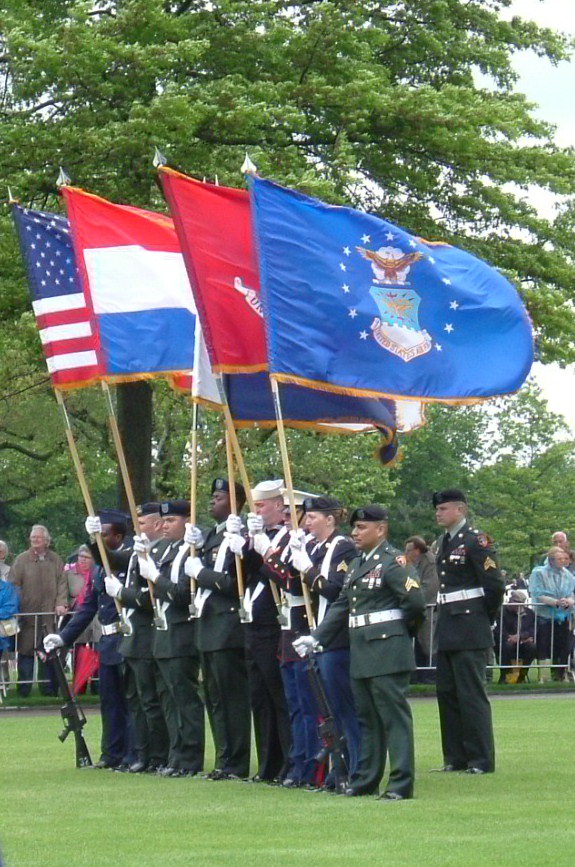


| MEMORIAL DAY, MAY 31, 2010 |
| Johan Heijkers, his wife Maud and their daughter Rose visited Margraten Cemetery on Memorial Day to honor the two Schuylkill Haven men buried there. |
| Above, the decorated graves of Gustave Anchorstar and Jack Kremer on either side of a picture of the color guard at Memorial day ceremonies at Margraten Cemetery. Left, right and below are other pictures of the day's events. |
| HENRI-CHAPELLE CEMETERY IN BELGIUM FINAL RESTING PLACE OF STERLING KNARR |
| The stories and pictures above relate the story of Johan Heykers, his partner Maud and their daughter Rose, and how they are caretakers of the grave of Gustave Anchorstar of Schuylkill Haven buried in Holland in the Margraten Cemetery. During correspondence with Johan, we discussed the Henri-Chapelle Cemetery in Belgium and the fact that another Schuylkill Haven soldier, Sterling Knarr was buried there. On Memorial Day, 2010, Johan and his family traveled there and honored Sterling by placing flowers on his grave. The Henri-Chapelle American Cemetery and Memorial lies 2 miles northwest of the village of Henri-Chapelle which is on the main highway from Liege, Belgium to Aachen, Germany. The 57 acre cemetery lies on the crest of a ridge affording an excellent view to the east and west. Here rest 7,989 of our military dead, most of whom gave their lives in the repulse of the German counteroffensive in the Ardennes or during the advance into, and cross Germany during the fall and winter of 1944 and the spring of 1945. Others were lost in air operations over the region. The cemetery and memorial were completed in 1960. Private Sterling A. Knarr, 20, son of Mr. and Mrs. John A. Knarr, Fairview Avenue, Schuylkill Haven, was killed in action at Aachen on October 16. Sterling was a graduate of Schuylkill Haven High School, Class of 1942. He is now honored by a grateful Dutch family along with his two Schuylkill Haven comrades in Margraten. |


| The center picture above shows the decorated grave of Sterling Knarr, buried in Henri-Chapelle Cemetery in Belgium. On either side of that picture are views of the tombstones, putting into perspective the sacrifice made. Below at left is the Colonnade, listing those missing in action. In the center below is the statue, Guardian Angel, which overlooks the cemetery. At right, below, are wreathes placed at the cemetery on Memorial Day, 2010. |
| LUXEMBOURG AMERICAN CEMETERY AND MEMORIAL FINAL RESTING PLACE OF STANLEY J. SKUBISH |
| Friend of Schuylkill Haven veterans, Johan Heykers of Ell, Holland, visited the Luxembourg American Cemetery and Memorial in August of 2010. Stanley J. Skubish, son of Mr. and Mrs. Norman Skubish of Willow Lake, another Schuylkill Haven son who gave his life, is buried there. The Luxembourg American Cemetery and Memorial, 50.5 acres in extent, is situated in a beautiful wooded area. The cemetery was established on December 29, 1944 by the 609th Quartermaster Company of the U.S. Third Army while Allied Forces were stemming the enemy's desperate Ardennes Offensive, one of the critical battles of World War II. The city of Luxembourg served as headquarters for General George S. Patton's U.S. Third Army. General Patton is buried here. Not far from the cemetery entrance stands the white stone chapel, set on a wide circular platform surrounded by woods. It is embellished with sculpture in bronze and stone, a stained-glass window with American unit insignia, and a mosaic ceiling. Flanking the chapel at a lower level are two large stone pylons upon which are maps made of various inlaid granites, with inscriptions recalling the achievements of the American armed forces in this region. On the same pylons are inscribed the names of 371 of the missing. Rosettes mark the names of those since recovered and identified. Sloping gently downhill from the memorial is the burial area containing 5,076 of our military dead, many of whom lost their lives in the "Battle of the Bulge" and in the advance to the Rhine. Their headstones follow graceful curves; trees, fountains and flower beds contribute to the dignity of the ensemble. |


| This series of images is from the Luxembourg American Cemetery and Memorial. On the top row, the photo shows the entrance gate while the flanking photos are of two monuments. In the second row, the grave of Stanley Skubish of town, is flanked by two photos of the over 5,000 American graves. To the left is an image of the chapel with a battle map of the area shown beneath that. On the right is the grave of General George S. Patton, while below that is Johan Heijkers and his daughter Rose visiting the site. |
| ARDENNES AMERICAN CEMETERY & MEMORIAL FINAL RESTING PLACE OF CHARLES J. PEEL |
| In August, our friend Johan Heykers and his family also visited the Ardennes American Cemetery to find the grave of Schuylkill Haven soldier, Charles J. Peel. Sergeant Peel was the son of Mr. and Mrs Thomas Peel of town, and had originally been declared missing in action. It was later discovered he was killed in action on November 4, 1944. The Ardennes American Cemetery, 90 ½ acres in extent, is situated near the southeast edge of the village of Neupre (formerly Neuville-en-Condroz), 12 miles southwest of Liege, Belgium. The Ardennes American Cemetery is generally rectangular in shape. Its grave plots are arranged in the form of a Greek cross separated by two broad intersecting paths. The cemetery itself rests on a slope descending gently northward toward Neupre. To the south and east, it is enframed in woodland in which red and white oak, beech and ash are predominate; its west side is lined by an avenue of stately lindens and its north boundary by informal tree group. The 1st Infantry Division liberated the site on September 8, 1944. A temporary cemetery was established on the site on February 8, 1945. After the war, when the temporary cemeteries were disestablished by the Army, the remains of American military dead whose next of kin requested permanent interment overseas were moved to one of the fourteen permanent cemetery sites on foreign soil, usually the one which was closest to the temporary cemetery. There the Graves Registration Service interred them in the distinctive grave patterns proposed by the cemetery’s architect and approved by the Commission. The design and construction of all facilities at the permanent sites were the responsibility of the Commission, i.e., the chapel, museum, visitors’ building, superintendent’s quarters, service facilities, utilities and paths, roads and walls. The Commission was also responsible for the sculpture, landscaping and other improvements. Many of those interred here died during the enemy’s final major counteroffensive in the Ardennes in December 1944 and January 1945. They include some service troops who were fighting as infantry. Others gave their lives in the advance to the Rhine and across Germany, and in the strategic bombardment of Europe. |


| This series of images is from the Ardennes American Cemetery. At top left, is the entrance to the cemetery and on top right, is a photo of a monument. These pictures flank a photo of the grave of Charles J. Peel. At left in row two is Johan Heijkers tending to Sergeant Peel's grave and on the right is the chapel. Both pictures in row three show the thousands of gravestones. Row four shows more graves on the left and the monument on the right. Finally the two bottom photos are of battle maps at the cemetery showing the history of the war in this area. |

PEARL HARBOR
The attack on Pearl Harbor in Hawaii on December 7,1941
marked the beginning of American involvement in the Second
World War. Listed here are Schuylkill Haven residents known to
be on duty there when the Japanese made their infamous attack.
marked the beginning of American involvement in the Second
World War. Listed here are Schuylkill Haven residents known to
be on duty there when the Japanese made their infamous attack.
William J. Cleary David Fessler
Staff Sgt. Marlin T. Goas PFC Guy E. Hand
Donald Heiser PVT Robert W. Heisler
George McGovern Oscar Welde
Staff Sgt. Marlin T. Goas PFC Guy E. Hand
Donald Heiser PVT Robert W. Heisler
George McGovern Oscar Welde
| The Call of May 24, 1940 WAR RELIEF QUOTA FOR THIS TOWN $1000 Schuylkill Haven people will be asked to contribute the sum of one thousand dollars next week to the American Red Cross for War Relief. The quota for the Southern Schuylkill District is $16,000. This is part of the Ten Million Dollar Fund that is to be raised throughout the nation for war torn and suffering European peoples. Mr. A. D. Maberry will be in command of the drive in Schuylkill Haven. He is appointing captains for different sections of the town and an intensive solicitation is to start early in the week. This will not be an ordinary Red Cross membership campaign. This campaign will have a far more definite and immediate need to fill. No one needs to be appraised of the need for funds for medical supplies, equipment, food, clothing and what not for the people of France, Belgium, Holland, Finland, Norway and Poland. Most everyone knows the call for financial assistance has come to America. It is the first real call that has come during the second World war. What is of equal importance is the fact that money must be raised quickly. Conditions demand it and in every community throughout the land, the Red Cross is, this week, organizing its forces to appeal directly to the public in a definite way, with the hope that the response will be wholehearted. It may be of interest to know that the nations of Germany, Japan and Russia have notified the American Red Cross that they will take care of their own suffering peoples and will not need the assistance of the American Red Cross. During the first World war, Schuylkill Haven people met all of their Red Cross quotas and, even better than that, went "over the top." It is hoped that Schuylkill Haven will respond to the first Red Cross appeal in the Second World War and meet the assigned quota. |
| The Call of June 14, 1940 DEFENSE COUNCIL SOON TO BE ORGANIZED IN SCHUYLKILL HAVEN Schuylkill Haven people have been reading with interest the newspaper articles concerning the organization of a "Home Defense Council" in Pottsville, within the last several weeks. This organization, which began with a membership of eighty five, had reached a total of four hundred on Monday evening of this week. The purpose of the Defense Council is to enlist loyalty of American citizenship and to protect the public from subversive influence in the community. Within the next week or two, an announcement will be made concerning a public meeting to be held in Schuylkill Haven, at which time the Schuylkill Haven Defense Council will be organized upon the same lines as is being organized in every community throughout the nation. It is therefore, unnecessary for Schuylkill Haven people to take member ship in a defense council in any other town or city. The enrollment and membership card which the individual will be asked to sign, is to the effect that he or she believes in the ideals and principles upon which this country was founded and is desirous of having these ideals and principles to endure. Allegiance to the flag is pledged. Investigation of all un-American tactics within the community will be investigated by the authorities and the results of their investigations will, in turn be turned over to the United States government for further investigation and action. It is expected that the public meeting that will be held in Schuylkill Haven will be addressed by several local and out of town speakers and that the Defense Council membership in Schuylkill Haven, will, within a short period of time, have reached a high total. |
| The Call of June 28, 1940 RED CROSS PRODUCTION UNIT ORGANIZED A production unit of the National Red Cross was organized in Schuylkill Haven on Tuesday evening. The purpose is to provide clothing for the refugees. It is a war relief movement. The units have been organized throughout the county and nation. An assigned number of finished garments must be completed by September 1st. After that date it is expected the quota will be doubled. All women of Schuylkill Haven are invited to give their services either through sewing or knitting, each Tuesday afternoon from two until four, and on Thursdays from two to four and seven to nine in the evening at the headquarters, which will be the Coldren Knitting Mills. Anyone who has a sewing machine, who would care to loan it, should get in touch with any member of the committee named below. Anyone who has such articles as belts, tape measures, thread, ironing boards, etc. to loan for the use of the above unit, is asked to communicate with any one of the members. The organization consists of the chairman, Mrs. Harrison A. Berger and the assistants, Mrs. Walter Meck and Miss Pearl McCormick. The purchasing committee is composed of Mrs. Charles Michel and Mrs. W. P. Fisher. Those in charge of the sewing are: Mrs. L. E. Bashore, Mrs. Wilmert Miller and Mrs. Robert Lenker. Those in charge of knitting are: Mrs. Edward Reed, Mrs. Warren Kramer and Mrs. J. Philip McConnell. |
| The Call of August 23, 1940 ALIEN REGISTRATION UNDERWAY For the next several weeks, employees of the Schuylkill Haven Post Office, will be very busy with extra work. The extra work will be that of registering aliens, in conformity with the specific act of Congress passed recently. This extra work will not be due to the fact there are such a large number of aliens in Schuylkill Haven, but that there are a larger number in the Schuylkill Haven district. As the County Almshouse and County Hospital for the Insane, are located in the Schuylkill Haven district, the work will therefore include, for the Schuylkill Haven Post office, practically the registering of aliens from every section of Schuylkill County and many different parts of the state of Pennsylvania and perhaps other states as well. At the Almshouse alone, it is stated, there are at least one hundred and sixty aliens. Aliens may register at the Schuylkill Haven Post Office during the first five days of each week until further notice. All aliens over fourteen years of age are required to register. An employee of the Post Office will visit the County Institutions above named, to gather the registration information. Included in the Schuylkill Haven district are the outlying districts of Landingville, Summit Station, Adamsdale and the several townships. Aliens, however, can and may register at any registration point. All aliens must be fingerprinted and answer a number of questions. The answers are set down upon a specific questionnaire. Specimen copies of the questions to be answered may be procured at the Post Office and can be taken home by the individual and filled out and returned to the Post Office. The registration of the aliens at the County Institutions will require the services of on e of the Post Office employees for a considerable time, it is believed. This for the reason that many can not answer the questions although not any of them are difficult. In this event, records at the institutions must be referred to and the information therein found, set down upon the registration blank. |
| The Call of October 10, 1940 742 YOUNG MEN REGISTER FOR SELECTIVE MILITARY SERVICE IN NATION'S ARMY A total of 742 young men between the ages of twenty one and thirty five registered on Wednesday at the four polling places in Schuylkill Haven. The number for each ward was: North, 191, East, 252, South, 262 and West, 37. Large numbers of young men were waiting at the polls to register when they opened at seven o'clock in the morning. However, with an able corps of regular election officials, supplemented with teachers from the Schuylkill Haven schools, the registration was carried out quickly without long delays for the registrants. Of the total number, some were nonresidents who registered here because their work was in this vicinity. Cards of these persons will be referred later to the home districts. |
| The Call of February 21, 1941 LEGION TO HOLD REGISTRATION OF WAR VETERANS Post Commander R. R. Sterner of Robert E. Baker Post, American Legion, has named Friday evening and Saturday afternoon as dates for the national defense registration for all ex-servicemen of the World War. On Friday evening the registration will be held at the high school building starting at seven o'clock. On Saturday, it will be conducted at the Post home after one o'clock in the afternoon. Every American Legion Post in the country has been asked to conduct the registration and all members of the Legion, Veterans of Foreign wars and all unaffiliated World War veterans are asked to fill out the questionnaires. The registration is not compulsory but voluntary. Any veteran who does register and in the event of an emergency is called upon for some type of service, is not compelled to do that work. That too is voluntary. The registration is part of a home defense measure for the United Sates and in case an emergency does arise, the country will know what men to turn to for a particular type of work. The questionnaires will consist of questions about the individuals vocational abilities. In addition to several personal questions, the forms will contain a list of approximately sixty vocations from which the registrant is asked to select the different types of work he is capable of performing. In speaking of the registration, Commander Sterner said, "I feel certain that every Legionnaire and World War veteran generally will welcome this opportunity of perhaps doing another bit for his country. We do not expect to be called for active military service. Most of us are beyond that age. But there are many home defense duties to be performed. I urge every Legionnaire and other interested World War veteran in this community to register. If you are going to be out of town on that date, fill out your questionnaire before you leave. It is a patriotic duty." |
| NORMANDY AMERICAN CEMETERY AND MEMORIAL FINAL RESTING PLACE OF IVAN R. PHILLIPS, IVAN W. KNARR, DANIEL J. DRISCOLL AND HAROLD E. TEMPLIN |
| In October of 2012, Dutch friend of Schuylkill Haven, Johan Heykers visited the Normandy American Cemetery and Memorial, with friends. As he has in the past, he provided the pictures seen below and paid tribute to men from Schuylkill haven who died in France during World War Two. Four sons of Schuylkill Haven are buried here: Ivan R. Phillips, Daniel J. Driscoll, Ivan W. Knarr and Harold E. Templin. The Normandy American Cemetery and Memorial in France is located on the site of the temporary American St. Laurent Cemetery, established by the U.S. First Army on June 8, 1944 and the first American cemetery on European soil in World War II. The cemetery site, at the north end of its half mile access road, covers 172.5 acres and contains the graves of 9,387 of our military dead, most of whom lost their lives in the D-Day landings and ensuing operations. On the Walls of the Missing, in a semicircular garden on the east side of the memorial, are inscribed 1,557 names. Rosettes mark the names of those since recovered and identified. The memorial consists of a semicircular colonnade with a loggia at each end containing large maps and narratives of the military operations; at the center is the bronze statue, “Spirit of American Youth.” An orientation table overlooking the beach depicts the landings in Normandy. Facing west at the memorial, one sees in the foreground the reflecting pool; beyond is the burial area with a circular chapel and, at the far end, granite statues representing the United States and France. The cemetery is the resting place for Medal of Honor recipient Theodore Roosevelt Jr. and also thirty eight sets of brothers killed in action. |


| Above are the four grave markers of the aforementioned Schuylkill Haven men buried at the Normandy Cemetery in France. |


| The five surrounding pictures here are views of the memorial and a portion of the over 9000 graves in the cemetery. |
| The images from left to right: a tribute to the American soldiers killed in action, the twenty two foot high bronze statue "Spirit of American Youth", and a statue at the entrance to the cemetery. |
| At left is the overlook at the cemetery which allows a view of the beaches, stormed by American troops on June 6, 1944. At right is a map of the cemetery. |
| The Call of December 12, 1941 DEFENSE GROUP WILL ASSEMBLE ON MONDAY A meeting of the local Council of Defense has been called for Monday, December 15, at 4:15 p. m. at Town Hall by the chairman, Roy A. Scott Sr., in compliance with the request of Governor James and the State Council of defense of Pennsylvania. Today all of the chairman of the 584 Councils of defense of the state are assembling in Harrisburg to receive instructions which will be transmitted by them to the local councils. In a letter to Chairman Scott, the State Council asked that a meeting of the full membership be called, at which meeting the members will canvass the defense situation within their council and accelerate and stimulate all their protective measures such as air raid warning, emergency fire and emergency medical service and instruction of first aid. Organized over a year ago, the Schuylkill Haven Defense Council has not been active to any great degree. Periodical meetings were held but their activity was limited to investigation and general surveillance. This work naturally was kept secret and no public account of the work of the committee was made. Now with the United States involved with World War Two, the Schuylkill Haven Defense Council will be called upon to play a more active role in the nation's defense. Local citizens will be asked to participate in the defense measures decided by the council. The State Council, which went into action a few minutes after Congress declared a state of war existed with Japan, is providing for the immediate organization of a course of instruction in every county of the volunteer fire forces and the volunteer air raid wardens. These classes will give eighteen hours of instruction, three hours per week for six weeks. Upon the recommendation of the Council's Committee on Highway Control, Chairman Scott announces that in case of an air raid, the people of town are to go immediately to their homes and stay inside their own homes on the first floor, away from all windows, which is the safest place for the average family during an air raid. Early action taken by the governor as Chairman of the Pennsylvania Defense Council was to call out the Reserve Defense Corps who joined the Motor Police, the local police staffs and thousands of special guards and watchmen in the protection of the state's so called sensitive spots; bridges, main highways and vital defense industries. |
| The Call of December 19, 1941 DEFENSE COUNCIL STARTS PREPARING FOR EMERGENCY The Defense Council went into high gear this week to prepare Schuylkill Haven for any war emergency, following an organization meeting on Monday afternoon at Town Hall. Roy A. Scott Sr., who has served as chairman of the council since its founding, was unanimously selected as the man capable of heading the organization in charge of the town's defense efforts. Judge G. E. Gangloff and Melvin Bamford were selected by Chairman Scott as his aides. Judge Gangloff will supervise the communication, transportation and the evacuation committees under him and Mr. Bamford will be responsible for the coordination of the supply and medical units, the auxiliary police and the auxiliary firemen units. Serving as head of the communication division will be William V. Young, who will plan Boy Scout participation and the using of telephone and telegraph. It is planned to set up a short wave radio system which could be used in the event that telephone and telegraph communication had been destroyed or cut off. Charles D. Manbeck will head the transportation unit. His committee will make a survey of all the buses, trucks, autos and railroad facilities in Schuylkill Haven. A registration of all trucks ranging from one half ton upwards will be made and contact points with the owners will be established so that if needed in a hurry, the trucks can be secured immediately. Evacuation will be in charge of Reverend Herbster and Councilman Joseph McGlinchey. Their committee will make a survey of all halls, schools, churches or any other buildings that could be used to house evacuees. A personnel survey will be made and persons listed as cooks, waitresses, etc. This committee will cooperate with the Red Cross. Dr. W. E. Stine will organize the medical division. The duty of his committee will be to organize all the doctors, nurses, druggists and all types of first aid treatment available in town. Chief of Police Frank Deibert will head the auxiliary police unit. His work will be to organize the local police and supervise cooperation with state police. The auxiliary firemen will be in charge of Fire Chief Claude Sausser. In addition to the volunteer firemen, he will arrange to have civilian defenders that may be called upon to give aid if needed. The various division chairmen proceeded immediately to select their committee members and fulfill their duties. Another meeting will be held in two weeks when the leaders will report to Chairman Scott. At a later date, a public meeting will be held, at which the townspeople will be informed of the activity of the Defense Council. Those present at the meeting on Monday were: Chairman Scott, Warren Lesser, secretary; Judge G. E. Gangloff, Melvin Bamford, Reverend J. L. Herbster, D. C. Gilham, Ray R. Sterner, Joseph McGlinchey, William V. Young, Charles D. Manbeck, Dr. W. E. Stine, Mrs. Reigel and Paul S. Christman. |
| The Call of January 2, 1942 THREE MAN BOARD HAS CHARGE OF TIRE RATIONING A board of three men will have complete charge of the tire and tube rationing in Schuylkill Haven and the neighboring towns included in the territory comprising draft board district Number 9. Members of the board appointed by Howard R. Fernsler, Chairman of the County Civil Defense Council, are Roy A. Scott Sr., Schuylkill Haven; Claude Waltman, Orwigsburg and A. H. Henninger of Pine Grove. Until other quarters can be provided, the Tire Rationing Board will function at the draft board headquarters in the grade school building. Starting January 5, all persons desiring to buy new tires or tubes will be required to obtain a certificate of purchase from the rationing board. Only a limited class of car owners will be able to secure these purchase forms. They include persons whose vehicles are used exclusively in protection of public health and safety or for essential freight and bus transportation or industrial or commercial operations. In this classification are doctors, nurses, veterinarians and truckers whose trucks are used exclusively for the hauling of ice and coal. No restrictions have been placed on the purchase of used tires, retreads, or recapped tires or on bicycle tires but prices on these have advanced sharply since the executive order of the government which stopped all tire and tube sales. This freezing of the most important rubber products came shortly after the United States became actively involved in World war Two and the rubber supply became endangered by the enemy. All members of the board will serve without remuneration and for the time being will not have clerical help other than that supplied by the Department of Public Assistance as sanctioned by the governor. |
| The Call of January 2, 1942 TOWN MOBILIZES FOR DEFENSE Organization of Schuylkill Haven's defense continues at a rapid pace with the naming this week of the auxiliary police, the recruiting of auxiliary firemen by the fire companies and the laying out of the town into eleven air raid zones. Police Chief Frank Deibert, who is in charge of defense police, appointed all councilman and employees of the electric light and gas and water departments as auxiliary policemen to aid the regular police force in time of emergency. The fire companies are each planning to recruit from 35 to 40 men who will be trained in fire fighting and may be called upon to aid the regular firemen if their services are required. Each company will select one of its members to attend the school for fighting incendiary bombs which will be held at Edgewood Arsenal in Maryland. Expenses for this course will be paid by borough council. Defense Council Chairman Roy A. Scott called upon the president and vice president of the Civic, Lions and Rotary clubs to name air raid wardens for the eleven zones into which Schuylkill Haven has been divided. These wardens will in turn select assistants who will assume charge in their territory in case of an air raid. At the first report of enemy bombers overhead, the wardens and assistants will clear the streets of all pedestrians and motorists and see that they are safely housed in protective places. An air raid school for wardens, which was to be held in Pottsville on January 7 and 8 was postponed until a later date which has not yet been set. A survey of the various churches, halls and school buildings will be made for the purpose of determining the number of persons who may be accommodated in town. Taking care of women and children from evacuated cities will probably be the most important part that Schuylkill Haven may be called upon to do in this World War. With the evacuation record prepared and on file, the evacuation officials will know how many persons this community will be able to care for and the facilities can be set up at a moments notice. With this defense set up of police, firemen, air raid wardens and evacuation facilities, Schuylkill Haven will soon be ready to meet any wartime emergency or fulfill any duty required of the community. |
| The Call of October 31, 1941 LOCAL BOY TOOK PART IN CAPTURE OF NAZI RADIO STATION SHIP A Schuylkill Haven boy, Daniel Davis, participated in the capture of the German radio station and supply ship off the coast of Greenland, which was in the headlines recently. His mother, Mrs. Edith Davis of Dock Street, received the news in a letter written by a sailor friend of Daniel who came to Boston harbor with the ship carrying the prisoners. He explained that her son was in good health and that he had aided in the capture of the radio ship. Because of strict censorship, Daniel's letters cannot go into great detail about any of his duties in Greenland and it is not expected that his next letter home will tell much about the incident. In other letters, however, he explained that he has been to Iceland and has crossed the Arctic Circle four times and that although an Army man, is aboard ship a large part of the time. He enlisted in the Army fifteen months ago and is in the Army Air Corps as a weather forecaster. |
| The Call of February 6, 1942 WOUNDED AT PEARL HARBOR Guy H. Hand, son of Mr. and Mrs. Louis Hand of 138 Columbia Street, was among the soldiers wounded in the attack upon Pearl Harbor by the Japanese on December 7. Hand, who is a first class private and engaged as an auto mechanic at Wheeler Field, received a bullet wound in his arm when the field was machine gunned by the Japanese fliers during the attack. The wound has healed and he is again on duty. A letter was received by his parents last Wednesday telling them he had been wounded. Previous letters which had been written after the attack made no mention of the bullet wound and it wasn't until they learned he was back on duty after being in the hospital that they knew he had been wounded. |
| The Call of March 6, 1942 TOWN WILL HAVE BLACKOUT, SIGNAL TEST ON MONDAY Schuylkill Haven and surrounding towns will have their first blackout test in the very near future. This order was issued by County Chairman Howard Fernsler and in preparation for these tests Chairman Roy Scott announced that air raid alarm signal tests will be made regularly beginning Monday evening, March 9. The purpose of these tests will be to acquaint the citizens with the type of signal which will be given in the event of an air raid. The alarm for an air raid will be four blasts of the fire siren. When this is sounded the citizens of the borough are instructed to follow out in detail the suggestions outlined in another part of this issue of The Call. Shortly thereafter a long blast of the alarm will indicate an all clear signal. Too much stress on following out the orders as laid down by the National Civilian Defense Council cannot be made. It is very important to your safety and to the safety of those about you that you keep cool and follow out instructions immediately. The air raid wardens in each section have been instructed as to their duties and persons who violate any orders issued by these wardens will find themselves in a very embarrassing position. In some cities the councils have passed ordinances placing penalties on violators and this severe action may be taken here in the event that the matter of air raid drills and blackout tests are taken lightly. Merchants who have not made arrangements for a switch outside their illuminated windows or stores are cautioned to do so before the blackout tests and arrangements for immediate extinguishing of the same must be made. Illuminated signs, neon flashers and all lights must be completely extinguished. In all probability there will be airplanes used in the blackout tests and they will report any lights which have been allowed to burn. Get on your toes and read the instructions "What To Do When An Air Raid Comes" and plan to lend every assistance possible when the emergency arises. There are still many openings in the Civilian Defense Corps and a telephone call to Schuylkill Haven 1 will afford you the opportunity to do your part in the great business of Winning the War. |
| The Call of April 17, 1942 PATRIOTIC DEMONSTRATION TOUCHES OFF PLEDGE DRIVE Schuylkill Haven joined with the other towns and cities of the nation on Wednesday evening in opening the drive for pledges for Defense Stamps and Bonds by presenting a demonstration of large numbers of interested persons in parade and along the route of parade. Civic leaders, civilian defense, workers, industries schools, boy and girl scouts, legionnaires and others lined up and paraded through the streets displaying the colors and marching proudly in the cause of victory. American Legion Post 38, headed by Chairman Albert Mayberry, Postmaster Brownmiller, Chief Burgess Haldeman and Reverend Boohar led the procession with the color guard making a splendid picture. They were followed by the Schuylkill Haven High School band under E. C. Unger. The Civilian Defense group was led by Chairman Roy Scott and Chief Air Raid warden Frank Lewis. Boy Scout Troop 122 with the first aid car from Troop 135 came next. Alpha Mills headed the industrial group with 135 men and women in line. Bashore Mills came next with thirty five. Reider Mills followed with a large American flag carried by eight women. Alberta Mills and the Federal Manufacturing Company made a neat appearance with a V for Victory motif. Union Mills marched with 90 members. Probably the most impressive sight in the parade was the massed colors of the Boy and Girl Scouts with more than 150 marching. Students of all grades participated. Their teachers acted as marshals. All three fire companies paraded. Bringing up the end of the parade were the cyclist messengers of the Boy Scouts who are doing such a fine job in the civilian defense setup. Arriving at the high school building on Haven Street, the parade dissembled and gathered around a speaker's platform erected outside the building. Chairman Mayberry had charge of the program. The invocation was given by Reverend K. R. Boohar. Following selections by the high school band, Judge G. E. Gangloff gave a stirring address to arouse the local people to action. To show the reason why Schuylkill Haven individuals should act, the speaker asked for a showing of hands of all persons in the audience who had a son, brother or nephew in the service now or who expected to have one in uniform in the near future. Most assembled raised their hands. They were then admonished not to let these men down. Do what they can at home to see that equipment and the necessities of war reached the men in the armed services. Chairman Mayberry invited the adults to see a moving picture on the "Attack on Pearl Harbor" in the high school auditorium after the benediction. All persons who wished to volunteer to serve as workers for the house to house canvass for pledges to buy war savings bonds and stamps regularly were asked to remain for a short meeting. Four secretaries aided in taking the names of the volunteers who were disappointedly few in number. With 180 workers required, 55 persons volunteered to help. The remainder of the workers were recruited from the ranks of the air raid wardens. The house to house canvass began in most sections of town on Thursday evening but owing to a scarcity of supplies, all the workers were unable to begin work at this time. Supplies were secured and the canvass will be continued today and tomorrow with the final report to be turned in to Chairman Mayberry on Saturday. |
| The Call of May 8, 1942 MOTORISTS WILL REGISTER AT HIGH SCHOOL GYMNASIUM FOR GASOLINE RATIONING CARDS Having completed the registration for sugar rationing cards, the citizens of Schuylkill Haven will next turn to registering for gasoline consumption this coming week. Registration of car owners will be held here on Tuesday, Wednesday and Thursday, May 12, 13 and 14 at the high school gymnasium. Although the hours have not yet been set, Paul S. Christman, superintendent of schools and head of the Draft Board Number 9, stated that the registering will take place after school hours. The rationing of gas will begin on May 15 in seventeen eastern states including Pennsylvania. Gasoline may be secured only by motorists having rationing cards. To secure a rationing card on the days of registration, the motorist need only present his automobile registration card. Four different rationing cards will be issued depending upon the needs of the motorist. Card A for nonessential auto users, contains seven units; Card B-1, eleven units; Card B-2, fifteen units; Card B-3 nineteen units; and Card X, unlimited. The relation between the units and gallons has not yet been announced by Price Administrator Leon Henderson. It has been announced, however, that nonessential users will be limited to from two to six gallons weekly depending upon their needs. In contrast with the sugar rationing cards which allow only one stamp for each two week period, the gasoline user may buy his allowed gallons of gasoline for the period May 15 to July 1 in any manner he pleases. That is, he may divide it equally for each week of the period or he may use all of it at one time. A second rationing card will be issued after July 1. SUGAR RATIONING A total of 5,925 persons in Schuylkill Haven made application for sugar rationing books on the registration days this week. Nearly two hundred of this number did not receive books because they had in their possession more than the maximum allowance of sugar. A total of 5,733 books were issued. MERCHANTS CAUTIONED Merchants are cautioned not to put the number 2 stamp on the same card with the number 1 stamp in issuing sugar to consumers. The first stamp is the only one that may be used for the period May 5-16. The second stamp is good for May 17-31. Each period number is to be kept on separate cards. REPORT DEATHS AND BIRTHS When any person in a family dies, the ration book in his name must be returned to the rationing board within ten days. In the case of a birth, parents may secure a book when proper identification can be made. |
| The Call of February 13, 1942 Second Class Seaman William Patrick Casey, who is the son of Mr. and Mrs. Martin Casey of Caldwell Street in Schuylkill Haven enlisted July 5, 1941 in the U. S. Navy and is on the U. S. Prairie at the present time. He is seventeen and is the youngest and heaviest on the ship, weighing over two hundred pounds. He has been home on but one furlough since his enlistment. He also has a brother, Martin, who expects to go into the U. S. Marines. He will be sent to San Diego, California. |
| The Call of February 27, 1942 SOLDIER TO LEAVE FOR EAST INDIES At the present time the whereabouts of Sergeant Edwin J. Yerger is not known as he sent word home that he expects to be sent to the East Indies. Sergeant Yerger is a graduate of Pottsville High School and before enlisting in the National Guard he had been a knitter and machinist helper at the Alpha Mills. He was later transferred to the Savannah air base, where he qualified as a machine gun operator on a large bombing plane. He was the transferred to San Francisco where he patrolled the border. He is a son of Edwin P. Yerger of Williams Street, Schuylkill Haven. |
| The Call of February 27, 1942 LETTER REPORTS GUY HAND SAFE; GIVES ATTACK DESCRIPTION Reverend C. A. Steigerwalt received a letter Thursday from PFC Guy H. Hand, who is stationed at Wheeler Field in Honolulu, Hawaii, which had been postmarked February 13 and mailed via clipper. Guy states that he is well and that David Fessler and Austin Brommer, the latter from Friedensburg, as well as the other local boys, were also well. His war news was scarce since letters are censored, so he states there was not much new in the war. His description of the attack on Pearl Harbor on December 7 was brief and to the point, stating that he was in the mess hall when there was a zoom and a boom and they discovered Jap airplanes above making an attack. He stated he ran but not away, and that he ran faster than some who did run away. He received a left arm wound which is completely healed now. He also stated that there was no beer or other drinks but that none of them minded at all. |


| The Call of May 29, 1942 BLACKOUT HERE CALLED PERFECT Schuylkill Haven's participation in the five county blackout on Monday night was voted 100% by those whose duty it was to observe the work of the air raid wardens and all those who participated as well as those who cooperated with them. The practice blackout held Friday evening by the fire department was also flawless. Chairman Roy Scott and assistant Air Raid warden Ivan Reed are justly proud of the results accomplished and Schuylkill Haven lent a very helpful assistance in the splendid results attained by the entire county. Observing the blackout from the county courthouse, representatives from the state office stated that it was one of the finest ever witnessed by them and when the reports from the other parts of the county came in stating that everything was in good order, they were highly pleased. There were several instances where people were slow to extinguish their lights but upon being told by the warden in the particular sector the offenders were quick to make amends. |
| The Call of June 19, 1942 TOWN COLLECTS 25,664 POUNDS OF OLD RUBBER With the children of the town in the lead, Schuylkill Haven is giving a surprising response to President Roosevelt's drive for old rubber. A survey of the service stations made late Thursday afternoon showed that 25,664 pounds of rubber had been collected. The storage yard of the Esso company between Cressona and Schuylkill haven on Friday morning had nine tons of rubber on hand and this represents only a small part of the rubber collected by their dealers. In town the largest deposit was found at the Earl Stoyer garage. Here 6,539 pounds of old rubber in the form of old tires, stair mats, hot water bottles, shoes, dolls and trimmings from shoes partly filled the large display room. Th station of Harry Moyer on Dock Street had collected 4,750 pounds. One of these items was a large rubber heel used for display purposes which weighed seven pounds. Earl Williams had approximately two and one half tons. At the Troutman Richfield station on Centre Avenue, one of the rubber articles brought in was a 1917 inner tube which had been lying unused in a garage since that time. At the East End service station on Liberty Street, several old timer tires from the first World War period were brought in. In their collection also were two small rubber tire ash trays. GOLD MINE FOR YOUNGSTERS The cent a pound paid on the old rubber proved to be a money maker for the youngsters. All service stations reported that the greater part of the rubber brought in was carted there by children. Judging by th equality of the rubber items surrendered, the giving of it did not mean a great sacrifice to most of the donors because for the most part the articles were old, worn out and useless. In addition to the patriotic value, the collection of rubber also cleaned up the town to some extent. The following amounts of rubber were collected by the various service stations in the vicinity: Earl Stoyer, 6,539; Harry Moyer, 4,750; Troutman's, 2,500; Earl Williams, 5,000; Shadle's Gulf Station, 100; L. C. Driesbach, 200; Ammon Miller, Dock Street, 150; Yenosky's, Main Street, 75; East End, 800; Sterner's, 200; Connors Station, 750; Keller's, Cressona, 2,400; Parkway service Station, 2,200. Any person having an amount of rubber in excess of what could be carried to a service station can have a truck call for it by calling the Esso plant at 790. The items that can be used are tires, inner tubes, hard rubber tires, crepe rubber soles, boots and overshoes, hot water bottles, tennis shoes, rubber belting, rubber gloves, rubber sheeting, pads and matting, raincoats, rubber heels, bathing caps, jar rings, plumbers suction cups, sample tire sections and rubber ash trays. The drive which began on Monday will continue until the end of the month. Service stations are paying one cent per pound and the oil companies will get $25 per ton. The extra five dollars will be given to the U. S. O., Red Cross, or Army and Navy Relief. No charge is being made by the oil companies for the weighing, handling and hauling of the rubber. The rubber which is to be turned over to an agency of the government will go through a reclaiming process and will eventually find its way into active use in the war machines of our armed forces. |
| The Call of May 15, 1942 LIEUTENANT JAY MYERS LOST AS PLANE CRASHES IN SEA Hope has been abandoned for the finding of Lieutenant Jay W. Myers, son in law of Reverend John W. Wolfe of Schuylkill Haven, and four other young men, who were lost at sea since Sunday. Lieutenant Myers and Miss Lucille Wolfe were married April 25 in Saint Matthew's Lutheran Church by her father, Reverend Wolfe. They left for Georgia where Lieutenant Myers was stationed and were immediately sent to New York for active duty. They had gone to housekeeping at Westbury, Long Island in New York. Lieutenant Myers, together with the other four men, was sent out on patrol duty on Sunday morning from Mitchell Field, Long Island, New York. Lieutenant Myers was a copilot. It is believed that they ran into a fog and for some reason dived into the sea from a low altitude, as they were flying low, being on the lookout for submarines. The tragedy occurred sixty five miles from the coast. A searching party found two rubber boats from the plane and a cushion from one of the seats and also found considerable oil on the surface when they got there, indicating that was the spot where the plane hit the water. The plane was a bomber and was equipped with life rafts. Lieutenant Myers is a son of Mr. and Mrs. Zel Myers of Newville and has a sister and two brothers. He graduated from the Shippensburg Teachers' College and received his training at Turner Field, graduating April 29, 1942. During his first week at Mitchell Field, he had been sent out on several trial flights but this was his first active flight. His father and reverend Wolfe went to Westbury on Wednesday, returning Thursday evening and attending the services which were held in the chapel at Mitchell Field on Thursday morning in honor of the five men. Mrs. Myers accompanied her father and is now residing with her parents. |
| The Call of June 5, 1942 MEMORIAL SERVICE TONIGHT FOR PRIVATE CHARLES B. HAND Memorial services for Charles Bentley Hand, twenty, who was fatally injured at Curacao, West Indies, May 25, will be held Friday evening, June 5, at 7:30 o'clock in Messiah Church, United Brethren in Christ, Schuylkill Haven. Sergeant Edwin H. Welker, twenty five, Pottsville, was also fatally injured at the same time. They were members of a detachment from the 213th Coast Artillery. Their families were notified last Friday afternoon that they were involved in an accident while on maneuvers. Private Hand was killed instantly, while Sergeant Welker died a few hours later of a fractured skull. Details of the accident were not made known in the announcement they received from the office of the Adjutant General but the families were notified that their bodies would not be returned until the end of the war. Private Hand is a son of Mr. and Mrs. John W. Hand of 24 Charles Street in Schuylkill Haven and was born October 16, 1921. He joined the National Guard three years ago and left Pottsville in the same contingent as Sergeant Welker. He was a member of Battery F, headed by Captain H. R. D. Schwenk and was also sent to the West Indies with the anti aircraft outfit. He was a graduate of the Schuylkill Haven high school, class of 1939 and was a member of the school band, the Dramatic Club, Mixed Chorus, Hi-Y Club and played on the football team. He was also a member of the United Brethren Church in Schuylkill Haven. For a short time after graduation from high school he held a position of salesman. Private Robert Dietrich, who was also born and raised in Schuylkill Haven, was a school mate of Private Hand, is the same age and was in the same barracks. He recently wrote home, stating that Private Hand, who played the trumpet, livened up the camp with his playing of popular songs. His mother preceded him in death a number of years ago. He is survived by his father, a Spanish American War veteran and employee of the Highway Department in Schuylkill Haven, his stepmother and a sister, Betty. The family wishes that all relatives, friends and family meet in the Sunday School room from whence they will march to the auditorium. A tribute of memory and experience will be shared by Reverend John Kauterman. The American Legion will enter in group form and will also share in the services. |

| The Call of July 17, 1942 LIEUTENANT WILLIAM A. LOWE BURIED WITH FULL MILITARY HONORS Lieutenant William A. Lowe of 402 Union Street, who died in the hospital at Camp Claiborne, Louisiana, last Friday, was buried with full military honors on Wednesday afternoon. The funeral was largely attended by the friends of the Lowe family in Schuylkill Haven and Catawissa, their former place of residence. Members of the American Legion Post of Schuylkill Haven and of Catawissa joined in giving the lieutenant a military burial. Funeral services were held from the D. M. Bittle funeral home. Reverend J. W. Wolfe, pastor of Saint Matthew's Lutheran Church, conducted the services in the funeral home and at the grave in the Hillside Cemetery in Catawissa. Members of the Masonic Lodge of Catawissa also conducted rites at the grave. Lieutenant Lowe , 37, was a native of Catawissa, a son of the late Albert and Ellen Bresich Lowe. He lived in Potts- ville for two years and for the past five years had been a resident of Schuylkill Haven. Before entering the Army in April, 1941, he was a foreman for the bridge and building department of the Reading Railroad. He was first stationed at Fort Belvoir, Virginia and then sent to Louisiana to take charge of the construction of the railroad between Camp Claiborne and Camp Polk. He died only a few hours after the completion of the road, which was dedicated on Saturday, the day after his death. He was scheduled for promotion to the rank of captain upon his discharge from the hospital. During the dedication ceremony, a five minute period of silence was observed in Lieutenant Lowe's honor. Lieutenant Lowe was a member of Saint Matthew's Lutheran Church and the Men's Bible Class of the Sunday School. He was associated with the Masonic Order in Catawissa. Surviving are his wife, the former Freda Roberts of Catawissa and a daughter, Ruth Louise, 16, who had been residing in Louisiana since school closed; a brother, Charles of Northumberland and sisters: Mrs. Maurice Broadbelt of West Chester, Mrs. Harry Rhodes of Kingston, Mrs. Ernest Williams of Williamsport and Mrs. Charles Eddy of Catawissa. |

| The Call of September 25, 1942 CHILDREN COLLECT THREE TONS OF SCRAP AS HEAP GETS LARGER The children of Schuylkill Haven threw their scrap into the fight to help Uncle Sam keep the steel mills operating. Over three tons of scrap metal and rubber were deposited at the Rio Theatre when the children accepted the offer of Manager Sork to attend the movie show held after school on Thursday afternoon. This metal and rubber was hauled to a large pile which is growing in size at the intersection of Main and Saint John Streets. Attracting most attention is the old 1904 model Franklin automobile given by the Schuylkill Haven Body and Fender Works. The ancient car is an open air model of the first horseless carriage. At a meeting held at the Legion rooms on Wednesday night, Chairman Scott handed out the pledge cards which were given to the local Boy Scouts to be distributed to all parts of town. They were under the supervision of Chief Scout Commissioner Leroy Shollenberger and George D. Keller. These pledge cards are to be signed by the home owner and on the bottom of these cards is to be noted if they have any heavy pieces of metal and the salvage committee will come to remove it. On Wednesday, September 30, the Air Raid wardens under the leadership of Frank Lewis will be assigned to their stations and with the assistance of the Boy Scout troops of town will ring door bells of all the homes in front of which no scrap has been placed to see if they have anything to donate to the drive such as old metal, rubber, aluminum, copper or brass. W. V. Young is in charge of the trucks and will direct the collection of the scrap throughout town for delivery to the Main and Saint John Street intersection and placed on the pile. Charles Meck is in charge of soliciting the factories and he reports the cooperation of all mill owners. The committee urges all residents to go into their basements and attics and rout out the junk that is there. Talk about the drive to your friends and neighbors. Get this scrap ready to be placed on the street Wednesday night between the hours of 5:15 and 7:00, September 30th. A committee of five men was appointed by Chairman Scott to sell the scrap metal and rubber for the highest price. The committee consists of John McGuire, Commander of the American Legion; Chief Burgess Paul F. Haldeman; Harry Moyer, President of the Civic Club; Roy Wagner, President of the Lions Club and Charles Meck, vice president of the Rotary Club. |
| The Call of November 27, 1942 COFFEE RATION STARTS NOVEMBER 29 The local Rationing Board in the South Ward school building will continue to ration coffee for restaurants and eating places up to and including December 4. This rationing covers a period to January 31, 1943. These users are to give the amount used in September and October less the amount they have on hand at present and will receive the difference. Individuals will use their regular sugar book for coffee rationing, using stamp Number 27, which will be good for five weeks, November 29 to January 3. It is only persons fifteen years or older who are entitled to a rationing of coffee. They will later use stamps 28, 25, 26, 23, 24, 21 and 22 unless in the meantime rationing books are issued for coffee. It was planned that the local board would be closed and the office moved to Pottsville but due to th excessive amount of work in rationing coffee to merchants and also in preparation for the rationing of truck certificates for gasoline, postponement has been made until a later date. The local board has not yet received any applications as a matter of record for trucks or any of the T books for the trucks and the board can give only the amount of gasoline for trucks as specified by the Certificates of War Necessity. |
| The Call of January 8, 1943 COLLECTED TWENTY TONS OF SCRAP A large heap of approximately twenty tons of scrap metal and rubber was collected by the Boy Scouts of town in their drive on New Year's Day, the second scrap collection to be made here to further the war effort of the nation. Promptly at 1:30 in the afternoon at the blowing of the bull whistle at the Light Plant, the boys set out to cover the town. The last truck load was brought to the salvage depot at the corner of Main and Saint John Streets at 4:30 p. m. Numerous people, particularly farmers and others living outside the borough limits, have continued to add to the pile throughout the week. The committee in charge announces that the scrap pile will remain for two weeks and that persons having old metal and rubber are asked to throw it on the heap until January 16 when the pile will be removed. Bids are being solicited from the junk dealers in this vicinity. Proceeds of the sale of the scrap will be apportioned among the local Boy Scout troops. The committee thanks the following for donating the use of their trucks and helping to make the drive a success: Robert Dallago, Ralph Fisher, Arthur Krammes, William Lohman, John Bolton, Loos Estate, Quentin Quinter, George Coover, Paul Feeser and R. C. Gehrig. |
| The Call of January 22, 1943 WARFARE IN NEW GUINEA - As described by Staff Sergeant Edwin J. Yerger in letter for publication in The Call The following letter, written for publication in The Call was received by the parents of Staff Sergeant Edwin J. Yerger. It is one of the most revealing accounts of actual warfare conditions that has been brought to the attention of the editor. Because we feel it will have greater effect by printing it as written by Sergeant Yerger, no blue penciling has been done. The letter was passed by the Army censors and we will not censor it. Hiah Folks in Schuylkill Haven, And to the folks that is responsible for sending us The Call news. We wish to thank you folks for the same even though we do not get the paper very often. I am now Staff Sergeant Edwin J. Yerger and I am living in a shack somewhere in New Guinea with three other comrades. I have a cowbell connected to my shack and a wire running from my shack to Tom Maberry's shack and a cowbell also connected to his shack. Tom rings the bell each morning and thereby calls me, as we are too far away from squadron and it is impossible for us to hear the whistle blow for roll call. Sergeant Maberry is now working for maintenance section and likes it very much. As for Staff Sergeant Yerger, he is a qualified machine gunner and radio operator of the type of plane he is assigned. For the last month I have been flying with our Squadron Commander and can he handle the plane! We are looking for you folks to send us more equipment and the ammunition and supplies so we can do the job we enlisted to do. We are fighting for Liberty and Freedom, so help all you can to have this dreadful war over. WAR IS HELL and I mean just that. I must say the dirty Japs sure are brave but they can't lick us red blooded Americans. The other day we were called to quarters and had the articles read to us. We went out with our planes and what we did to the dirty Japs, well I can't tell. We did not lose a plane and all came back safe. So please help us in every way you can so we can trim these dirty yellow Japs. I am doing my share fighting and also buying bonds. I have $500 worth in Schuylkill Haven and have bought another $75 bond over here and am sending it home for safe keeping. On November 15, I was out in the swamp and jungle on duty and I spotted a wild chicken. I grabbed my automatic revolver and shot it. I took it to our shack and we cleaned it and after rolling it in butter and flour we roasted it and Tom and I ate it with a loaf of bread and a can of peas. I seen by the papers the boys in the various camps had either chicken or turkey on Thanksgiving. Well we did not have any chicken or turkey, we were glad to have what we did have. Well I sure am getting sick of this dam war, there is no future in it. Things aren't what the people think they are back home. The trouble is they don't know the other side of the story. I have been here since February 7, 1942. When I get back home if I ever do, I am going to celebrate for a couple of weeks at a time and catch up with some of the things I am missing while being over here and that sure will be plenty. The fellows in the army back home are living like kings and as for us we just won't be kings. We enlisted in the first defenders and did not wait till we were drafted and when our country called us we answered the call. Tom and I often get together and talk about the good old times we had at home, and at Pottsville and how we used to work together in the knitting department at the Alpha Mills and my dad, Edwin Yerger Sr., and Tom says he was a dam good boss, and how we used to go to the U. B. Sunday school on Center Street. The good Lord certainly has been good to us that we are still together. Tom was bitten by mosquitoes terrible. He had to have an injection. We often have to start a smoke fire in our shack to drive out the mosquitoes so we can have a little peace. So please send us planes and ammunition so we can win this war for freedom and make this world safe to live in. Yours, Staff Sergeant Edwin J. Yerger |
| The Call of January 29, 1943 PARENTS GET KNIFE TAKEN FROM JAP A long, seven and one half inch bladed knife, taken from a Jap in hand to hand combat was received this week by Mr. and Mrs. Lewis Hand of 138 Columbia Street from their son, Staff Sergeant Guy Hand in Hawaii. Staff Sergeant Hand while on leave with two friends, engaged in a scuffle with a Jap who drew the long knife and attempted to use it. The Jap was subdued and the weapon taken from him. The long bladed knife is opened by pressing a button which releases the blade. A slide on the bone handle permits it to be closed. Oddly enough, the weapon is inscribed in English and bears the marking of an American patent. The Hand family also has in its possession the Purple Heart decoration which Guy received for being wounded while doing meritorious service at Pearl Harbor during the December 7 attack. Guy entered the service three years ago and at present is in the Ordnance Department, training to be a pilot at Wheeler Field, Hawaii. A brother,Lamar, is stationed at Camp Young, California. Twin sisters, Fay and Fern, complete the family. |

| The Call of October 9, 1942 Corporal Paul Wise, Tech 5th Grade, of Hess Street, returned to Fort Benning, Georgia, after spending his furlough with his family and friends. He was inducted February 23, 1942 and received training at Camp Wheeler before being transferred to Fort Benning, where he is in the detachment of the finance department. Before being inducted, he was in the Home Guard of Pottsville. |

| The Call October 30, 1942 Paul L. Palsgrove, who is a son of Mr. and Mrs. Roy J. Palsgrove of Schuylkill Haven, has been transferred to the 38th Signal Company of the 38th Division at Leesville, Louisiana. |
| The Call October 10, 1942 Sergeant Wetzel is a son of Mr. and Mrs. Howard Wetzel of 29 Schumacher Avenue in Schuylkill Haven. He is in the service ten months and at present is on foreign soil, his relatives not knowing his exact whereabouts. He has never been home on furlough. He does photo work and in time of action would be rear gunner. Sergeant Wetzel is a member of the 154th Squadron, 68th Observation Group. |
| The Call of November 6, 1942 Charles R. Greenawalt and Marlin D. Greenawalt are sons of Mr. and Mrs. Charles D. Greenawalt of Schuylkill Haven. Charles enlisted in the Navy July 28, 1942. He was first sent to the U. S. Naval Training Station, Rhode Island for basic training. Later he was sent to Great Lakes Naval training Station in Illinois, where he studied hospital work. After weeks of training he was graduated as a hospital apprentice. At present he is stationed at the U. S. Naval Hospital in Philadelphia. Marlin or"Pete" has been in the service sixteen months and during this time has been stationed at Mississippi, California, Ohio, Texas (where he graduated from a six weeks aerial gunnery school), Tennessee and Alabama. There he took his preflight course at Maxwell Field to be one of Uncle Sam's future pilots. On September 24th he was promoted to corporal in the Army Air Corps. On October 10th he graduated from his preflight training. While there he was the first man of his squadron and had a group of men under him. Reports from these men are that he ranks very high in leadership and discipline. His average grade was 91 percent in his studies. At present he is at Darr-Aero-Tech School in Albany Georgia taking his primary training. |
| The Call of November 13, 1942 Martin and Billy Casey, sons of Mr. and Mrs. Martin Casey, North Berne Street in Schuylkill Haven are both in Uncle Sam's service. Billy has a year of foreign service and is first class point gunner aboard a U. S. destroyer somewhere in the Atlantic. Martin is also in the U. S. Marines, stationed at Parris Island. Both attended Saint Ambrose Parochial School. |

| The Call of December 4, 1942 A son of Amy Moyer of 506 East Main Street, Schuylkill Haven, he enlisted in the Navy in July and is stationed at Newport, Rhode Island. He is training to be a gunner's mate. Stirling has a brother, Ivan Knarr in the Army, stationed in Wisconsin. |

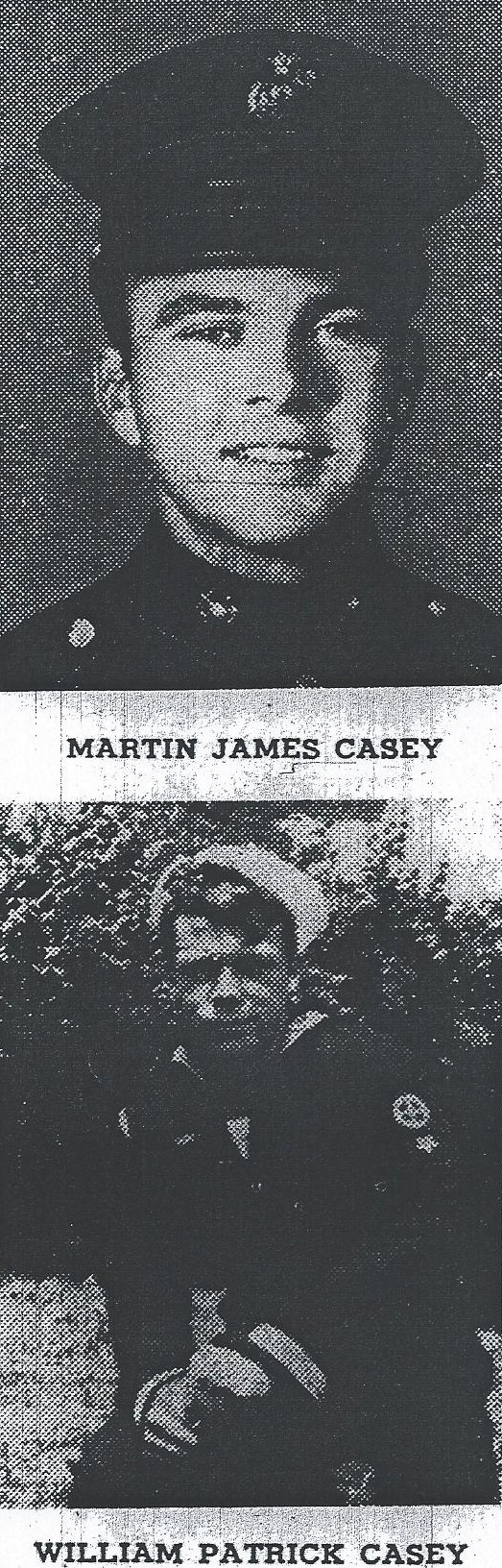


| The Call of December 4, 1942 Staff Sergeant William Emerich,son of Mr. and Mrs. Edward Emerich of Dock Street, was recently promoted to Warrant Officer of Communications and is stationed at Fort Bragg, North Carolina. His knowledge of radio has given him rapid advancement. he expects to be home on a short furlough soon. |

| The Call of December 11, 1942 Gilham is a son of Mr. and Mrs. D. C. Gilham of Schuylkill Haven, who had been attending Lubbock Army Flying School at Lubbock, Texas, received his silver pilot's wings on Thursday. He had formerly been stationed at Newfoundland. He will enter a school to learn to fly a four motor bomber. |

| The Call of January 8, 1943 Private Norbert E. Urffer of the Marine Corps is a son of Mr. and Mrs. Raymond Urffer of 515 Saint John Street in Schuylkill Haven and enlisted November 25, leaving for Parris Island on November 30. He has a brother, PFC Robert Shirey of the Signal Corps in the British Isles. |

| The Call of February 5, 1943 Joseph, who enlisted in the Merchant Marines on October 2, 1942 has finished his training with the rank of Second Class Petty Officer. He will work in the engine department of the ship. At present, Joe is busy instructing a section of the school but expects soon to be on the seas. William, brother of Joseph, is taking basic training at Parris Island Marine Barracks, South Carolina. He entered the service on January 10. He likes his branch of work very much. He, with Kenneth Reed of Cressona, enlisted at the same time and are now buddies. Both are sons of Mr. and Mrs. Joseph Sieck. |

| The Call of February 26, 1943 BAMFORD, STOYER WILL DIRECT WAR COLLECTION FUND Melvin W. Bamford, head of the Schuylkill Haven Bleach and Dye Works and Earl Stoyer, well known automobile dealer, will serve as cochairmen of the Red Cross war Fund drive to be conducted in Schuylkill Haven in March. The drive throughout the country during the month of March was proclaimed by President Roosevelt. Because of the heavy drain on the finances of the Red Cross by its extensive war operations on all the fighting fronts of the world, a plea is being made to the people at home to donate funds so this humanitarian work may continue so that boys and girls from Schuylkill Haven who are in the armed forces may be given help in their struggle. Chairmen Bamford and Stoyer met with a part of their committee, Heber D. Felix, Frank S. Lewis and Fred V. Knecht, at the Bamford home last evening and formed tentative plans for the enlarging of the committee and the general outlining of the drive. The War Fund campaign is not to be confused with the annual Red Cross Roll Call. This is a special war time drive made necessary by the added work of the organization. The goal set for the entire country is $125,000,000. The local chairmen announced that no goal will be set up here, for they feel certain that Schuylkill Haven residents, conscious of the fact that their own sons and daughters will benefit by their contributions, will give to the best of their ability. They ask no more. |
| The Call of March 12, 1943 PRIVATE HENRY RECLA RETURNS FROM GUADALCANAL FIGHT Private Henry Recla, recently returned to this country from Guadalcanal because of injuries requiring hospital care, is spending part of his furlough with his grandmother, Mrs. Ida Recla on Broadway and his aunt and uncle, Mr. and Mrs. Mario Recla of Broadway. Private Recla developed an arm injury which became infected from the thumb to the shoulder, and because he had not been wounded or had not sustained any kind of cut or scratch on that arm, the medical men on the island were at a loss as to what the trouble was. He also had a chipped kneecap sustained in a fall while carrying a machine gun. With the Marines for seven months in New Hebrides, Samoa, Fiji Islands and Guadalcanal, Private Recla participated in the taking of Bloody Hill and says his outfit had a really close escape. They took the famous hill, stayed on that position for a while and then moved out at six o'clock. At 6:30 the Japs began a concentrated shelling of the hill, which their captain told them, would have cleaned them out completely had they still been there. On one occasion Recla raised his hand above a dugout in which he was hiding and promptly had a piece taken out of it by a Jap bullet. He seemed mighty glad he did not come up head first. Although he handled a machine gun, he reports that the hand grenade is the most effective weapon to use on the island against the Japs. When grenade charges are made, the Japs begin yelling "Mercy." When questioned about the do or die courage of the Japs, he said they have this so called reckless courage only because they are all doped up. Each Jap soldier carries a dope kit consisting of three bottles, a needle and a wooden spoon. No major engagement is begun unless they are filled with dope. Although this gives them daring to engage in fighting, it is really a handicap because in close contact fighting, the doped Japs don't have a chance against the toughened Marines. He also states that without his officers, the Jap soldier is helpless. The highly trained Marine on the other hand, can go on without his leaders. The Japs, however, make every attempt to pick out the officers for their victims. For this reason all the men dress alike with no special distinction for officers and in all conversation and meetings between soldiers and officers, the salute is not given and the officer is never addressed as "Sir." It's just "Mac" or "Bill" or whatever his name may be. If a forgetting Marine should happen to slip in a "sir", Recla says he most likely will find an officers fist in his face. |
| The Call of March 19, 1943 PRIVATE LESTER STRAUSE, SCHUYLKILL HAVEN R. D. REPORTED KILLED IN TUNISIA FIGHTING Private Lester H. Strause, 24, son of Mr. and Mrs. Ralph Strause of Schuylkill Haven R. D., was killed in Tunisia on February 19, according to word received by his parents from the war Department. Private Strause who was inducted in February 1942 and went overseas in July, was an infantryman. Prior to his enlistment he had been an electric welder employed in Reading. He is survived by his parents, one brother, Ray of Fredericksburg, Pennsylvania and two sisters, Grace at home and Mrs. Mary Adams of Hamburg. His grandfather, Wilson Strause resides on Columbia Street in Schuylkill Haven and Mrs. John Bessa of North Berne Street is an aunt. His mother was the former Miss Bertha Reber. Lester was a member of saint Paul's Church on Summer Hill and was the first of his parish to give his life for his country. Last fall he assisted in harvesting while he was stationed in England. He was an outstanding young man and was highly respected by all who knew him. His many fine traits are brought out in a letter he wrote to his pastor, Reverend C. A. Steigerwalt of Schuylkill Haven, on February 11, just eight days before his death, which was postmarked February 16 and which Reverend Steigerwalt received on Monday, just a short time after his parents were notified of his death. The letter follows: February 11, 1943 Africa Dear Pastor, After being relieved from some mountain we have been holding for the past several weeks, and are now getting a few nights sleep and rest, I feel much better. Yesterday was the first time I had a chance to take a hot bath in several weeks and after taking a hot shower I felt 100% better, as I have not had a chance to shave in several weeks. I looked almost like Santa Claus. We may rest a few days and then continue on to victory. We have been doing a wonderful job the past few weeks and we can look up to God and thank Him for the way he has helped us. Many a day and night I felt so tired and weary that I didn't know which way to turn any more. But as I looked up to God and asked Him to help us in the mighty distress we were in, I could see Him looking down upon us to go on and that we shall soon win this campaign and return home again and live in peace. Several weeks ago, while we were holding a mountain here, I got a letter from home. In fact it was from sister Grace. As I opened it I saw a picture of mother and me. It was taken while I was at the Gap and wish you could have seen how glad it made me feel just to see the swell picture of mother. I almost felt like I was home for a few minutes. As I put it back in the envelope again, I said to myself, "I really have something to fight for, as I know I will only have one mother like her." As I looked at the picture for a few minutes, it seemed to give me new courage and strength to fight on. As I have not been to church services for three or four weeks, I find your small Testament very useful each night before it gets dark. And as I remember all of you back home in a prayer each night before I go to sleep, I pray for victory and I pray that God may be with each and every one of you, who are so far away from us. In your last letter you asked me if I keep a diary. No, I do not, as we are not allowed to keep any or write anything we do, that in case we would get captured, we would have no information on us of any kind. All you have is your identification tags. Where I am at now you see a lot of camels. You should try riding one some time. What a ride, walk next time, I will get there quicker. Will now close, wishing you all the best of luck and health back home. May God, our everlasting Father, soon bring peace throughout the entire world. Sincerely yours, Lester Strause |
| The Call of May 28, 1943 TWO SOLDIERS HURT IN ACTION Mr. and Mrs. Edward Bittler received word on Saturday noon that their son, PFC Clarence E. Bittler, was wounded in action somewhere in the Solomons and was removed to the Naval Hospital at Oakland, California. He had been somewhere in New Zealand prior to being sent to the Solomon area. Word was received that Private John Schaeffer, son of Mr. and Mrs. William Schaeffer of 104 Parkway in Schuylkill Haven, was slightly wounded in action somewhere in North Africa. |
| The Call of June 4, 1943 PFC JOHN BRINICH DIES OF WOUNDS IN NORTH AFRICA Word was received by Mrs. Lillian Brinich of Willow Lake in Schuylkill Haven last Saturday, that her husband, Private First Class John A. Brinich, died April 25 somewhere in North Africa of wounds received in action. On May 23, Mrs. Brinich was notified that her husband was slightly injured on April 23. He was a machine gunner in the infantry, being a member of the First Armored Division. He entered the army on June 26, 1942 and was sent across in December of 1942. PFC Brinich was the son of Mr. and Mrs. John H. Brinich of Beckville. His survivors are his wife, the former Lillie Ney, who operates a beauty shop at the corner of Dock and Haven Streets in Schuylkill Haven; his parents; a four month old son, Lee Allen, who he has never seen and three sisters and two brothers: Beatrice and Janet at home; Mrs. Ethel Scheitauer of Philadelphia; Herman of Pittsburgh and George who is in the service and stationed in Georgia. |
| The Call of June 11, 1943 SERGEANT RICHARD DIETRICH DIES IN PLANE CRASH Sergeant Richard R. Dietrich, son of Robert Dietrich of Schuylkill Haven, was killed in an airplane crash somewhere in England on May 29 according to word received by relatives from the War Department on Sunday. No details of the accident were given in the telegram. Sergeant Dietrich is a graduate of Pottsville High School, class of 1936 and during that time made his home with his grandmother, Mrs. John Dietrich and his aunt, Mrs. Elizabeth Dietrich of 213 Fairview Street in Pottsville. He was a star ball carrier for Tubby Allen's team and was an all around athlete at Muhlenberg College in Allentown. Prior to his enlistment last July in the Army Air Corps, he was employed at the ship yards in Woodbury, New Jersey and lived with an uncle and aunt, Mr. and Mrs. Donald Schressler of Woodbury, New Jersey who were notified of the accident. He received his training at Parksdale Field, Louisiana and in Florida and had been in England for several months serving as a gunner with a bombing crew. Sergeant Dietrich has a brother Walter who is in the Navy, stationed at Norfolk, Virginia on a D. E. destroyer and a stepbrother, Robert of Schuylkill Haven. |
| The Call of July 16, 1943 SERGEANT CHARLES ALLEMAN WOUNDED IN AFRICA Sergeant Charles Alleman of Schuylkill Haven and only son of Mrs. Warren Miller, formerly of Deer Lake, now of Portsmouth, Virginia, was reported wounded in the North African area on July 7th, according to a telegram received by his wife at her home in Schuylkill Haven, from the War Department. He was one of twelve Pennsylvania soldiers who received air medals recently. Sergeant Alleman enlisted in the Army Air Corps in December, 1941 and prior to being assigned to patrol duty against submarines, he received his training in a number of training centers in the country. Last May he was awarded the Air Medal by the U. S. Army Air Force for outstanding antisubmarine work along the eastern seaboard area. He is a radio operator and a gunner on a Flying Fortress. His wife was the former Esther Kupko of Schuylkill Haven, and is employed in a defense plant in Bristol, Pennsylvania. He has two sisters, Mrs. Wesley Stump of Schuylkill Haven and Mrs. Fidler of Baltimore, Maryland. |
| The Call of August 13, 1943 RUSSELL NEYER DIES IN NORTH AFRICA Miss Clara Neyer of 127 Columbia Street, Schuylkill Haven, received a telegram from the War Department last Friday officially informing her of the death of her brother, Russell Neyer, who was with an antiaircraft coast artillery unit in the North Africa area. On Monday she received a letter from the Adjutant General in Washington stating that they were unable at that time to give any information as to how his death occurred. He died May 3rd and burial was made on May 4th. Miss Neyer had not heard from her brother since May 1st and had been informed indirectly of his death, but had no official word at that time. Corporal Neyer who was 34 was a son of the late Charles Neyer and Elizabeth Kauterman Neyer and was born and reared in Schuylkill Haven. Prior to his entering the service, he had been employed by the Walkin Shoe Company. He was an active member of the United Brethren Church. He has been in service twelve years, having been a member of the National Guard for nine years and he was assigned to an antiaircraft Coast Artillery unit nearly three years ago. He was first stationed at Virginia Beach and then at Camp Stewart, Georgia, Fort Bragg, Georgia then back to Camp Stewart and then at several camps in New York, Camp Kilmer, New Jersey, Fort Dix, New Jersey and left for Africa in November 1942. His survivors are two brothers, Sergeant Richard Neyer, who is also somewhere in Africa, Albert of Schuylkill Haven and a sister Miss Clara Neyer of Schuylkill Haven, with whom he made his home. Corporal Neyer and his brother Richard joined the National Guard at the same time and were together in the service until Corporal Neyer was sent to Fort Dix. Richard left for Africa in September. |
| The Call of August 20, 1943 LOCAL PARATROOPER SAFE - JOHN HAAS CAPTIVE FOR THREE HOURS The following letter dated on August 2nd was received by Mr. and Mrs. John Haas of 753 Garfield Avenue from their son, Corporal John Haas, a paratrooper in Sicily: "Well at last I have the time and a the paper to drop you a line for the first time in over two weeks. At last we have been in it and are now finished for the time being and enjoying a rest period. We made our first jump here in Sicily but that's all I can tell you about the operation except that we made out O. K. Butch McCord, Bill Crevin and I are in perfect shape and I saw Hez Weaver the other day so we know for sure that Haven didn't have any men killed out of our outfit here in Sicily. You came pretty close to receiving a missing in action telegram because I was a prisoner of the Italians but the British captured the above and turned us loose after about three hours. Dad, tell mother I'll be O. K. and not to worry as we will probably never have it any tougher than we did here in Sicily. There is one thing I wish you would tell all the family. Tell them not to forget that a lot of nice guys died for them here in Sicily. Love to all." |
| The Call of July 23, 1943 SEAMAN HAS CLOSE CALL IN TWELVE DAY ENGLISH BOMBING Returning from his trip to the war zone as a seaman in the Merchant Marine, Lyle Seiler came to Schuylkill Haven to visit his brother, George Seiler, with a store of experiences to relate and numerous souvenirs to bear out the details of his accounts. His ship docked in England at a London port and had the misfortune to be near an arsenal of which the Germans were familiar. Every night of the twelve they were there, the German bombers, usually three, flew at a high altitude over the place and dropped their bombs. While on watch on the signal bridge of the ship, a bomb fell nearby and a piece of iron from the bomb along with dirt and stones truck a stack of the ship near him. He brought the piece of the bomb back with him. On another occasion, he went into town and was on the street when an oil bomb was dropped on a post office nearby. The force of the explosion knocked him and his companion out. They spent the remainder of the evening in the safety of a police station. As this was his first trip, Lyle kept a small diary while on the journey. He consented to permit us to publish it as written, with certain parts deleted for obvious reasons. His diary is as follows: May 6 - Went aboard ship at ____, after a long train ride from ____ and a layover and then a hundred mile bus ride. May 16 - Signed on ship as A. B. Left same day for ____. May 21 - Arrived in ____ on a very rainy day. Had trouble in docking due to a barge or tug in the way. May 24 - Left dock and laid overnight at anchor. Convoy made up on Tuesday. Our ship drew a good position on starboard side. June 8 - Birthday at sea. No celebration. June 9 - Arrived at ____ in Scotland. Scotland is a very beautiful country for scenery. The mountain ranges paint more than a natural picture, a scene one could never forget. June 13 - Arrived in London docks at 10:30. What a welcome sight in seeing our destination. The only excitement we found on the trip was several bombings. June 14 - After working all day, we were finally permitted to go ashore. I chose the nearest town, Woolwich. The beer was terrible. June 15 - Paid my first visit to city proper, but it dropped a thousand pound oil bomb near my bus stop. I was shaken up something fierce but thankful to be in one piece. Air raid shelter filled to capacity, unable to get in. Sweatshirt covered with oil from spray. Knocked out but revived shortly but minus two pounds. Was a terrible thing to undergo but a real experience I shall never forget. I really can see what the English underwent during the Blitz. June 20 to 24 - Nothing too exciting other than going about our daily routine and undergoing Gerry's nuisance raids. June 24 - I went on a sightseeing tour of London with a guide from the British Sailor's Society. Nice fellow but poor guide. Ended up going with Chief Mate's wife and Pack Bergstrom, the cadet. Was sure tired when I arrived back. June 25 - Started out for the good old U. S. A. after completing our mission. What a wonderful sight to see Old Glory still flying as we left London Locks. Sure proud to be an American. |
| The Call of August 20, 1943 TWO SOLDIERS INJURED IN SICILY - ROBERT MYERS AND DONALD BERGER HURT Word was received through the War Department that two local soldiers were wounded in the invasion of Sicily last month. Private Robert Myers was seriously wounded on the island on July 11 and Private Donald Berger, son of Mr. and Mrs. Warren Berger of 240 North Berne Street was slightly wounded on July 16. Private Myers is married to the former Miss Violet Dallago of Broadway. Private Berger, a graduate of Schuylkill Haven High School in the class of 1936, entered the service January 21, 1942. He has been overseas since August 2, 1942 and took part in the African invasion. |
| The Call of August 27, 1943 PFC DONALD BERGER KILLED IN ACTION IN INVASION OF SICILY Mr. and Mrs. Warren Berger of 240 North Berne Street were notified by telegram by the war Department on Monday evening at five o'clock that their son, PFC Donald R. Berger was killed in action during the invasion of Sicily on July 16. A telegram was received by them last week stating that he had been slightly wounded in action July 16. The telegram read as follows: "The Secretary of War desires that I tender his deep sympathy to you in the loss of your son, Private First Class Donald Berger who was killed in action on July 16th in North African area." PFC Berger, a member of the infantry, had been inducted January 20, 1942 and had been overseas since August 1942 and had also taken part in the African invasion. He had been first stationed at Camp Wheeler, Georgia, Camp Blanding, Florida, Fort Benning, Georgia, Indiantown Gap and then left for England and later North Africa. He landed in Sicily July 11. His last letter to his parents was dated July 3 and was received by them about two weeks later. He had evidently received a promotion recently as his parents were not aware of the fact that he was a Private First Class until they received the second telegram. PFC Berger was a graduate of Schuylkill Haven High School, class of 1936 and prior to his induction had been employed at the Walkin Shoe Company. He was a member of Saint John's Evangelical and Reformed Church. His survivors include his parents, Mr. and Mrs. Warren Berger; two brothers, Marlin of Schuylkill Haven and Orville of Philadelphia; his grandmother, Mrs. Annie Felty of Pine Grove R. D., and his grandfather Milton Berger of Birdsboro. |

| The Call of May 7, 1943 TWO SURPRISE AIR RAID ALERTS ON THURSDAY Two surprise air raid alerts, one in the morning and one at night, were carried out without a hitch in Schuylkill Haven yesterday. The first alarm was sounded about 10:30 o'clock in the morning and fifteen minutes later the red signal was given. All traffic was stopped and the streets cleared of pedestrians. The blue and then the all clear sounded. The second alert, coming the same day caught the town unexpectedly shortly before nine o'clock last evening. No yellow warning was flashed to the local chief air raid warden and none of the air raid organization knew of the test until the sounding of the blue alarm. The organization formed rapidly and the blackout was carried out as successfully as any in the past. A casualty and a fire were reported at the corner of Main and Haven Streets. The Boy Scout first aid trailer and the two trucks of the Schuylkill Hose Company were dispatched to the scene. The only unfavorable report in the two alerts came during the daytime test, when through a misunderstanding of the signals, motor police stopped cars at Connors Crossing on the blue signal and permitted them to move on the red. The opposite should have been the procedure. For these two alerts, the whistle recently erected at Manbeck's plant on Liberty Street was used. Persons living in that part of town who previously were unable to hear the light plant alarm had no trouble in following the progress of the tests. |
| The Call of July 9, 1943 LARGE CROWD WITNESSES UNVEILING OF HONOR ROLL The Schuylkill Haven Honor Roll was unveiled and dedicated on the Fourth of July with appropriate and impressive ceremonies. Most of the town's 6500 people with their visiting guests assembled at the town hall to take part in the program and witness the unveiling. Preceding the ceremony, a parade made colorful by the high school band, the Red Cross unit, Legion and Scouts, marched from lower Main Street to the Honor Roll site. Chairman Paul F. Haldeman invited all servicemen in the audience to occupy the speakers stand. The program opened with the singing of America, led by Edwin Yerger. Reverend Frederick D. Eyster, pastor of Saint John's reformed Church, pronounced the invocation. Following brief remarks by the chairman, Judge G. E. Gangloff spoke pointedly to the audience, admonishing them to do their part at home so that the men and women being honored by the Honor Roll might soon return home. Quoting from the Declaration of Independence, he explained how the well worded document has stood through the years and still is the basis of our democracy. Introduction of the servicemen present was made by Chairman Haldeman. The following were presented: Second Class Seaman Lawrence Mohl, PFC Clarence Bittler, Tech Sergeant Frank Sarvas, PFC Harrison Koenig, PFC Glen Miller, Second Class Seaman Leo McCormick, Private Marne Bubeck, Seaman Second Class Robert Spittler, Private Wilson Quinter, Private Glenn Evely, Private Howard Bolton (recently honorably discharged), and an English sailor, Robert Nunn of London, England. Following a selection by the band, Judge Vincent J. Dalton was introduced. He gave a resume of the history of the borough, starting from the time of the first settler, John Fincher in 1774, through the War of 1812, the Civil War, Spanish American War, World War and finally the war in which the country is now engaged. In each war Schuylkill Haven responded with men and contributions to aid the prosecution of the war. In World War One, 342 responded. With the audience singing God Bless America, the Honor Roll was unveiled and the Service Flag hoisted to the top of the mast. Lawrence Mohl and Clarence Bittler undraped the Honor Roll and at the same time Harrison Koenig raised the service flag. The ceremony closed with the benediction by the Reverend Michael A. Brown of Saint Ambrose Church and the singing of the Star Spangled Banner. |
| The Call of July 2, 1943 SERGEANT ED COLLER WRITES OF NORTH AFRICAN INVASION Three brothers, sons of Mrs. Isaac Gehrig of Garfield Avenue of Schuylkill Haven are located somewhere in North Africa. Edward, Harold and Richard are across nearly a year but are not together and do not get to see each other. They have two other brothers, Wilbur of Schuylkill Haven and Jim of Landingville, and also a sister living in Nanticoke. Corporal Harold celebrated his 22nd birthday on Wednesday. The following letter was sent to Mrs. Gehrig by Sergeant Edward Coller. North Africa - Since the campaign has ended, restrictions have been lifted quite a bit. It seems we can mention all the places we've been at up until a certain specified date. We embarked from the states on the 26th of September with a large Navy escort. The trip was uneventful except for the few instances in which we were told that the Navy had spotted and sunk Axis submarines. One of chief diversions during daylight hours was watching the boats in the convoy change positions. The swells were tremendous, almost engulfing the boat on several occasions and due to that fact many of the boys were "riding the rails." On board ship we were able to enjoy the last few luxuries afforded in the states such as ice cream, candy and the like. Of course you had to sweat out a line for a few hours. Our boat finally pulled into the docks at Belfast, Ireland. We've endured the most miserable weather of the whole trip at this place. It was well named as being the land of liquid sunshine. It rained at least once every day of our short stay and that once lasted all day. On the few occasion we've had to visit the city, we had a very enjoyable time. Being all good things come to an end, we were ordered back to the boat after one week. We sailed with a much larger convoy this time and the destination was a matter of guessing. We had no idea what we were headed for after traveling quite a few days at sea, seemingly in circles, we passed the large boulder that was the Rock of Gibraltar. After seeing this most wonderful sight we guessed our future destination was somewhere along the Mediterranean. The Mediterranean itself was truly a beautiful sight. Our last few days on this sea were spent mostly by basking in the hot sun. During the last days, Axis reconnaissance planes were spotted and alerts were sounded as had been done many times during the trip across. During one of the early morning hours, one of the ships, the "Stone", was hit by a torpedo which knocked a hole in the stern of the ship making it flounder helplessly. It had to be abandoned by the convoy since our mission was not to be delayed, as our entire mission was tied to a rigid schedule. On November 1, 1942 we were informed that we were to invade North Africa. A few important French phrases were taught to us at these last moments. Intensive studies of maps and our duties were explained two nights before zero hour. We learned that we were to invade Algeria and open the second front the entire world was awaiting. On the eve of November 8 we finally reached our destination. The ship was buzzing with the excitement of preparations. The Rangers and Commandos were scheduled to leave the ship during the first wave of the assault. A fort on shore opened fire on the convoy but luckily none of the shots ever reached their objective. All the forts on shore but one were silenced by these Ranger raiders. All of us waited impatiently for our turn to go over the side. Our turn came at last. We scrambled down the rope ladders into bobbing assault barges. Shore searchlights were repeatedly lighting up the barges but the situation was soon well in hand due to the excellent cooperation of the Navy and the Rangers. We landed at our designated beaches after being on the sea fifty two days. As soon as daylight broke our antiaircraft guns were unloaded and transported to the beaches. With a great deal of unison the guns were dragged through sandy beaches to battle stations along the coast. During these early hours of the invasion enemy planes were frequently trying to interrupt operations. An Axis torpedo plane dove down between the Leedstown, formerly the Santa Lucia of the Grace Line and another ship under intense fire and succeeded in sending one of its missiles into the stern of the Leedstown injuring an entire gun crew and disabling the ship. The plane was immediately destroyed by machine gun fire from the Leedstown. Some of our forces proceeded to Maison Blanche Airport on the outskirts of Algiers. This objective had to be taken by ten o'clock that morning due to the fact long range Spitfires were expected at that time and they carried fuel enough for a one way trip. Our orders were to take this field and hold it at any cost. Our mission was successful. During all of these operations a few of the task force were rendered casualties. Sunday at dusk a formation of JU88's came over at a very high altitude. They held their formation over the harbor and started to peel off, one by one heading for the ships. A tremendous barrage was sent up by the ships in the harbor causing the planes to veer off course. A few of the planes continued on the deadly mission despite the heavy antiaircraft fore but luckily no hits were made. The concussion of the bombs landing nearby smashed nearly every pane of glass on board. Then and there we realized that early morning and evening bombings would be a usual occurrence with an interlude of reconnaissance planes dropping flares. This premonition came true with the boats being attacked the very next morning. Through all of this, the unloading of boats at the docks continued under the most hazardous of conditions. Most of our day was spent digging in and scanning the skies for enemy planes. During this all types of Allied planes and fighters were gathering at the airport. It all resembled a giant beehive of activity. That evening on schedule, the Heinies appeared for the attack on the harbor and the airport. They succeeded in sinking the Leedstown during which every assistance was given to the remaining survivors. This sinking resulted in the loss of all of our equipment. During the many days at Maison Blanche that followed we were constantly harassed from the sky. Little by little we gained superiority and for that reason above all this campaign was successful. |
| The Call of September 3, 1943 SERGEANT ALFRED STANK HOME FROM PACIFIC WAR ZONE Staff Sergeant Alfred Stank, who was personally decorated with the Air Medal by Captain Eddie Rickenbacker and received the Flying Cross from General Clayton Bissell, returned to his home at 301 Haven Street to spend a thirty day furlough with his parents, Mr. and Mrs. Alfred Stank Sr., after eighteen months of service in India. In the service for twenty two months, he received the medals for meritorious service in twenty eight bombing forays against Japanese ships and supply lines and other objectives. India, in his estimation, is a land of filth and fanatics and none of the boys have any desire to remain there. The inhabitants where he was stationed have many shades of colors and there are many sects there. Most of them worship the Holy Cow and live with a cow. So that children may become good beggars when they grow older, they are maimed in brutal ways. The people are chiefly vegetarians and live on rice and vegetables, no meat. The mother does the work while the father thinks of ways to sell the services of his children, especially of the older daughters. Sergeant Stank flew 17,000 miles home, coming by way of the Mediterranean to Africa and South America and up the Atlantic Coast. He was on a ship between Hawaii and the Phillipines when war was declared but his ship did not stop at the Phillipines but went to Fiji Islands and then to Australia. After being in Australia for several months, he went to India. While there he helped to bomb Rangoon. His squadron accounted for many merchant ships and naval auxiliary vessels. Distances longer than from New York to San Francisco were covered on most bombing missions. His crew had many narrow escapes. No one individual took credit for planes downed as they gave the credit to the whole squadron. Sergeant Stank was a side machine gunner on a Fortress. He saw many Jap planes go down in smoke, in long glides and with wings and tails torn off but he saw only two Jap pilots bail out and he thinks that the Japs at first did not have parachutes. Sergeant Stank who graduated from high school in 1937 met an old classmate of his in India in a most unusual manner. A newcomer sat down at mess one day opposite him. His face looked familiar and he soon recognized Henry McEldererry,now of Allentown, a classmate of his at Saint Ambrose school in town, whom he had not seen in eight years and who later became a member of Sergeant Stank's squad as bombardier. He has an interesting album of pictures of life in India and Australia. Some of his best pictures, showing falling Japanese planes were taken by censors. At the end of his furlough he will seek to become an instructor at a flying school or take an officers training course. |
| The Call of September 17, 1943 PREPARATION FOR SICILIAN CAMPAIGN DESCRIBED IN LETTER FROM WILLIAM EMERICH One of the first letters to reach Schuylkill Haven from the Sicily war area was received by Mr. and Mrs. Edward R. Emerich, who operate the bakery on Dock Street, from their son, Warrant Officer William E. Emerich. This letter gives an excellent description of the preparation and the campaign itself as far as censorship will permit. His letter follows. Northeast Sicily August 21, 1943 - Dear folks, It is my understanding that we can now tell of a lot of our experiences. To begin, I boarded ship at New York January 11th. The remainder boarded the 13th. We went to sea on the 14th and landed just where I told you we would, Casablanca. January 26th, President Roosevelt was in town with Churchill, had a big parade but I couldn't go. We stayed there a few days and then went to Port Layautey, where we met those parts of the battalion (less A Company) that landed on November 8th. We stayed there for some time and then moved from Morocco to Algeria , a town named Tlemcin where I met many nice people including Gdette and some fine French officers. Were at Tlemcin a little over four months teaching French soldiers how to use American equipment. I was teaching radio as can be expected. Not long ago we were made ready for battle, getting A Company back. They were in Tunisia. We boarded ships at Oravo, put to sea and landed at Gela on the south shore of Sicily on July 10th. For a few days we did police work until more troops landed and then we began our pursuit of the enemy. Everything was in favor of the defenders, hilly mountainous, rocky country, few roads, and being on the retreat, they could make ready for us as we came along. Our battalion received a big buildup in the soldier's newspapers here and a wonderful commendation for the commanding generals of the Second Corps, the First Infantry Division General Allen and also General Roosevelt. We fought at Gila, Barra, Franco, Cerami, Troina, Randazzo, Pirnpetro and other small places along the route I can't recall. Because of our losses and the country getting more rough we were recalled for a rest and have been doing that since Randazzo. I went almost to Messina in the last few days in a jeep as the observer for out battalion. I thought I'd be scared in battle but a soldier is too busy to get scared until later. And because of my behavior, I expect soon to be a lieutenant and the top man here as far as the radio goes. The lieutenant who now has the job wants to come back to his wife and baby in the states where he will probably make captain. H tells me I am to take his place if he leaves. I'd like the job, maybe some day I can be a captain too! This ink is weak with water. I haven't anymore. From here it is anybody's guess, but we have shown that these German "Supermen" and their friends can be licked and for the first time in years the whole German nation is beginning to get scared. What few Germans escaped Sicily are scared to hell. The Italians don't want to fight and few bothered to go back to Italy. A great number just gave up or deserted and want to be civilians. In Sicily here, one out of every ten have been to the states and most of them wish they were still there. Also they helped, unconsciously, to convince the Italian soldiers to quit. We captured a lot of German prisoners too and they are the people to watch. I'm fine, a little lean but feeling very good. And am looking forward to more work soon. I'd like to finish as quickly as possible. I, like all of us, want to come home. This isn't the full story. Only as much as I dare say now. There are more details but will have to wait until we return. It is far from being fun. To shoot and be shot at, to see your friends injured, dying or dead. Many burned beyond recognition. One, a fellow named Adams from Fleetwood, Pennsylvania. C'est Le Guerre! There were others, many of them, who gave their lives trying to keep war from our shores, our homes and our people. The end is still not in sight and so there will be more to go yet. Who knows who they will be? We who fight, hope that you keep pitching back there, we need your effort and support. Respectfully, Bill. |
| The Call of September 24, 1943 PFC ROBERT MYERS REPORTED KILLED ON ISLAND OF SICILY PFC Robert K. Myers, son of Mr. and Mrs. John Myers of Broadway, was reported by the war Department as killed in the North African area on July 12. On August 17, a telegram was received by his family informing them that he had been seriously injured on July 11. Last Friday a telegram was received stating he had died on July 12 in action. A third telegram was sent saying he died as the results of a motor accident, but no details were given. Robert was 23 years old, a graduate of the local high school in the class of 1937. For five years he carried newspapers for Frank S. Lewis. He was a member of Saint John's reformed Church. PFC Myers left for the service in April, 1942 and trained at Fort Knox, Kentucky and then was transferred to Camp Hood, Texas. He was returned to Fort Knox for gunnery training and from there was sent to Camp Pickett, Virginia. He was sent overseas in April, 1943. He was participating in the Sicilian campaign as a member of a tank battalion at the time of his death. A month before going into the service, PFC Myers was married to Miss Violet Dallago, who is residing with her parents, Mr. and Mrs. J. C. Dallago on Broadway. Besides his wife and parents, there survive two sisters, Josephine, wife of James Moran of Pottsville and Alma, wife of Martin Dunkel of Pottsville and three brothers, James and Paul, at home and Howard of Pottsville. |
| The Call of September 24, 1943 DR. JOSEPH MATONIS WRITES FROM NORTH AFRICAN POST Dr. Joseph E. Matonis, with the medical corps in North Africa, took a little time out to write a letter to the editor of The Call. It reads: Dear Mr. Knecht, Was in Africa quite a few months before I started to receive The Call. Recently it has been catching up with me. It really is swell to get the home "rag" and get all the "dirt." Helps one keep up with the happenings around home. Have enjoyed reading what the other boys have said about Africa, especially when I compare them with my experiences. As a whole this continent is rather dreary and desolate but there are some truly beautiful spots. As a rule, the European quarter of the larger cities is very nice. The architecture is usually ultramodern and the villas streamlined. French architecture is quite modern and beautiful. The people are quite nice and friendly. Of course the native quarters are as they were in Biblical times and I believe they haven't been cleaned since. Usually can smell them before you see them. The natives are persistent beggars and quite shrewd; the American soldier has spoiled them with his generosity. Our outfit has a very nice setup. We are a mobile medical unit, can pullup in a hurry and setup likewise. Have handled many types of cases and have done a lot of operative work. We are able to handle most any type of surgery and with surprisingly good results. Recently have been doing a few appendectomies. Have run into Dr. Hohman of Pottsville, also B. Miller, Bill Morris, who used to work at the Acme Market. Many thanks for The Call. Sincerely, J. Matonis |
| The Call of November 5, 1943 NAME CAMP IN HONOR OF WILLIAM LOWE In a letter received from an officer in Iran, Mrs. William A. Lowe of 432 Union Street, was informed that the camp now occupied by the men who were in her husband's outfit at the time of his death in the United States, has been named camp Lowe in his honor. Lieutenant William Lowe was a construction foreman of the military railroad from Camp Clairborne to Camp Polk in Louisiana, and died of pneumonia within a few hours of the completion of the job he was directing on July 10, 1942. Before entering the service he had been employed with the Reading Railroad. The honored soldier, was one of the first to give his life in the service of his country, has one daughter, Miss Ruth Louise. His fellow soldiers, although in far off Iran, formerly Persia, remembered their comrade and showed the high esteem in which he was held by naming the camp in his honor. |
| The Call of December 10, 1943 PRISONER OF WAR PFC Franklin W. Weaver, a local paratrooper, who was reported missing in action in the invasion of Italy, is now a prisoner of the Germans. The report was made by the International Red Cross through the War Department. PFC Weaver entered the service February 16, 1942. He is married to the former Marilyn Reber of East Main Street. He is the son of Charles and the late Sarah Weaver of Seven Stars. |
| STERLING A. KNARR |

| The Call of January 28, 1944 SERGEANT EARL LORD HAS SEVEN OAK LEAVES Staff Sergeant Earl R. Lord, who has flown forty missions over enemy territory in Pantelleria, Sardinia, Sicily, Italy and France, now has seven Oak Leaf Clusters on the Air Medal. As a tail gunner, Earl has a Messerschmidt 109 to his credit. The outstanding battle in which he participated was on July 4th when his squadron shot down nineteen enemy fighters in a raid over Gerini Airfield in Italy. It was in this fight he brought down the German plane. Earl 23 years of age, is the son of Mr. and Mrs. George Lord of 17 Eaton Street. He is a graduate of the local high school and was employed at the Reider Shoe Factory before entering the Army on February 18, 1942. He was graduated from the Keesler Field, Mississippi, air mechanics school, the Glenn L. Martin specialist school and the Tyndall Field, Florida gunner school. He has three brothers, Lester and Kenneth at home and Private George F. Lord, an MP whose present whereabouts are not known. |
| The Call of March 3, 1944 LOCAL BOYS' PLANE LOST IN BOMBING Newspapers and the radio early this week reported that the Liberator bomber, "Evelyn the Duchess," after making 54 successful bombing missions over Europe, failed to return from the 55th flight. Master Sergeant Clyde Dewald, son of Mr. and Mrs. Lewis Dewald of town, was crew chief of the "Duchess," but as yet no word has been received that he was on the ill fated ship when it was shot down. On previous missions he was wounded four times. Returning pilots of the Eighth United States Air Force in England said that "The Duchess" was hit by ground fire and fighters after laying bombs on a German aircraft factory at Furth. |
| The Call of January 24, 1944 FOURTH WAR BOND DRIVE STARTS; BERT MABERRY CHAIRMAN The Fourth War Loan got off to a running start in Schuylkill Haven with total bond sales of $81,000 already reported. The quota for the town in this drive is $270,000. Albert R. Maberry, chairman of the drive, called a meeting of the committee at his home on Wednesday evening. It was definitely agreed that special effort will be made to reach the quota which has been missed in previous war loan campaigns. To accomplish this, the drive will be conducted by the women of town, a blue star brigade, who will make a thorough house to house canvass. The date for the big drive has been set for Monday evening, January 31 at six o'clock. At this time the whistles and sirens will blow, announcing the start of the bond selling campaign. Sales will be continued through Tuesday and Wednesday. To increase the sales of stamps and bonds, the Junior Woman's Club will open a selling booth in the lobby of the Rio Theatre. The manager of the theatre, Henry Sork, is making arrangements to secure a special "hit" picture to which a bond purchase will be the admission requirement. So that the citizens of town may watch the progress of the drive from day to day, a large thermometer will be erected in front of the Gordon D. Reed Insurance Agency on Main Street. A meeting of all workers of the Fourth War Loan Drive will be held at the high school auditorium on Thursday, January 27, at eight o'clock. The quota for the county is $7,418,000. |
| The Call of February 11, 1944 HOME FRONT BACKS UP FIGHTING SONS WITH $300,408.50 BOND PURCHASES Backing up the boys in uniform in fine style, the "home front" of Schuylkill Haven went over the top in the Fourth War Loan Drive, with still several days remaining before the drive comes to an official close. Reports of bond sales as given to Chairman Albert R. Maberry by his committee at a meeting on Wednesday night revealed the good news that a total of $300,408.50 in bonds had been bought in this community. The quota set for Schuylkill Haven was $270,000. The excess of the quota is $30,408.50. Although well pleased with the results of the drive so far, Chairman Maberry states that the fact that we have topped the quota does not mean that bond buying is to cease. He points out that in previous drives the town was under the quota and other towns had to try to make up the difference for us. Now that we have surpassed the mark, buying should continue so that the county quota, which to date is only 80.5 percent of this goal, may be reached. Thursday night papers announced that Pottsville also had gone over the top, by selling $1, 563,712 in bonds with a quota of $1,500,000. With credit for this grand accomplishment belonging to practically everyone in town, special commendation goes to the women who conducted the house to house canvass and to the school children who have increased the sales of stamps and bonds. |
| The Call of March 10, 1944 LOCAL PARATROOPERS INJURED IN ACTION Sergeant John Haas, Private Leonard McCord and Private Robert Fetter, all paratroopers somewhere in Italy, were wounded in the same attack and are in the hospital together. The three boys received their training together and went across at the same time. John Haas, who was recently promoted to sergeant, has a shrapnel wound in the left shoulder, but in a letter he stated that it wouldn't be long before he would be out again. He had been a patient in the hospital suffering with pneumonia and had just been assigned to active duty when wounded. The following is a part of the letter which was dated February 18: "the last scrap was like something out of a Tom Mix movie. The Krauts tried a counterattack in broad daylight across an open field. Our machine guns had a perfect field of fire with a grazing fire for about a thousand yards. What the machine guns missed, we got with our rifles. I got hit about an hour after the fire fight began so I missed out on the finish." |
| The Call of March 10, 1944 SERGEANT ROBERT MILLER MISSING ON FLIGHT Mr. and Mrs. George D. Miller of 117 Saint John Street were notified by the War Department on Monday evening that their son, Tech Sergeant Robert S. Miller,has been reported missing in action over Germany since February 21. Robert, who at 22 years of age was flight engineer and top turret gunner on a B-17, recently received his promotion to technical sergeant and was awarded the Air Medal. Prior to entering the service on August 22, 1942, he was a ward attendant at Indiantown Gap. By trade he was a welder and was at one time employed by Henry Ebinger. He also worked for a short time at the Alpha Mill. While attending high school he was popular as a sports enthusiast and never missed a basketball game. After entering the service he was stationed at the following camps before being sent to England four months ago: Fort George G. Meade, Maryland; Saint Petersburg, Florida; Keesler Field, Mississippi; Burbank, California; Las Vegas, Nevada; Alexandria, Virginia and Salt Lake City, Utah. In letters received by his family he told of completing ten bombing missions. The last letter they received from him was dated February 19, two days before he was reported missing. In the letter he stated he started to write before he went on a bombing trip and finished the letter when he returned safely. Recently he donated a pint of blood to a member of the crew who had a leg shot off. An older brother, Bernard, who is also in England, planned to visit Robert while he had an eight day pass, but arrived too late to see him. The telegram received by the family stated that if any further information became available, they would be informed. Although the plane is reported lost and the fate of the crew unknown, the Miller family has hopes that their son as well as the rest of the crew landed safely and are prisoners. Robert has three other brothers in the service: Private Bernard J. in England; PFC Guy L. with a medical detachment at Camp Van Dorn in Mississippi and Corporal Dallas L., a range detector in an anti aircraft unit at Camp Cooke, California. He also has three other brothers: Russel D. and Arthur M., both of Schuylkill Haven and Charles P., assistant postmaster at Williamstown. |
| The Call of March 17, 1944 CLYDE DEWALD NOT ON MISSING PLANE Several weeks ago it was reported that Master Sergeant Clyde Dewald, son of Mrs. Lewis Dewald, might have been on the ill fated Liberator bomber, "Evelyn the Duchess," when it was hot down over Europe on its 55th bombing mission. Recently Mrs. Dewald was informed that Clyde was not on the bomber and was safe. She was also informed by Reverend E. E. Fahringer of Summit Station, that in a letter he received from Clyde, he stated that he had been on 61 missions and that the "old girl was still going straight." For that reason, Mrs. Dewald is inclined to believe that the bomber which is missing and the bomber of which Clyde was crew chief are not the same. |

| The Call of March 24, 1944 PRIVATE QUENTIN FREY MISSING IN ITALY SINCE JANUARY 30 Private Quentin P. Frey, son of Mr. and Mrs. Paul Frey of Deibert's Valley, R. D. 1 has been reported missing in action in Italy since January 30. The family was notified on Sunday, March 12 by a telegram from the War Depart- ment. Private Frey is an infantryman and was a member of the First Ranger Battalion. It is believed that he was lost in the Ranger raid on Anzio, Italy. He entered the Army in May, 1943 and received his basic training at Camp Shelby, Mississippi. He was assigned to an infantry battalion and after receiving advanced training at Fort Meade in Maryland, he left for overseas duty in November and enlisted in the Rangers in Italy. Prior to entering the service, he was employed at Stoyer's Garage. He is a member of Saint Paul's Lutheran Church at Summer Hill and served as an usher there and also sang in the choir. He has two brothers, Charles and Carl and three sisters, Betty, Hannahlee and Ruth Ann. |
| The Call of March 24, 1944 SHORTWAVE REPORTS FLYER A PRISONER Tech Sergeant Robert Miller, son of Mr. and Mrs. George Miller of 117 Saint John Street, Schuylkill Haven, who was reported missing in action over Germany since February 21, has been unofficially declared a prisoner of war in Germany from a radio broadcast. The broadcast was heard by Frank Pauly of Branchdale on his short wave set. This broadcast will be repeated on Saturday night at 7:30 o'clock. Pauly notified the Southern Schuylkill Chapter of the Red Cross, who notified Miller's family and are investigating. Mr. and Mrs. Miller received a telegram this morning from Washington D. C. which read as follows: "Dear Mother and Dad, Everything is all right. I am a prisoner of war in Germany and being well taken care of. The food is good and they are treating me fine. I am not wounded. Neither was anyone in the crew. Everything is okay and I will write as soon as I'm in a permanent camp. Tell them goodbye. This is Saint Patrick's Day Mother and I wish you a Happy Birthday tomorrow. Robert Miller" Pending further confirmation this report does not establish his status to be a prisoner of war. Any traditional information received will be forwarded. Signed Gulion, Provost Marshal General. |

| The Call of April 7, 1944 DANIEL SHADLER SENDS LETTER FROM ALEUTIAN ISLANDS From the Aleutian Islands, Daniel Shadler, MM 3C, writes an interesting letter about service in that part of the world: Aleutian Islands, Monday March 6, 1944 Dear Sir: I am sorry I didn't write sooner and thank you for sending The Call. I enjoy reading it and enjoy reading what is going on back home. I am getting along fine up here in the Aleutians and am in good health. I can't tell you much about the place up here, for they would only cut it out. I only met one fellow that I know up here from Schuylkill Haven and met some fellows from Pottsville and Port Carbon. One thing I don't like about the island is the weather. Plenty of cold and snow and sure is plenty windy. In August and September when it gets warmer out, it's always raining up here and sure is muddy when it gets warm out. Some days the wind is that string, it blows telephone poles down and tents apart. The wind breaks them in two as if the poles were match sticks. One night the wind blew the door off the hut. It sailed along just like paper and hit another hut 150 yards from my hut. When I first came up here in July, 1943, the first two weeks I was on the island, we got off the ship and put tents up, lived in tents for two weeks until we dug in and built huts and moved in them within two weeks. When I had time I went back in the mountains where the battle was and picked up some Jap souvenirs. My brother Roy is also in the Seabees, somewhere in the South Pacific. He wrote and told me he had plenty of Jap souvenirs. My brother made Seaman First Class a few weeks ago. I went from Fireman Second Class to MM Third Class. I am in the U. S. N. Seabees over a year now. I went to Camp Peary, Virginia in January, 1943 and from there to Rhode Island and then I went to the Aleutian Islands. I would rather be back in good old Schuylkill Haven. I like being up here but don't like the weather. I am still driving a truck up here. I go to the movies up here after work at night. We get one day a week off up here. I hope I am home for next Christmas. We sure had a good dinner on Christmas Day. Thanks again for sending The Call. Just received one today dated February 4 and hope everyone at home is fine. Sincerely, Daniel Shadler, MM 3C |
| The Call of April 7, 1944 SERGEANT PEEL WRITES AMERICAN SOLDIERS POPULAR IN INDIA In far off India, Sergeant Matt Peel is especially appreciative for receiving The Call. In most parts of the country they don't know what a newspaper is. Only the larger cities have them. He also urges with a few quaint words to the home front to write letters to the boys in the service. He says, "It beats hell when they have mail call and you don't get a letter." His letter reads: India March 18, 1944 Dear Sir: Dropping you a few lines to let you know I have a new change of address. Since I have left the States I have traveled quite a bit. I didn't stay long enough in one place to receive and mail or papers and am finally located for the time being at a place where I can at least read a newspaper if I had one. You see, here they don't know what a newspaper is. They have a few newspapers in the larger cities of India. But being in the country the majority of these folks can't read. So a newspaper isn't of much use to them. But being Americans we are used to getting the news. So the Army tries to put out a small sheet of world news. But it doesn't have anything about my home town and I sure would like to know how things are. I'm working as an engineer in a railroad battalion. We are kept mighty busy. I have met several different troops from different countries in my travels so far. And I can truthfully say that the American soldier is well liked and respected by all. If we all had our way and the wishes of our Allied Comrades, there would be many more stars in Old Glory after the war. For I know of no country that would not like to be Americans. You folks back home are doing a mighty fine job. We really appreciate it. Keep it up and don't forget to drop us a line. It beats hell when they have mail call and you don't get a letter. So a letter here means more than money at home. Write to any one of the fellows. They will sure be glad and I'll bet you'll be glad to hear from them. Keep that paper "a coming." I'm looking for it. |
| The Call of April 21, 1944 MONSULICK IS KILLED ON ROUTINE FLIGHT IN WYOMING Flight Officer Charles Monsulick, son of Mr. and Mrs. Michael Monsulick of Manheim Township, was killed last Thursday while on a routine flight near Casper, Wyoming. The telegram from his commanding was delivered when Mrs. Mary Monsulick was decorating easter eggs for the coming Greek Easter. His parents received a letter from their son the day before his death, in which he enclosed a postal money order for $100. He stated he would be stationed at Casper, Wyoming until May 15 and would then be transferred to another base before going overseas. The youth enlisted August 18, 1941 and received basic training at Jefferson Barracks, Missouri. He later went to Camp Shawfield, South Carolina, Albuquerque, New Mexico and several other bases for advanced training. He was a member of a bombing crew. His last visit home was January 11. Monsulick was a graduate of Schuylkill haven High School, class of 1940. He was born in saint Clair and the family lived in Saint Clair until seven years ago when they moved to a farm at Willow Lake, Schuylkill Haven RD, between Schuylkill Haven and Orwigsburg. He was a member of Saint Michael's Greek Catholic Church in Saint Clair. He leaves to survive his parents and the following brothers and sisters: Cadet Stephen with the Air Corps in South Carolina; Staff Sergeant John, radio operator aboard a bomber now at Langley Field, Virginia; George Seaman First Class with the Navy in the Marshall Islands and Michael, Andrew, Joseph and Peter at home and a sister, Mrs. Peter Kohodick of Frackville. The body, accompanied by Lieutenant Edward Coklan, a friend of Monsulick, arrived home about 10:40 o'clock on Tuesday evening, the 7:15 train being several hours late. The young flier was accorded full military honors and flags were on display all over Saint Clair and near his parents' home. Services were held from the home of his parents on Thursday morning at 9:00. Members of the Robert E. Baker Post Number 38, American Legion of Schuylkill Haven were in charge of the services and a detail of soldiers from Indiantown Gap assisted. Pallbearers were members of the Robert E. Baker Post Number 38. |
| The Call of April 28, 1944 AIRMAN MISSING OVER GERMANY Second Lieutenant Marlin D. Greenawalt, aged 25 years, son of Mr. and Mrs. Charles Greenawalt of Schuylkill Haven, a resident of Orwigsburg when a child, is missing in action over Germany since April 9th, on his first com- bat mission. His family was notified by the War Department on April 23rd. He arrived in England six weeks ago. Two days after he was lost, his wife, the former Lorraine Kauffman of Schuylkill Haven, gave birth to a daughter. Lieutenant Greenawalt was a bombardier in a Flying Fortress and entered the service in July, 1941. He was com- missioned a Second Lieutenant in August, 1943 at Midland, Texas. He was a graduate of the Schuylkill Haven High School, class of 1935 and prior to entering the Air Corps was manager of the Fuller Brush Company in this territory. His family is composed of his wife, one daughter, his parents, one brother, Charles, P M 2C of Earl, New Jersey; and one sister, Mrs. George Hartranft of Baltimore, Maryland. Among his aunts and uncles in this vicinity are Mrs. Roscoe Frantz, Mrs. Charles Kramer and Mrs. Earl Mengel of Orwigsburg; James and Edward Dreher of Adamsdale and Salem Greenawalt of Schuylkill Haven. |


| The Call of April 16, 1943 Two Shadler brothers are in the U. S. Navy. Roy is a second class seaman in the Seabees. He entered the Navy on January 29, 1943 and is now located at Camp Endicott. A brother of Roy, Daniel is a First Class Seaman in the Seabees. He left town January 21, 1943 and is also located at Camp Endicott, Davisville, Rhode Island. They are the sons of Mr. and Mrs. Clyde Shadler of 59 North Berne Street. |
| The sons of Mr. and Mrs. Joseph McCormick of 218 Dock Street in Schuylkill Haven are both serving in the U. S. Navy. Their father was a World War One veteran and served in France. John entered the Navy on March 8, 1943 and is stationed at Chicago where he is attending school. He is a graduatye of the Schuylkill haven High School, Class of 1940 and prior to entering the Navy, was employed as an instrument maker at Mitchell Field, New York. Leo is in the Navy since May 7, 1943. He received his boot training at Sampson, New York and was then sent to Pleasanton, California. He is a graduate of Saint Ambose Parochial School, class of 1942 and had been employed as a mechanic at Indiantown Gap. |
| The Call of July 2, 1943 - Brothers in North Africa The above are brothers of Mrs. Isaac Gehrig of Garfield Avenue in Schuylkill Haven and are located somewhere in North Africa. Another brother, Private Richard is also somewhere in North Africa. The three brothers are across nearly a year but are not together and do not get to see each other. |
| The Call of November 19, 1943 - Brother and Sister in Service Doris Quinter and Carl Quinter, children of Mr. and Mrs. William H. Quinter are in the service. Doris enlisted in the WAAC, March 23, 1943 and upon completion of basic training and motor transport school, was assigned to the motor pool at the 2nd WAAC Training Center. Carl was inducted into the service at Allentown on May 29, 1943, leaving Schuylkill Haven for New Cumberland on June 5. On June 7th he was sent to Camp Pickett, Virginia where he was classified as an ambulance driver in the Medical Corps. He is at the present time in New Orleans where he is studying malaria control. He is married to the former Dorothea Shuey and is the father of daughter, Peggy. |
| 1944 - INVASION |
| The Call of May 19, 1944 MARLIN GREENAWALT GERMAN PRISONER Lieutenant Marlin D. Greenawalt, son of Mr. and Mrs. Charles Greenawalt of Schuylkill Haven, who was reported missing in action on his first flight over Germany on April 9th, is a German prisoner according to a telegram received by his wife, the former Lorraine Kauffman, from the United States War Department. Lieutenant Greenawalt was a bombardier on a Flying Fortress and was reported missing when his plane failed to return from its first bombing mission. |
| The Call of May 26, 1944 SOUVENIRS OF AFRICAN AND ITALIAN BATTLES ARE ON DISPLAY IN CALL WINDOWS A very interesting display of souvenirs sent by Corporal Jerris Hawk, who is somewhere in Italy, to his parents, Mr. and Mrs. Albert Hawk of Edgewood in town, is on display in The Call window. In a letter to his parents he stated he acquired many of the things in Africa, although he collected some in Italy. He was only a few minutes ride from Mature when the battle was taking place, so he joined others in going to the town before the smoke of the battle had cleared, looking for souvenirs. He was peering through a door of a captured German truck and looked over to the other side of the cab and saw a big German looking around to see what he could find. He asked him, in his broken high school German how he was doing in finding anything and the German replied in excellent English that he was looking for soap. The German gave him some of the articles now on display. Corporal Hawk gave him cigarettes in return, the first he had in over a week. This German still felt that Germany will win the war. Corporal Jerris further stated that the Germans walked right up to American soldiers and asked to be taken prisoners and that they even drove their own trucks in loaded with men and then turned around and went back for another load. He also stated there were good and bad stories connected with the souvenirs, but the telling would have to wait until later. The display consists of a number of enemy bayonets, knives, flags, money, etc. |
| The Call of May 26, 1944 PRIVATE FREY IS PRISONER Word has been officially received by Mr. and Mrs. Paul Frey of Deibert's Valley, Schuylkill Haven RD 1, that their son, Private Quentin Frey, who had been reported missing in action since January 30, is a German prisoner of war. On Wednesday they received a typed card from him dated February 17, with their name and their son's name written on it, informing them he was a prisoner. On the same afternoon they received a telegram from the War Department to the same effect. Yesterday they received a letter from him but did not send his address as he stated he would be moved to another place. He asked for cigarettes and chocolate candy and fudge and told them to send their mail to him trans Atlantic so he would get it quicker. Private Frey is an infantryman and was a member of the First Ranger Battalion and was taken prisoner in the Ranger raid on Anzio, Italy. Two captains and a lieutenant of Philadelphia, who took part in the same drive are home and his parents contacted the lieutenant, who said he did not know Quentin personally, but was familiar with the name and knew he was missing in action and would find out from the captain whether he knew him. He entered the Army in May of 1943 and received basic training at Camp Shelby, Mississippi. He was assigned to an infantry battalion and after receiving advanced training at Fort Meade, Maryland, he left for overseas duty in November and enlisted in the Rangers in Italy. He was a faithful member of Saint Paul's Lutheran Church on Summer Hill where he sang in the choir and was an usher. He has two brothers, Charles, who left Monday to enter the Navy, but who is home on a ten day leave and Carl and three sisters, Betty, Hannahlee and Ruth Ann. |

| The Call of June 2, 1944 CORPORAL JAMES RENNINGER SERIOUSLY WOUNDED Mr. and Mrs. Charles Renninger of 302 Saint John Street in Schuylkill Haven, were informed by a telegram from the War Department last Thursday that their son, Corporal James B. Renninger was seriously wounded in action in Corsica on May 13. Mrs. Renninger received a letter from her son on Monday stating that he knew by that time his parents had been informed of his injuries and stated he was slightly improved. The letter was dated May 17. The war Department also sent a letter informing them of his hospital address. Corporal Renninger is a member of the former 213th Coast Artillery and left for service in September of 1940. He has served in Africa and other places and has been overseas twenty months. He is also rated as a technician fifth grade in addition to corporal. He has two brothers, Roy of Reading and Adam of Schuylkill Haven and three sisters, Carrie, Ruth and Dorothy, all at home. His mother received a huge bouquet of carnations from him several weeks ago. |
| The Call of June 9, 1944 SERGEANT JOSEPH SMITH MISSING ON FLIGHT Mr. and Mrs. Charles Smith of James Street in Schuylkill Haven, received a telegram from the War Department on Wednesday evening advising them that their son, Staff Sergeant Joseph R. Smith was missing in action over Germany since May 27. Sergeant Smith, 20, is a radio operator aboard a Flying Fortress and was awarded his third Oak Leaf Cluster to the Air Medal shortly before he was lost. He had been on more than a score of combat missions. He entered the service November 20, 1942 and received his first Oak Leaf Cluster to the Air Medal in March. |

| The Call of June 30, 1944 PRIVATE IVAN PHILLIPS KILLED IN FRANCE A telegram from the War Department was received by Mr. and Mrs. Edwin J. Phillips of 491 West Columbia Street, on Tuesday evening about seven o'clock, that their son, Private Ivan Phillips, a paratrooper, was killed in action over France on June 16 and that a letter would follow. Private Phillips, 20, is a graduate of the local high school, class of 1943 and played on the football and basketball teams. He was inducted into the service on June 29, 1943 and received his training at Camp Wheeler, Georgia, Fort Benning, Georgia and Fort Meade, Maryland. He arrived in England in February. His parents received a letter from him from England several days ago but prior to that time had not heard from him for nearly a month. He had been home on furlough during the winter. His survivors are his parents and a sister, Phyllis. He was a member of the Grace Evangelical Congregational Church of town. |
| The Call of July 7, 1944 SEABEE JOSEPH FLEMING TELLS OF SEA, JUNGLE EXPERIENCES Miss Rosalia Fleming received an interesting letter from her brother, Joseph Fleming, CF Second Class, who is stationed in New Hebrides in the South Pacific. Fleming served overseas during World war One and enlisted in the Seabees of World War Two about a year ago. Excerpts from the letter follow: "We really have been on the move most of the time, and talk about ride well, I really had my money's worth. They sure do give you a ride for your money. We had been on the water coming over for forty two days and had quite a few experiences during that time. Then we hit a bad storm, a hurricane. The wind blew at a rate of 120 miles an hour and did it toss us around! (censored) I never saw so many sharks waiting there for a good meal. Well after the storm we then thought everything okay but it wasn't, we ran smack into the tail end of another storm. We didn't sleep for quite a few nights. Well I'm telling you we got down to some good old fashioned praying and I think someone's prayers were answered or else we wouldn't be here to tell about it. I believe all the boys after that believe there is a God above. There was no more swearing and cursing after that, the whole bunch seemed to change. After this is over, the only time I want to cross the water is over a bridge, no more roaming for me! All you see here are jungles and water and the weather is so hot you can hardly stand it. I think the natives have the right idea in not wearing clothes. Really all they have on is a little string around their waist; they call it a "G" string and they have a longer piece hanging in the back of them. This they use to chase the flies from the rear. They sure are a dirty bunch. They live like our pigs do back home. It's very disgusting to look at those who live in the jungles; there are pygmies, headhunters, Punganese, Polynesioans and Molynesians, some mixtures. The natives here are a lazy bunch. They hunt and fish, also pick coconuts for the copra that we make soap from back in the States. They also make grass skirts, carpet making and straw hats. The women do all the work. They certainly like the Americans you know, the soft Americans, they buy all the skirts and shells the natives can make and find. They speak much English. The Tunganese, the Tunks as we call them, like to take the Americans across. They are like the Japanese; you can hardly tell the difference. They all have black teeth which is from chewing the beetle nut. It acts like a narcotic. I haven't seen a good looking Tunk yet. They dress differently than the other natives. The women wear pants like the men. They also pick coconuts, coffee, limes, oranges, lemons, bananas and the cocoa bean. You can get a wife for just one pig to daddy and you are a married man. I think I would much rather keep the pig. These natives are not as Hollywood pictures them. You should really get a bird's eye view of them as they look to us. There are all kinds of game in the jungles but mostly wild boars. The real headhunters wear bones in their noses. They have eaten many a missionary; they say the meat of a white man is sweet in flavor. Well all I can say is I wish I was back in God's country. They can have their South Sea Isles and natives. Will send you some native trinkets and a grass skirt. Hope you are in the best of health, so will say goodbye and lots of good luck. With best regards, Joe |
| The Call of July 7, 1944 DR. MATONIS PRAISES G. I. IN INVASION Dr. Joseph F. Matonis, in telling of the invasion of France as he saw it, has plenty pf praise and admiration for the American fighters. "Doc" wrote the following letter on June 10th, the fourth day of the invasion: Dear Fred, We finally made it, the boys surely cracked the much vaunted west wall of Hitler's featuring Europe in grand style. The sea trip over was relatively uneventful, as a matter of fact most of the boys seemed to enjoy it and they were all eager to go. This is a great relief to all of us, the tension has been released and we all feel that we have made the biggest strike toward our homes and loved ones. The going has been pretty tough but the boys have been up to it and are taking a big toll from the Boche. Am filled with the greatest admiration of our G. I., he is a good fighter and has a stout heart. Naturally, we have been rather busy as was expected, but not unnaturally so. Have been having excellent results, particularly so with plasma, which we use a great deal. Believe that plasma is one of the greatest contributions the folks back home have given us. It would do anyone's heart good to see the wonders it works. This is truly a beautiful country, many luscious green hills, great numbers of hedgerows and beaucoup apple blossoms in Normandy. Course the nights are kind of noisy and it's just too bad if you aren't a sound sleeper. Regards to all, sincerely, Joe Matonis. |
| The Call of July 7, 1944 GERMAN PRISONER HAS LEG INJURY Mr. and Mrs. George D. Miller of 117 Saint John Street, Schuylkill Haven, received a letter from the office of the Provost Marshall General at Washington D. C. as follows: The Provost Marshall General has directed me to communicate with you, regarding your son, Tech Sergeant Robert S. Miller. Information has been received to the effect that your son was wounded at the time of his capture, the information reading, "gunshot wound of left leg and knee." This is all the information available at this time. You may be sure that you will be notified promptly when further information is received regarding your son. Sincerely yours, Howard F. Breese, Colonel CMP, Assistant Director Prisoner of War Division Mr. and Mrs. Miller have received letters from their son since February 21 when he was reported missing but he made no mention of being wounded. |
| The Call of July 28, 1944 SERGEANT TEMPLIN KILLED IN FRANCE JUNE 26 Sergeant Harold Templin, 23, was killed in action in France on June 26 according to a telegram received by his father, Jesse Templin of Willow Lake, last evening. Sergeant Templin entered the service in April of 1942 and received his training at Camp Wheeler, Georgia, Camp Gordon, Augusta, Georgia, Camp Gordon, Johnstown, Florida and Fort Dix, New Jersey. He had been overseas about eight months and was stationed in England before going to France. His survivors are his father, Jesse Templin of Willow Lake; one sister, Mrs. William Glass of Schuylkill Haven, formerly of Philadelphia and two brothers, Lieutenant John Templin in England and Kenneth Templin of Orwigsburg. |

| The Call of April 14, 1944 Leonard Deibler, Chief Petty Officer Third Class, is home on an eighteen day leave after spending seven months in the South Pacific area. He fought in battle in the Marshall Islands and wears two stars for major encounters. He has several overseas medals and stripes. Leonard entered the service February 1943 and was trained at Sampson, the Solomon Branch, Washington D. C. and attended diesel school in Richmond. He is a machinist mate and has been on an LST boat. After visiting his grandmother, Mrs. Ida Deibler, he will report to the Solomon Branch. Mrs. Effie Hughes of Railroad Street is an aunt. |

| The Call of May 12, 1944 Corporal Willard E. Webber is a son of Mr. and Mrs. Joseph Webber of 417 East Union Street. He entered the service a year ago an is a power turret specialist somewhere in England. He has a brother Joseph and a sister Elaine both at home. |

| May 19, 1944 - Sergeant Warren Fisher is now stationed at Camp Breckenridge, Kentucky. He has been in the service 19 months and was in six states; Indiana, Missouri, Fort Benning, Georgia, where he graduated as a mechanic, Louisiana, Texas and Kentucky. Private Harold A. Fisher is stationed somewhere in England and has been in the service ten months. Before going overseas he had been in three states; Georgia, Maryland and New York. He is a brother to Sergeant Warren Fisher. They are the sons of Mr. and Mrs. Andrew Fisher of 53 Center Avenue and are graduates of the local high school, Warren in 1940 and Harold in 1943. |
| July 14, 1944 - Private Guilford Sherer is recuperating in a hospital in Italy, having been wounded on the Anzio beachhead on June 1. At this time his left arm is in a cast and is suffering bruises of the leg. Private Sherer is the son of Mr. and Mrs. Frank Sherer of town. He entered the service September 13, 1943 and after receiving his basic training at Camp Croft, South Carolina, he left for overseas duty February 22, 1944. He has been awarded the Purple Heart. His wife is in New York. He has a brother, Corporal Thomas Sherer stationed in New guinea and another brother, Russell and a sister, Mrs. Leroy Shollenberger, both of town. |

| The Call of June 2, 1944 STERNER ANNOUNCES JUNE 20-21-22 AS BOND DRIVE DATES The Fifth War Loan Drive was officially opened with the arrival of the Southern Schuylkill Bondwagon on Saint John Street last evening at 8:30 o'clock. Preceding the arrival of the Bondwagon, the high school band, led by Earl C. Unger, entertained the fair sized crowd that had assembled. The Bondwagon arrived on time and without delay the lighting and sound system connections were made and the program started. Opening announcements were made by Kenneth Brennan of the Pottsville Republican staff, who acted as master of ceremonies. Miss Helen Schneider of Pottsville led the singing of the national anthem and the invocation was given by the Reverend Howard W. Diller, rector of Trinity Episcopal Church at Pottsville. R. R. Sterner, chairman of the drive locally, explained the drive as it wold function in Schuylkill Haven. The quota he announced at $325,000 and stated that the drive would be conducted on June 20, 21 and 22 and would be in charge of the Junior and Senior Women's Club and the Business and Professional Women's Club with Mrs. Arlo Bensinger and Mrs. Michael Colitz at the head. The introduction of two servicemen, on home and leave, John Zettlemoyer and Joe Manbeck, was made by Mayor Claude A. Lord pf Pottsville. The singing of "My Own United States" by the choir of Trinity Episcopal Church of Pottsville followed. After explaining the woman's part in the drive, Mrs. Martha Haley presented Mrs. Arlo Bensinger and gave her the honorary rank of lieutenant in the County Woman's Corps and pinned the lieutenant bar upon her lapel. Two high school acts, three girls with Indian clubs and the drum major twirling batons were presented. This was followed by the singing of "Buying Bonds Song": by the choir. Paul L. Wagner of Tamaqua made the Fifth War Loan appeal in a brief, straight forward talk to the audience. The Bondwagon presentation came to a close with a prayer by Reverend Diller and the singing of "God Bless America." As an inducement for the buying of bonds, two tickets, entitling the bearers to attend the Army show entitled, "Gilliblis Travels," which will be presented by the men from New Cumberland Reception center on Tuesday, May 20th at 8:15 p. m., in the Capitol Theatre, Pottsville, were given to each individual who signified his intention to buy bonds by signing his name. |
| The Call of August 4, 1944 DIES OF WOUNDS RECEIVED IN FRANCE Private Bernard L. Rhodes, 25, son of Mrs. Irvin Reybuck of 519 South Centre Street in Pottsville and Clayton Rhodes of 23 Pleasant Row of Schuylkill Haven, died on July 11 as a result of wounds suffered the previous day in France. Private Rhodes was a member of an armored division and received his training at Camp Polk, Louisiana. He entered the service late in 1943. Prior to entering the service he had been employed at the Alcoa plant in Cressona. He was born in Schuylkill Haven and attended the local and North Manheim schools. He resided in Pottsville for some time and was a member of the Pottsville Methodist Church. His last furlough had been in September before he left for overseas duty. His survivors are his parents, his wife, the former Marie Taylor, a son, Bernard, Jr.; two sisters, Helen and Marian, better known as Betty, and one brother, Private Donald, 18, at Camp Stewart, Georgia. |

| The Call of August 4, 1944 WOUNDED IN FRANCE Corporal Arlon Bittle, son of Mr. and Mrs. Ralph Bittle of 460 west Columbia Street, town, was slightly wounded in action in France on July 5 according to a telegram received by them last Wednesday from the War Department. He received his training at Camp Atterbury, Indiana and Camp Breckenridge, Kentucky and left for overseas duty in March of 1944. He will be in the service two years this coming October. A brother, PFC Kenneth Bittle is stationed in England. He also has a sister, Mrs. Earl Scott of Bethlehem and a brother, Richard at home. |

| The Call of August 4, 1944 DIES OF SUNSTROKE AT TEXAS CAMP Private Ernest B. Zukauskas of town died at Camp Wolters, Texas last Friday morning of a severe sunstroke. Private Zukauskas was a son of Mrs. Ellen Kaltaukas of 116 East Norwegian Street in Pottsville. He was a graduate of the Pottsville high school, Class of 1929, being an honor student and Penn State college in 1933, where he received a degree in journalism where he was on the honor list for four years. He was employed for some time at the completion of his college career at the Pottsville Republican at Pottsville and then became manager of the Tower City liquor store for five years. He served as assistant manager of the Pottsville liquor store for five years and was manager of the Coaldale liquor store prior to entering the service on June 30. His father William Zukauskas died eleven years ago. He was a member of Saint Ambrose Church in Schuylkill Haven and of the Liederkranz in Pottsville and also of the Liquor Store Clerks Association in which he was very active. Surviving are his mother, who is now the wife of Barney Kaltauckas; his wife, the former Anna Grouge of Mahanoy City, who lives with their five year old son Billy at 204 Centre Avenue; a sister, Mrs. Gerald Wharton, who lives with her mother in Pottsville and a brother, Herbert, employed by an advertising firm in Pittsburgh. The body arrived in Pottsville on Monday morning and military services were conducted on Wednesday morning from the home of his mother in Pottsville. The firing squad and the bugler were furnished by the Woodbury Legion Post and soldiers home on furlough acted as pallbearers. |
| The Call of August 11, 1944 SERIOUSLY WOUNDED Sergeant Lester Schweigert was seriously wounded in France according to a telegram received by his parents, Mr. and Mrs. Menton Schweigert of 25 Fairview Street in Schuylkill Haven. They received the telegram from the War Department. His family had been notified by a letter they received last week which was written by a friend of his and which stated he had been hit in the stomach and legs. Sergeant Schweigert entered the service in September, 1942 and was assigned to the infantry and received his training at Camp Atterbury, Indiana. He has been overseas since February. He is a graduate of the local high school and prior to entering the service had been employed by the Walkin Shoe Company. His wife was formerly Gloria Romana of 29 Fairview Street of town. |
| The Call of August 11, 1944 CORPORAL RUSSEL MENGLE KILLED IN ACTION Mr. and Mrs. John W. Mengle of 9 Eaton Street in Schuylkill Haven, received a telegram from the War Department on Monday evening informing them that their son, Corporal Russel H. Mengle was killed in action in France on July 25. Corporal Mengle was inducted in October of 1942 and received his training at Camp Atterbury, Indiana and at Camp Breckenridge, Kentucky. He was a member of an anti tank company and had been overseas since last November. Prior to entering the service he had been employed by the Bashore Knitting Mill, Schuylkill Haven. He is a graduate of the Schuylkill Haven High School Class of 1939 and is 23 years old. He was a member of the First Evangelical and Reformed Church, Schuylkill Haven. A brother Williard, who was the husband of Miss Edna Rissmiller, of Orwigsburg died last October. She is making her home at the Mengle residence on Eaton Street. His survivors are his parents and these brothers and sisters: Jean, Charles and Arlene, wife of Robert Moyer at home; Grace, wife of Edgar Standiford, Long Run; Corporal John, somewhere in India and PFC Robert, somewhere in Italy, who had been wounded three times. |

| The Call of August 11, 1944 CORPORAL IVAN KNARR DIES IN FRANCE A telegram was received by Mrs. Amy Moyer on Wednesday morning informing her that son, PFC Ivan Knarr of Auburn, was killed in action in France on July 19. He had been in the service over three years and had been overseas since April. He was in the infantry and received his training at Fort Sam Houston, Texas, Camp McCoy, Wisconsin, Camp Atterbury, Indiana and Camp Breckenridge, Kentucky. PFC Knarr who was 28 on July 3 was born in Schuylkill Haven but has been a resident of Auburn since he was six years of age. He is not married. he was a member of Saint Paul's Lutheran Church, Summer Hill and was an officer of the Luther League, an usher at the church and a member of the choir. He attended Auburn High School. His survivors are his mother, Mrs. Amy Moyer and one half brother and two half sisters, Stirling Moyer of the Navy, Mrs. Viola Gouldner of Fairview Street and Treva at home. |

| The Call of August 18, 1944 PFC WILLIAM THOMPSON DIES IN SOUTH PACIFIC Mr. and Mrs. John H. Thompson of Columbus, New Jersey, formerly of Schuylkill Haven, received a telegram on Sunday from the War Department informing them that their son, PFC William H. Thompson was killed in action somewhere in the South Pacific. Details of his death have not as yet been received. PFC Thompson enlisted in the Marine Corps on October 5, 1942, one of the first Marines to enlist from the Trenton Marine office. He received his boot training at Parris Island, South Carolina and Camp Lejeune, North Carolina. On May 5, 1943, he left from San Francisco for the South Pacific. He fought in the Marshalls, Engli and Parry Islands. In a letter home he stated that the proudest and most exciting thing in his life was when he raised Old Glory on the Island of Lib, when his outfit, the 22nd Marines, took the island. He sent home many pictures of the Japanese, their money and a Jap flag. The last letter received from him was written on his mother's birthday, July 14. He wrote they were aboard ship but did not know where they were going. He was born in Schuylkill Haven March 1, 1925 and was known to his family and friends as Bill. He was a member of Christ Evangelical Lutheran Church. He attended the public schools at Schuylkill Haven until the family moved to New Jersey in February, 1942. His survivors are his parents, his mother being formerly Miss Edna I. Bubeck; four brothers, Staff Sergeant John H. Thompson, Jr., now in India, Raymond E., Carl R., and James David and three sisters, Alice C., Mary Lois and Joanne. |
| The Call of May 5, 1960 $200,000 U S ARMY RESERVE CENTER DEDICATED TO MEMORY OF CAPTAIN ROEDER Approximately 1000 persons attended the ceremonies last Saturday afternoon when the new $200,000 U. S. Army Reserve Center on the outskirts of Schuylkill Haven was dedicated to the memory of Captain Robert E. Roeder of Summit Station who heroically gave his life for the cause in Italy in September of 1944. A memorial plaque was unveiled by his mother, Mrs. Cora Roeder and General Ralph Cooper, XXI Army Corps Commander. The plaque is located in a prominent spot in the lobby of the center. General Matthew Ridgeway former Army Chief of Staff who flew here from Pittsburgh for the occasion, paid glowing tribute to Captain Roeder and read the citation for the Congressional Medal of Honor, posthumously awarded to Captain Roeder. It read as follows: Roeder, Robert E., Captain, Company G, 350th Infantry, 88th Infantry Division. Mount Battaglia, Italy, 27-28 September 1944 For conspicuous gallantry and intrepidity at risk of life above and beyond the call of duty. Captain Roeder commanded his company in defense of the strategic Mount Battaglia. Shortly after the company had occupied the hill, the Germans launched the first of a series of determined counter attacks to regain this dominating height. Completely exposed to ceaseless enemy artillery and small arms fire, Captain Roeder constantly circulated among his men, encouraging them and directing their defense against the persistent enemy. During the sixth counter attack the enemy, by using flame throwers and taking advantage of the fog, succeeded in overrunning the position. Captain Roeder led his men in a fierce battle at close quarters, to repulse the attack with heavy losses to the Germans. The following morning, while the company was engaged in repulsing an enemy counter attack in force, Captain Roeder was seriously wounded and rendered unconscious by shell fragments. He was carried to the company command post, where he regained consciousness. Refusing medical treatment, he insisted on rejoining his men. Although in a weakened condition, Captain Roeder dragged himself to the door of the command post and picking up a rifle, braced himself in a sitting position. He began firing his weapon, shouted words of encouragement and issued orders to his men. He personally killed two Germans before he himself was killed instantly by an exploding shell. Through Captain Roeder's able and intrepid leadership his men held Mount Battaglia against the aggressive and fanatical enemy attempts to take this important and strategic height. His valorous performance is exemplary of the fighting spirit of the Army of the United States. General Ridgeway in his speech emphasized "that freedom is our goal, the goal for which any sacrifice that God may demand should be gladly made." Also, "many Americans who have known only liberty and freedom are prone to regard these priceless possessions as forever ours but if we are to remain free, are we willing to make the sacrifice demanded of us?" "The answer must come from us, every man, woman and child who like Captain Roeder loved his country and what it stood for and was willing gladly to fight for it." Captain Roeder's brother, Master Sergeant Charles Roeder, his wife and son, Robert, named after his uncle, were also guests of honor at the dedication ceremony. Preceding the formal program, a luncheon catered by Spehrley's of Pottsville, was served at the center for 220 invited guests. A similar luncheon for the reservists who participated in the program was held at the American Legion hut. Colonel James Schwenk, a native of town and a graduate of West Point Military Academy, was toastmaster. Reverend Lee F. Adams of the First Methodist Church gave the invocation and Reverend William Powers of Saint Ambrose Church gave the dedicatory prayer. A light rainfall fell during the program but not enough to dampen the spirit of the crowd. Nearly all the adults and all the children present took advantage of the opportunity to examine the tank and the five missiles transported to the grounds of the center for the occasion. The committee in charge of the affair was: Attorney John S. Lewis, chairman; John Bamford, John Schimmel, Mark Bast, chief burgess, Russell Farley, Major Russell Yoder, USAR and Elwood Bodenhorn. Capatin Buchanan, senior unit advisor at the center acted as military advisor to the group. |
| The Call of August 25, 1944 GAVE HIS LIFE FOR COUNTRY IN FRANCE JULY 23 Mrs. Daniel Driscoll of Dock Street, Schuylkill Haven, received a telegram from the War Department last Friday afternoon informing her that her husband, PFC Daniel J. Driscoll was killed in action in France on July 23. PFC Driscoll was born in Pottsville and lived there most of his life. He was a member of Saint Patrick's Church in Pottsville and attended the parochial schools in Pottsville. His wife was the former Miss Marion B. Palsgrove, daughter of Mr. and Mrs. J. Willis Palsgrove of 305 Dock Street in Schuylkill Haven. His son John W. Driscoll will be 17 months old this Sunday. They celebrated their third wedding anniversary in June. He entered the service in November, 1942 and was a member of the infantry. He received his training at Camp Van Don, Mississippi and Camp Maxey, Texas. His last visit home was on Palm Sunday and by Easter Day he was on his way overseas. About two weeks before the telegram was received, a letter from him dated July 25 in which he stated he was in the front line in France and as soon as he had a breathing spell or a rest period, he would write more. PFC Driscoll's mother died on May 27. His father, Bartholomew Driscoll then moved from Pottsville to Philadelphia. Besides his wife, son and father he is survived by three sisters and one brother: Mrs. Julia Lamay of Harrisburg; Mrs. Marion Heebner of Pottsville; a twin sister, Mrs. Anna Campion of Tiger, Arizona and Roland C. Driscoll who had seen active service in Africa and who has just been discharged from the Naval Hospital in Philadelphia. |
| The Call of September 15, 1944 HAVEN SOLDIERS PLAYING IN CORSICA The following letter was written jointly by Sergeant Kenneth Strouse and Corporal Anthony Kupko, now in Corsica on August 14, 1944: Dear Sir, We believe it's about time to write and let you know about our change of address. We have been getting the Call for the past two years. With our back addresses, it always took at least two months until it reached us. We should have written before this, so I guess it's our own fault. We are now stationed in Corsica, after putting in time in Italy and North Africa, including the invasion on November 8, 1942. Things are all right over here. About our only complaint is the prices. Things really cost. It seems to be that way everywhere we've been. We are playing a lot of baseball over here which is down our alley (no doubt you remember the combination of Strouse and Kupko). We expect to enter the championship playoffs for Corsica. Well, there isn't much more to say, so we will close by giving a vote of thanks to the Lion's Club for the good job they are doing in sending The Call to the boys in the service. Kupko is the son of Mr. and Mrs. Edward Kupko of Willow Street. He is 25 and is a graduate of the local high school. He has a brother, Raymond, now in Detroit, having been discharged from the Army and a sister, Mrs. Charles Alleman, who is with her husband, Sergeant Alleman in Kansas. Sergeant Alleman was wounded and is expected to go overseas again. Strouse, 23, is a son of Mr. and Mrs. William Strouse of Willow Street. He has a brother in the service stationed in Florida and three brothers, Russell, Charles and Donald and a sister, Irene at home. Both Kupko and Strouse are members of the 213th Coast Artillery, entering service four years ago. They received training at Virginia Beach and Camp Stewart, Georgia. They left for overseas two years ago. They are now in Corsica. Both were active in baseball before entering the service. |
| The Call of September 22, 1944 JOHN MONSULICK IS GERMAN PRISONER Sergeant John Monsulick, 26, son of Mr. and Mrs. Michael Monsulick of North Manheim Township, who was previously reported as missing in action over Germany since July 31, is now reported to be a prisoner of the German government, according to a telegram his parents received from the War Department on Tuesday. He entered the service over two years ago and has been overseas since May of 1944. He was with a bombing crew as a radio operator and a gunner. He has five brothers and a sister. A brother, Flight Officer Charles Monsulick, was killed last April while on a routine training flight near Casper, Wyoming. |


| The Call of September 22, 1944 CHARLES KANTNER REPORTED MISSING AT SEA Charles Robert Kantner, 32, of Orwigsburg RD 1, who was aboard the United States Destroyer Warrington, which together with two small Coast Guard vessels, went to the bottom of the sea during last week's hurricane, is reported missing, according to a telegram his wife received from the War Department on Tuesday afternoon. The Warrington had a 1,850 ton capacity and carried a normal crew of 230 officers and men. It was launched May 15, 1937 at the Federal Shipbuilding and Drydock at Kearns, New Jersey. Seaman Kantner was the son of Walter W. Kantner of 71 South Berne Street in Schuylkill Haven and the late Bertha Kirkpatrick Kantner. He is a graduate of the Schuylkill Haven High School class of 1929. He married Miss Barbara Reichert, daughter of Mr. and Mrs. J. S. Reichert of Pottsville, in 1935 and they have a daughter, Christine, who will celebrate her third birthday next month. They resided at Deer Lake the past six years. He has a sister, Miss Georgine Kantner, who is a member of the Schuylkill Haven High School faculty. He had been manager in the A & P store in Schuylkill Haven and prior to entering the Navy on March 17, 1944, he had been employed in the branch office of the Prudential Insurance Company at Schuylkill Haven. Receiving his boot training at Sampson, New York, he was then transferred to Bayonne, New Jersey and just three weeks ago was assigned to the Warrington which had just left Norfolk when it was caught in the storm. |
| The Call of October 13, 1944 SERGEANT CHARLES WEISER GETS BRONZE STAR Sergeant Charles A. Weiser, son of Mr. and Mrs. Charles F. Weiser of 504 Dock Street, has been awarded the Bronze Star Medal for heroic service in connection with military operations. He entered the service on June 19, 1941 and received his amphibious training at Camp Lee, Virginia, Camp Gordon, Georgia and Camp Gordon Johnston, Florida. He is attached to the medical division and left for overseas duty in January of 1944 and arrived in England. He took part in the invasion at Cherbourg, Normandy and was with the other boys when they went through Paris, when the people there with joy in their hearts threw flowers and many other things at them including apple pies. A display of medals and other souvenirs which he sent to his parents is now on display in The Call window. |
| The Call of October 20, 1944 LIEUTENANT JOHN TEMPLIN REPORTED MISSING Lieutenant John O. Templin, 24, son of Jesse Templin of Willow Lake, was reported missing in action over Germany on September 28, according to a telegram from the War Department on Monday morning. He was a pilot of a fighter plane and had been in the service five years. He received his training at Langley Field, Virginia and Scott Field, Illinois. He was born at Port Carbon and is a graduate of Schuylkill haven High School, class of 1939. His brother, Harold, was killed in action on July 5 in France. His mother, Mrs. Florence Templin, died two years ago. Besides his father, there is a brother, Kenneth of Orwigsburg and a sister Dorothy Glass of Orwigsburg. |
| The Call of October 20, 1944 CAPTAIN ROBERT ROEDER MISSING IN ITALY Captain Robert E. Roeder, son of Mrs. Cora and the late Joseph Roeder, of Summit Station is reported missing in action in Italy since September 28, according to a telegram his mother received from the War Department on Wednesday. Captain Roeder enlisted on June 4, 1936 and had been stationed in Hawaii for three years from 1939 until March of 1942, when he returned to the states and entered Officers Training School at Fort Benning, Georgia, receiving his commission in June, 1942. Since that time he had been stationed at Camp Gruber, Oklahoma, Camp Polk, Louisiana and Fort Sam Houston, Texas before leaving for overseas duty. |
| The Call of April 14, 1944 At a USSTAF Air Force Command Depot somewhere in England, Private Harold Moyer, son of Mr. and Mrs. George Moyer of 16 Mildred Street is stationed. Private Moyer is now serving with the Air Force Command, Strategic Air Forces in Europe. He is assigned to duty as a post exchange clerk. Since his arrival in England in September of last year, Private Moyer has made good use of his furlough and off duty hours in acquainting himself with "Merrie Old England." Scotland, the Midlands and various English cities of historical interest have been included in his short sojourns from his station. Private Moyer was graduated from Schuylkill Haven High School with the class of 1941. He was engaged in construction work prior to entering the services. He has seen service at Waycross Air Base, Georgia, Columbia Air Base, South Carolina and Greenville, South Carolina prior to his transfer overseas. |

| August 4, 1944 - Ray Franklin Krammes, who is a son of Mr. and Mrs. William Krammes of 69 South Berne Street, is celebrating his birthday today. He is in the Seabees and is stationed at Camp Parks, California. He had formerly been stationed at Bainbridge Base, Maryland. He wife is the former Verna Fritz of Orwigsburg and they have a son, Ray Jr., four years old. Their home is at 75 North Berne Street. |
| August 8, 1944 - Irvin Mengle, Seaman Second Class is the son of Mr. and Mrs. Howard Mengle of Columbia Street. Entering the service January 8, 1944, he was trained at Sampson, New York and is now on duty in the Atlantic. His wife is the former Sadie Krammes of town. They have three children; Jack, Karl and Aurelia. |

| October 20, 1944 - Private George F. Lord Jr., son of Mr. and Mrs. George Lord of 17 Eaton Street, was awarded the Bronze Star Medal for heroic achievement in connection with military operations against the enemy on June 7 in France. He entered the service in November, 1942 and has been overseas since the beginning of January. He went into France on D-Day. PFC Paul Frey, better known as Skip, is in the same outfit with Private Lord. He has a brother, Staff Sergeant Earl R. Lord, who is now stationed in Louisiana, having returned from the Mediterranean area in March having completed his forty bombing missions. He has been in the service since February, 1942 and recently he received the Air Medal. |
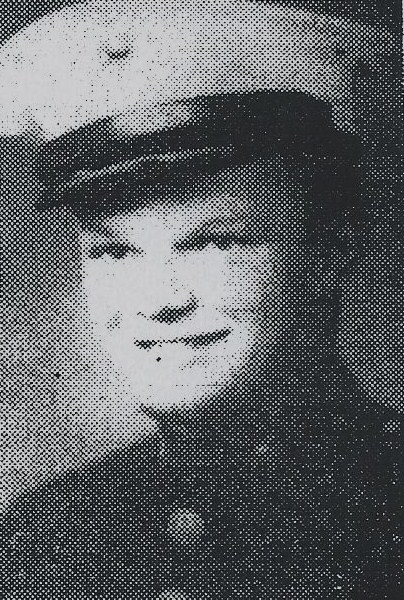
| December 15, 1944 - Private Robert C. Knoll, son of Mr. and Mrs. walter C. Knoll of 422 East Main Street, enlisted in the U. S. Marines in March 1944 and received training at Parris Island, South Carolina, Cherry Point, North Carolina and Camp Lejeune, North Carolina. He graduated from field telephone school and was then sent to San Diego. He is now stationed somewhere in the South Pacific. |

| December 15, 1944 - Private Kenneth Freeman, son of Mr. and Mrs. Walter Freeman of 108 Parkway is now stationed in Paris in the engineer section headquarters. He received his training at Fort McClellan, Alabama and Camp Meade, Maryland. |


| November 3, 1944 - Private Herbert S. Kerschner, son of Mr. and Mrs. Harry Kerschner of 30 Charles Street, was slightly wounded in action in Germany on October 14, according to a telegram his wife, the former Beatrice Fehr of Summit Station, received from the War Department on last Friday evening. He entered the service nine months ago and received training at Fort McClellan, Alabama for 17 weeks and left for overseas duty on July 13. He had been in England, France, Belgium and Germany. Prior to entering the service he had been employed at Elkton, Maryland. His wife is staying with her parents, Mr. and Mrs. Henry Fehr of Summit Station. |

| The Call of November 10, 1944 MISSING SOLDIER SAFE, PARATROOPER RETURNS TO UNIT Mrs. John McGlone received a letter from her brother, Leonard McCord yesterday, informing her that he was not missing but was back with his outfit. He stated he was sorry the government caused her to worry by telling her that he wasn't around anymore and that he just got back from Holland. He did not explain how he got back due to censorship but he told her that it would have to wait until he could come home to tell her and that he had a very interesting story to tell. Being pretty busy now he asked her to tell everyone that he is well and in good health and is now somewhere in England. The letter was dated October 31. The telegram they had received recently reported him missing in action over Holland since September 25. He is a paratrooper and entered the service in March 1941 and has been overseas about a year. |
| The Call of December 29, 1944 FRANCIS STERNER REPORTED KILLED ON BATTLEFIELD Corporal Francis E. Sterner, son of Mrs. Verna Sterner of Broadway and the late Robert Sterner, was reported to have been killed in action in France on December 12, according to a telegram his mother received from the War Department on Tuesday afternoon. Corporal Sterner entered the service on October 5, 1942 and received his training at Camp Gordon, Georgia. He was a member of a Chemical Warfare Battalion and served overseas for twenty months, leaving this country in April 1943. He was a graduate of Saint Ambrose High School and was a member of Saint Ambrose Church. Prior to entering the service he was an assistant manager at the local A & P store. His survivors are his mother, two brothers, Corporal Arthur, a member of the U. S. Marines and in service in the South Pacific and William at home; two sisters, Mrs. James Costanzo and Mrs. Fred Achenbach, both of Schuylkill Haven. Mrs. Costanzo's husband is serving in the Navy and Fred Achenbach is a member of an Infantry Division stationed in California. |
| The Call of June 23, 1944 FLIGHTS ON D-DAY PUT JACK REBER IN 100 MISSION CLUB Sergeant Jack H. Reber, 412 East Main Street of Schuylkill Haven is assistant crew chief on the Marauder, "Firebird," a member of the European Theatre's exclusive "100 Mission Club." The twin engined bomber flew two missions on D-Day to amass its 100th and 101st aerial operations. Only once during this time did "Firebird" run into trouble. That was the day B-26s smashed gun emplacements at Dunkirk. The bomber came back with over one hundred holes in the fuselage and wings. Not a member of the crew was injured. It dropped approximately 160 tons of bombs on targets in France, Belgium and Holland while piling up the total. Objectives included railway marshaling yards, airdomes, bridges and gun emplacements along the French coast. Prior to entering the Air Force in February 1942, Sergeant Reber was employed by the J. I. Hurst Coal Company of Landingville. He attended air mechanic's school at Kessler Field, Mississippi and was later assigned to the Ninth Air Force B-26 group commanded by Colonel Wilson R. Wood in Texas. He came overseas last spring. Sergeant Reber is the son of Mr. and Mrs. Guy E. Reber of 412 East Main Street. His wife, the former Harriet E. Coxe resides at 193 Parkway. |
| The Call of June 23, 1944 BOND SALES PASS MIDPOINT, GALA PREMIER NEXT THURSDAY NIGHT The third night of the house to house solicitation in the Fifth War Bond drive saw the halfway mark reached and passed with the total sales up to Thursday night of $180, 587.50. This figure is about $18,000 more than half of the $325,000 quota. A big boost in the total is expected at the War Bond premier of the picture, "Gaslight," starring Ingrid Bergman and Charles Boyer at the Rio Theatre next Thursday night. Admission to the picture will be by the purchase of a bond at the box office. Manager Henry Sork announced the doors will be open and bond selling will begin at 8:20 o'clock. The show will start promptly at 9:00. Persons planning to attend the premier are asked to come early so that there will not be a last minute rush because selling of the bonds takes more time than the mere handling of a ticket. Although well pleased with the results so far, cochairmen R. R. Sterner and Charles Manbeck request that bond purchases be maintained at the same splendid rate so that the quota may be reached before the close of the campaign on July 8. The house to house solicitation conducted by the Junior and Senior Women's Clubs and the Business and Professional Women's Club began on Tuesday and continued Wednesday and Thursday. Because a number of return calls have to be made, the final total of the results is not yet ready. |

| Call of January 26, 1945 - Captain Hugh W. Heim, son of Dr. L. D. Heim, 405 East Union Street, is now serving with a station hospital in Italy which has made an impressive record during almost two years of service overseas. In nineteen months of actual operation, more than 19,000 patients were admitted to this hospital in addition to more than 17,000 outpatients. A very large number of the hospital admissions were battle casualties from Africa and Italy. The unit was shipped overseas in January 1943 and was stationed in Tlemcen, Algeria until December 1943 when it moved to Italy. |

| Call of February 2, 1945 - Private Evelyn Sterner, daughter of Mr. and Mrs. George Sterner of 122 Broadway, left Tuesday for Fort Oglethorpe, Georgia, after enjoying a 15 day furlough with her parents. Private Sterner is in the service nine months and is a supply sergeant. Prior to entering the service she was employed at the Federal Mills. She has three brothers in the service: James Seaman First Class, Corporal Paul and Seaman Second Class George, all overseas. Other brothers and sisters are: Franklin, Charles, Leo, Ida, Alice and Martha, all at home. |
| Call of February 9, 1945 - SOLDIER DECLARED OFFICIALLY MISSING Tech Sergeant William T. Sterner, son of Mr. and Mrs. Theodore Sterner of 551 Columbia Street, was officially reported missing in action in France on January 20 according to a telegram his father received from the War Department. The message stated he returned to duty on December 20, having recovered from previously reported wounds. He has been in the service since February 1943 and received his training at Camp Polk, Louisiana leaving for duty overseas in May 1944. He was wounded in action October 15 and later received the Purple Heart. Then on November 15 he was wounded a second time. He is an only child and is a graduate of the local high school, class of 1942. |
| HUGH HEIM |
| WILLIAM STERNER |
| The Call of December 29, 1944 CARL A. BENSINGER AND AUSTIN GILHAM GET AIR MEDALS Staff Sergeant Carl A. Bensinger, 518 East Union Street, engineer-gunner on a B-24 Liberator bomber, has been awarded the Air Medal. Since arriving overseas last September, Sergeant Bensinger has taken part in twelve combat missions against enemy oil refineries, rail installations, aircraft factories and other strategic targets throughout Europe. He was awarded the Air Medal for "meritorious achievement and while participating in sustained operations against the enemy." A graduate of Schuylkill Haven High School, Sergeant Bensinger enlisted in the Army on September 15, 1943. His wife, Mrs. Mary Elizabeth Bensinger, lives at the Union Street address. His parents, Mr. and Mrs. London Bensinger live at 248 East Liberty Street Winner of the Air Medal with three oak leaf clusters, First Lieutenant Austin W. Gilham, son of Mr. and Mrs. Dilham C. Gilham of Schuylkill Haven, is a C-47 pilot in a squadron of the 61st Troop Carrier Group which has recently been decorated for outstanding achievement during the airborne campaign of the dropping of paratroopers in France. Lieutenant Gilham's group was awarded, by order of the President, the Distinguished Unit Badge. A graduate of Schuylkill Haven High School, the lieutenant joined the service in September of 1937. Accepted and trained at the Army Flying School of Lubbock, Texas, Lieutenant Gilham was graduated in December of 1942 and assigned to the 61st. With his present squadron, Lieutenant Gilham has been an active participant in the paratroop drops over Sicily, Italy, France and Holland. |
| The Call of January 5, 1945 WILLIAM McGLINCHEY AND ROY TRUMBO HOME Sergeant William J. McGlinchey, son of Mr. and Mrs. William F. McGlinchey of Haven Street, arrived home on Wednesday evening from Netherlands East Indies. He had been overseas for 35 months and entered the service six months prior to leaving for overseas duty. He never had a furlough. Sergeant McGlinchey worked in operations in the Fifth Air Force and had been stationed in Australia, New Guinea and then in Netherlands east Indies. Tom Sherer, who is now discharged, had been with him overseas. He will enjoy a 21 day furlough and then report to Miami, Florida for reassignment. Sergeant McGlinchey was accompanied by Sergeant Roy Trumbo, who also left with him. Sergeant Trumbo had been overseas the same length of time as Sergeant McGlinchey. He also, never had a furlough. Sergeant Trumbo was a mechanic in the Air Corps and had been stationed in Australia, New Guinea, Dutch East Indies and Netherlands east Indies. He will also report to Miami, Florida for reassignment after enjoying a 21 day furlough. He had previously resided with his grandmother, Mrs. Oscar Trumbo of Pottsville, RD3. Sergeant Trumbo and Sergeant McGlinchey have many experiences to relate. They are in fine health and reported the sun to be very hot, the temperature reaching 130 degrees at their last station. |
| The Call of January 26, 1945 PFC CLAIR W. REED REPORTED MISSING IN ACTION PFC Clair W. Reed, son of Mr. and Mrs. Ivan Reed, of 310 East Union Street, is officially reported as missing in action in Belgium since January 5 according to a telegram received on Wednesday. PFC Reed enlisted in the reserves while a student at the Valley Forge Military Academy and he was called to active duty in February of 1943. He received his basic training at Camp Wheeler, Georgia and was then sent to the Vanderbilt University at Nashville, Tennessee for a specialized course of training for nine months. When the AST program was discontinued, he was then assigned to the infantry and received his infantry training at Camp Atterbury, Indiana and left for overseas duty in September of 1944. He was attached to the Third Army. He is a graduate of the local high school and then entered Valley Forge Academy. He has three brothers, Private Kenneth in the Air Force at Avon Park, Florida; J. Stanley of Schuylkill Haven and J. Russel at home. |
| The Call of January 26, 1945 KRAMMES AWARDED BRONZE STAR Technician Fifth Grade Lewis D. Krammes was awarded the Bronze Star for heroic achievement in with military operations against the enemy during the attack on Moyenvic, France on November 9. On that date his company advanced on the town, swept the roads for mines and constructed foot bridges to facilitate the progress of our infantry units. Heavy enemy fire caused many casualties. Krammes, Company A aid man, in utter disregard for his own safety and under the strong enemy artillery concentration, went about rendering efficient first aid to the wounded and dressing numerous wounds. Later, though not called onto do so, he entered the town of Moyenvic which was being intermittently shelled, administered first aid to wounded infantrymen and organized their evacuation to the battalion aid station. His initiative, his unusual devotion to duty and his commendable solicitude for his wounded comrades reflects high credit upon him and the armed forced of the United States. |

| The Call of February 16, 1945 PFC EUGENE P. ROEDER KILLED IN PACIFIC PFC Eugene P. Roeder. 20, son of Mr. and Mrs. Rufus W. Roeder of 483 West Columbia Street, has been reported killed in action in Luzon on January 15. He was a graduate of the Schuylkill Haven High School, class of 1943, and was a member of Christ Lutheran Church. He was inducted into the service on June 4, 1943 and received his basic training at Camp Wheeler, Georgia. After a four day leave he was then sent to Fort Ord in California on November 3, 1943 and left for overseas duty on November 14. PFC Roeder had been at New Caledonia, New Zealand, Australia, New Guinea and then at Luzon, where he was killed. His survivors are his parents, two sisters, Lorraine and Mildred and one brother Merlin. |

| The Call of February 16, 1945 LOCAL BOY HELPS DESTROY FOUR ENEMY CRAFT Blazing away almost simultaneously to right and left at enemy fighters west of Cebu Island in the Central Phillipines, a Seventh Fleet PT patrol destroyed four of the small enemy coastal freighters in a running moonlit battle on December 29. At his battle station, the 37 mm cannon, aboard PT 190 was Joseph Robert Dallago, 19, Gunners Mate Third Class, USNR, son f Mr. and Mrs. Robert Dallago, 112 Broadway, Schuylkill Haven. To Dallago and his mates aboard the "Jack of Diamonds" the action wasn't something new. Their boat is a veteran of the Battle of Leyte Gulf. In that fight they were under the gunfire of a Jap battleship, several cruisers and destroyers. In the latest action, the PT patrol made a clean sweep of a Nip inter island convoy. Closing to a few hundred yards, they poured steel and incendiaries into the largest lugger until it caught fire. The Jap crews returned the fire but were no match for the speedy PTs. When Dallago's boat came around to make a run on the second freighter, a third was detected on their port side. Gunners shot up the one and then whirled their guns around to bear on the other. Both were left dead in the water and were later sunk. Meanwhile the remaining Nip ship was racing off in a vain attempt to escape. At full throttle the PT took up the chase. Under light gunfire from the enemy craft, two strafing runs sufficed to set the lugger ablaze and leave it sinking in the water. The entire enemy convoy had been destroyed. A few small bullet holes in the PT was the only damage suffered. Dallago enlisted in the Naval Reserve November 17, 1943. He received recruit training at Sampson, New York and was graduated from gunner's mate school in Bainbridge, Maryland and motor torpedo boat school in Melville, Rhode Island. He attended Schuylkill Haven High School and was employed as a service attendant by Elmer Johnson at Mount Carbon at the time of his enlistment. He has been in the Southwest Pacific area for four months and has participated in sixteen combat patrols in the New Guinea and Phillipines area. |
| The Call of April 2, 1948 BODY OF CPL RUSSELL MENGLE ARRIVES ABOARD SHIP TODAY The United Sates Army transport, the "John L. McCarley," is due at New York today with the bodies of 2,619 Americans who died in the struggle for the liberation of Europe. Aboard the vessel are the remains of 240 being brought to the United States under the provision of a 1946 congressional act at instructions of next of kin residing in Pennsylvania. Virtually all the remains aboard the "McCarley" which is scheduled to arrive from Cherbourg today, are being returned from the D-Day military cemeteries at Saint Laurentsur-Mer, Blosville and LaCambe in Normandy. Aboard this transport, which was to have docked on Tuesday, but which docked today due to stormy weather on the Atlantic Ocean, is the body of Corporal Russell H. Mengle, son of Mr. and Mrs. John Mengle of 9 Eaton Street. The body will be sent to Schuylkill Haven by train and will be accompanied by an honor guard of two men, former members of Corporal Mengle's outfit. The flag draped casket will be met by the joint military affairs committee of the Veterans of Foreign wars and the American Legion and the remains will be taken to the Geschwindt funeral home to await arrangements for burial in the Union Cemetery. Final services will be held the Saturday following the arrival of the body with Reverend Delas R. Keener, pastor of the First Evangelical and Reformed Church, of which the war hero was a member, officiating. Members of the National Guard who reside in Schuylkill Haven will have charge of full military affairs at the service. Corporal Mengle, better known as "Bucky" was killed in action in France on July 25, 1944 at the age of 23 years. His remains had been interred at the Blosville Cemetery, France, about 23 miles from Saint Lo. He received his training at Camp Atterbury, Indiana and Camp Breckenridge, Kentucky and was a member of the anti tank company and left for overseas duty in November of 1943. Prior to entering the service he had been employed at the Bashore Knitting Mill. Corporal Mengle was a graduate of Schuylkill haven high school class of 1939. Surviving are his parents; three sisters, grace, wife of Edgar Standiford of Long Run; Jean, wife of Marvin Baum of Schuylkill Haven and Arlene, wife of Robert Moyer of Willow Lake; three brothers; John Marvin of Long Run, Robert of Pottsville and Charles at home. Also his paternal grandparents, Mr. and Mrs. Henry Mengle of Garfield Avenue and his maternal grandmother, Mrs. Nellie Hamilton of Pottsville. A brother Willard died in October of 1943. |
| The Call of January 11, 1946 VFW TO BUY COLUMBIA HOUSE AS POST BUILDING The Veterans of Foreign War, Post 4385 of Schuylkill Haven, at its meeting last evening contracted with Mr. Charles Graver to purchase the Columbia House on West Columbia Street for $28,000. The building will eventually be converted into a post home. After the final purchase has been consummated, the veterans will conduct the bar and hotel for a period of six months until the present liquor license expires. Then the rooms will be closed and the building taken over as a strictly veterans' and associate members' home. Ninety five percent of the veterans present at the meeting voted for the purchase of the building. The price originally asked had been $32,000 but Mr. Graver dropped the figure to $28,000 for the veterans. To finance this new venture, the veterans organization will sell first mortgage bonds bearing two and a half percent interest. Already close to $8,000 has been subscribed. The public is now being contacted by the following executive committee which is acting as board of directors of the new undertaking: Ernest Rizzuto, Post Commander, Hugh Hoke, John Roeder, Robert Schaeffer, Leo Carr, Clyde Dewald, Dr. Joseph Matonis, Robert Rollman, Thomas Rudolf, William McGlinchey, Peter Bruzofsky, Karl Michel, Paul Chambers, Dr. J. H. Woodland and Robert Oliver. |
| The Call of May 18, 1945 CORPORAL PATTERSON FIRST TO GET OUT ON POINTS Corporal John Patterson of town was the first soldier to be given an honorable discharge from the armed forces on the Army's new point system. Corporal Patterson, with four and a half years of service, three of which has been spent overseas in Hawaii, had a total of 88 points and was among the first 2,5000 sent to Fort Dix last weekend. He received his discharge papers on Monday after undergoing a routine of discharge requirements over Saturday and Sunday at Fort Dix. He notified the local draft board and was informed he was the first one from Schuylkill Haven and the area included in Board 9 to be released from the Army under the point system. His first acts as a civilian after serving since 1940 were to have his discharge recorded, outfit himself with civilian clothing and apply for a job at the ordinance plant. |
| The Call of May 25, 1945 PFC ROBERT E. IMBODEN KILLED ON OKINAWA PFC Robert Earl Imboden, 19, a Marine, son of Mr. and Mrs. Ira Imboden of 33 Center Avenue, was killed in Okinawa on Saturday, May 12, during an air raid. A buddy, Robert Imler of Pennbrook, wrote a detailed letter to his mother, who in turn notified Lawrence Imboden of Harrisburg, a brother of the deceased Marine by letter, which he received on Monday evening and he in turn relayed the message to the bereaved parents on Tuesday morning. "Bobbie" as he was better known, or "Imby" by many school friends, was in a hut built of old lumber which was found around there at the time of the air raid. fragmentations of a bomb struck the hut and he died within a few minutes without regaining consciousness. Several others were hit but he was the only casualty. These facts are considered authentic even though no telegram was received from the War Department as yet, since his buddy helped to bury him in the Marine Corps graveyard on Mother's Day, May 13th. Memorial services were held in connection with Mother's day services. Bobbie was a member of an amphibian tractor unit. He enlisted in the Marines on September 10, 1943 and received his training at Parris Island, South Carolina, Camp Lejeune, North Carolina and Camp Pendleton, California. He left for overseas the latter part of July 1944. He had been injured on the Pelelieu Islands and was hospitalized at Guadalcanal for two months. He received the Purple Heart and returned to action on Easter Day landing on Okinawa. He attended the local high school and was employed at the A & P store. He was a member of the First Evangelical and Reformed Church and was always very active in Youth Fellowship, Sunday School and church work and was a member of the choir. He was very fond of music and played the saxophone and clarinet, played in the school band for several years and in the orchestra and also sang in the school groups and glee club. His survivors are his parents, one sister, Marie, wife of Russell Brown of Schuylkill Haven and three brothers, Walter of Wyomissing, Stanley of Lackawanna, New York and Lawrence of Harrisburg, who was a former member of the local high school faculty and now teaches in Lemoyne high school. |
| The Call of June 1, 1945 LOCAL SOLDIERS RELEASED FROM GERMAN CAMPS Technical Sergeant Robert S. Miller, son of Mr. and Mrs. George Miller of 12 Coal Street, who was injured and taken a prisoner after his plane was shot down over Germany on February 21, 1944, has been returned to military control. His parents received a cablegram from him on Tuesday stating he would soon be home. The last letter they had from him was on November 17. He has three brothers in service. Private William G. Miller, brother of Theodore Miller of Schuylkill Haven RD1, has been returned to military control. Official word was received by his brother through a telegram from the war Department. Second Lieutenant Marlin Greenawalt, who had been a prisoner for thirteen months has been liberated, according to official word his wife, the former Lorraine Kaufman, received last Friday. She has received a number of letters from him, the last one being dated May 16 in France, in which he stated he would soon be home. Tech Sergeant Joseph R. Smith, son of Mr. and Mrs. Charles Smith of Saint James Street, who was a prisoner of the Germans since May of 1944, and had been released and hospitalized in England, is now being returned to the states. Private Frank W. Weaver, husband of the former Marilyn Reber of Main Street, has been liberated, having been a prisoner of the German government since September 1943. He was a paratrooper and entered the service over three years ago. He had been taken captive in Sicily after having been overseas only several months. First Lieutenant John S. Templin, 24, son of Jesse G. and the late Florence Templin of Willow Lake, Schuylkill Haven, who has been a German prisoner since September 28, 1944, has been liberated by American forces. He entered the service five years ago and was a fighter pilot. A brother, Harold, was killed in action in France on July 5, 1944. |
| The Call of June 22, 1945 LETTERS HOME FROM SOLDIERS Warren H. Fenstermacher wrote the following V-Mail letter from England: Dear Sir, I would like at this time to express my appreciation and thanks to all those back home for the copies of The Call that I have been receiving. Almost a year had passed since I last received a copy of it, this due no doubt to my moving around so much. The copies are now coming through regular. When I first came overseas I landed in Ireland. This place I found to be very pretty although the training was rough. I later went to England and spent a little time there before I shoved off once more for France on June 16th. I went through France, Belgium and part of Germany with the Fourth Infantry Division up until I was wounded in the Huertgen Forest by an artillery shell. I spent a little over three months in a hospital in England and left the hospital with limited assignment due to my injuries. I have been in the Air Corps three months now and it sure is a good change after being in the infantry. I am getting along in my work very well and like it a lot. I haven't run into any of the boys from our town as yet, the nearest being Hazleton, but I am still keeping my watch with the hope that I will. Once again I'll say thanks for sending the home town paper as it enables me to keep track of the fellow servicemen and women who are striving for that one goal, namely the defeat of Japan, now that our fore, Germany, is through. The following letter was received from John C. McCormick, AMM Third Class in the Phillipines: Dear Sir: I left the states the 23rd of April and I arrived here one month and five days later. I'm writing this letter to notify you and your staff of my change in address. I want you to know that I appreciated The Call very much back in the states and I'll appreciate it much more over here so far away from good old Schuylkill Haven. I can't tell you exactly where I am but I am in the Phillipines. I don't think it's necessary that you should know. It's pretty far behind the main lines. I sure would like to move forward on (Censored). It took them a long time to send me over but they didn't have any transportation at the time, so I guess they can be forgiven. They kept us at the receiving station for five months. I'd like to do some flying. I'm going to try hard to get it. There's all types of planes here from (Censored). The work here is running pretty smoothly. The Seabees do a grand job over here. They build roads and shops in record time. The back issues of The Call haven't come in yet, but I'm waiting patiently for them. Well sir, this will be all for now. Lots of luck with your paper. I hope I get back home soon. |

| March 16, 1945 - PFC Milford S. Klahr, son of Mr. and Mrs. Milford Klahr of 124 saint John Street, is now serving with the 110th Infantry of the 28th Division somewhere overseas. He was placed with the 28th Division in August before Paris was liberated and since then has seen action in Belgium, Luxembourg and Germany. He was awarded the Purple Heart in October when he was slightly wounded in action. Klahr entered the service in January 1944, receiving his training at Fort McClelland, Alabama and Fort Meade, Maryland before leaving for overseas duty in July. His father, a veteran of World War One also served with the 28th Division. |


| June 22, 1945 BROTHERS IN SERVICE Four brothers from Schuylkill Haven are serving their country at the present time. Private Edward and Private Harold Coller have the same address and prior to entering the service they made their home with their sister, Mrs. Ike Gehrig of 323 South Garfield Avenue. They have been in the service since the 213th Coast artillery left town and they have been overseas for 33 months. Private James N. Coller has been in the service since April 26, 1945. He is married to the former Sara Reichert of town and they have four children. Their home is in Landingville. Private Richard Coller, better known as Dick, is in the service for three and one half years and has been overseas for 22 months. |
| The Call of July 6, 1945 SERGEANT LEO CARR AND T-5 FLOYD BROWN RELEASED ON POINTS Sergeant Leo Carr this week put aside the uniform of the United States Army after four years and again put on civilian clothes. He was discharged from service through the point system, having amassed 107 points. Sergeant Carr joined a unit in California where he spent a year. He had been overseas for 35 months and had been all through Africa, Tunisia, Sicily, Italy and the Austrian border and is the possessor of seven battle stars. He flew home from Italy, arriving in the states on June 16 and at the home of his parents, Mr. and Mrs. Bernard Carr at 29 Haven Street on June 25. T-5 Floyd H. Brown, in the service over four years, was discharged on points on July 2 and arrived in Schuylkill Haven on July 3. Entering the service in June, 1941, he left for overseas duty in August, 1942. He received training in England and then took part in the African invasion. He participated in the invasion of Sicily and Italy. He was flown from Italy to the United States, arriving in this country on June 24. With a total of 117 points, he was released on Monday. His campaign ribbons bore five battle stars. He is the son of Mr. and Mrs. Harvey Brown, 202 West Main Street. He is living at Cressona with his wife, the former Marguerite E. Kull of Friedensburg and daughter. |
| The Call of July 20, 1945 DETAILS GIVEN ON PRIVATE JACK KREMER The issue of June 29 had a story on the awarding of the Silver Star medal posthumously to PFC Jack Kremer. Last week a news release was received by The Call from the 76th Infantry Division in Germany giving a more complete account of the action in which Jack lost his life and earned the Silver Star. The release is as follows: "On 15 April Company A was assigned the mission of capturing the town of Bergisdorf, Germany. In approaching the town, the third platoon was subjected to enemy machine gun and small arms fire from Germans concealed in nearby hedgerows. One man was killed and another wounded. It was a tough spot for his platoon, but Kremer, responding to his platoon leader, advanced in the face of enemy fire, calling for his comrades to follow. Moving a short distance, he was wounded, but continued to advance. When he came to within thirty feet of the enemy position, he was again hit by machine gun fire and mortally wounded." The citation accompanying the award read in part, "His staunch and intrepid stand in the face of seemingly insurmountable obstacles will remain as a lasting inspiration to his comrades and reflects the highest credit upon himself and the armed forces of the United States." |
| The Call of July 20, 1945 SERGEANT VINCENT MCGLONE GETS BRONZE STAR William McGlone of 407 Dock Street has received the following concerning his son, Sergeant Vincent J. McGlone of the United States Marine Corps who has received the Bronze Star medal: "For heroic achievement in connection with operations against the enemy while serving with a Marine infantry battalion on Iwo Jima, Volcano Islands, on 12 March, 1945. While serving with a rifle platoon, Sergeant McGlone assumed command upon the death of his platoon leader. When the advance of his platoon had been halted by intense enemy mortar and machine gun fire, Sergeant McGlone, with complete disregard for his own safety, unhesitatingly undertook a lengthy reconnaissance in front of his lines and in the face of this deadly fire in attempt to locate enemy positions. Successful in this mission, he returned to his platoon, skilfully maneuvered them into position and courageously led a successful assault upon the enemy's positions. His courage, skillful leadership and complete devotion to duty was a constant inspiration to his men and enabled his platoon to complete its mission with a minimum of loss of life. His conduct throughout wa sin keeping with the highest traditions of the United States Naval Service." G. B. Erskine, Major General June 8, 1945 United States Marine Corps Commanding Sergeant McGlone has been in the service four years and overseas two years. He has a brother, Corporal Francis in the 4th Division Marines in the South Pacific and another brother and sister at home, William and Gladys. |
| The Call of July 20, 1945 PRIVATE GEORGE LORD ARRIVES HOME Private George Lord, son of Mr. and Mrs. George Lord, 17 Eaton Street, is enjoying a thirty day furlough. Private Lord arrived in New York July 11 aboard the John Ericson from the European front, where he served since January, 1944, seeing service in England, France, Belgium and Germany in the First Army. He holds the Presidential Unit Citation, the Bronze Star, the Bronze Arrowhead and also a Silver Star on his campaign ribbon, the equivalent of five Bronze Stars denoting participation in five battles. He returned from overseas with the 414th Regiment of the 104th (Timberwolf) Division. He met his 11 month old son for the first time. His wife was formerly Martha Hepler of Beckville. Two younger brothers, Earl and Lester are serving in the Air Corps. Earl, after overseas duty in the North African campaign and the Italian invasion is now located at Lake Charles, Louisiana and Lester at Kessler Field, Mississippi. |
| The Call of July 20, 1945 IVAN QUINTER AIDS IN NAVAL SHELLING OF JAP HOMELAND ABOARD THE USS QUINCY OFF JAPAN, July 14 - Ivan Charles Quinter, 19, motor machinist's mate Third Class, United States navy, whose parents, Mr. and Mrs. Ivan Quinter, live at 30 Fairview Street, and Irvin M. Mengel, 36, Seaman First Class, whose wife lives at 504 Columbia Street, Schuylkill Haven, went to the shores of Japan today and helped a mighty naval task force hurl dynamite into the Japanese homeland. In a force of Third Fleet warships, the Quincy turned her powerful guns on the Honshu steel city of Kamaishi, 275 miles north of Tokyo. More than a thousand carrier based planes also figured in the attack. The first ship to be fired upon in the Normandy landings, she was under fire for 19 days without a single casualty. Crew members displayed the same determination off Japan's shores that was exhibited when the ship sailed into an eight day duel with a 14 inch German coastal gun off the coast of southern France. In January 1945, the Quincy was temporary headquarters for the late President Franklin D. Roosevelt and his military and diplomatic staffs during the trip to the historic Yalta Conference. Earlier this year she fought at Okinawa. |
| The Call of September 28, 1945 SOUGHT BOOBY TRAPS IN TOKYO BAY IN TOKYO BAY, September 3 (Delayed) Leonard C. Deibler, 21, machinist's mate Second Class, United Sates Navy, of 524 Railroad Street, Schuylkill Haven, was a member of a Navy underwater demolition team, a secret volunteer outfit famous for "getting there first with the least and doing the most," which spearheaded the landing of Allied occupation troops in Tokyo Bay. The force moved in with the first landing, checked the landing areas for mines and the piers and docks for booby traps and then demilitarized all ships in the Yokosuka and Nagaura Bay naval harbors. In disarming the ships, the team threw overboard all small arms and vital parts of all large caliber guns. Part of the team led British forces ashore on one of the forts which formerly protected the entrance to the bay. After demilitarizing the island fort, the group participated in flag raising ceremonies four days before the formal surrender signing. Deibler is the son of Mrs. Ida Deibler, 524 Railroad Street, Schuylkill Haven. Before entering the service he attended the Schuylkill Haven high school. |
| The Call of September 7, 1945 LOCAL SEAMEN IN TOKYO BAY FOR JAP SURRENDER ABOARD THE USS MISSOURI IN TOKYO BAY Two Schuylkill Haven seamen, Joseph F. McGlinchey and Claude Alfred William, both seamen first class, are playing a role in a momentous event in American history. Serving on this mighty battleship they were present when the Japanese envoys came aboard to sign the final surrender document. General Douglas MacArthur, Supreme Allied Commander; Fleet Admiral Chester W. Nimitz, commander in chief of the Pacific fleet, who signed the document for the United States and other famous American military and naval chiefs were present. The 45,000 ton Missouri named for the home state of President Truman is one of the most powerful warships ever built. It is now the flagship of Admiral William F. Halsey, commander of the Third Fleet. ON THE USS QUINCY IN TOKYO BAY Irvin M. Mengel, Seaman 1C and Ivan Quinter, Machinist's Mate 3C, of Schuylkill Haven are serving on this heavy cruiser, which is part of the powerful Pacific fleet completing the first stages of the occupation of Japan. Under the operational control of Admiral William F. Halsey, the Quincy with 19 other cruisers, 12 battleships, 17 aircraft carriers, six escort carriers and more than 290 other United States ships, is helping take over control of the Nips' big naval bases. The Quincy took part in the victory at Normandy and was in the task force that bombarded Japan in July of this year. The following letter was received by councilman Joseph McGlinchey from his son Seaman 1C Joseph McGlinchey, who is aboard the U. S. S. Missouri: August 17, 1945 Dear Dad and Sis: It's hard to believe isn't it? A few days ago we were at war without much prospect of it finishing very soon. Now it's over all except the occupation. On the day the official word was received, the Missouri with the other ships of Task Force 38, was in position for an air strike on Tokyo. Since we have been in Task Force 38 all along, you will realize this was nothing new to us. It was a nice sunny day which is a rare thing in the vicinity of Japan in the summer time. The date, for us out here, was the 15th day of August. When the message came we already had air strikes on the way. Word was flashed to them to return and, after we gathered them all in, we retired to collect our wits and await any orders for our next move. At eleven o'clock word went out to celebrate the occasion by breaking the battle flags. All the ships flew their largest ensigns and blew their whistles and sirens in honor of this great occasion. We tooted our whistle with much gusto and the Mighty Missouri added her bit by getting the whistle stuck and continuing to toot until the engineers could get the steam secured and make minor repairs. That just about constituted our celebration. We continued in an alert status because, although the war was over, we weren't really sure that the Japanese knew it. This is very necessary in the forward areas for it takes time to notify all the forces and order them to stop fighting. We have been on the front lines for a long time now too. All of us here are certainly glad the war is over and are anxiously awaiting to get the final details cleared up so that we can be on our way home. Somehow or other the things we wanted to tell about a few days ago don't seem to be as important now as they did then. Anyway, our last replenishment period was spent in Leyte Gulf, Phillipine Islands, where we found all our old friends, the tenders and supply ships from Ulithi Atoll. Ulithi is the atoll in which the island of Mog Mog is that I told you about in my last letter. Other than that the replenishment period was much the same. There was a recreation beach on the island of Samar which was like Mog Mog except hotter. After our replenishment we went to sea and proceeded directly to strike at Tokyo. We went to the north and struck Hokkaido and made the Muroran Bombardment that I wrote about before. From then until the end of the war we have made strikes all along the Japanese coast, so many that they are hard to remember. Our bombardment group made Hitachi Arms factory, engineering works and Sopper Refinery near Minato on the east coast of Honshu. This was interesting because it was done on a night so black and in weather so bad that planes could not be used to observe the fall of shot. We did not have any idea of the damage until it was photographed by plane the next day and they sent us the pictures. To our surprise and gratification we found that the damage was extensive and the targets were well covered. It is amazing what can be done with modern war equipment. We could hardly even see the next ship in column much less the target which was fifteen miles away. We are all proud that we have been able to help win this war. Let us all hope that this will be the last time a war has to be won. Many of our friends have died with that hope. That hope has carried us through many a grinding, grueling day. Let us pray that it carries those charged with formulating and preserving the peace to a successful accomplishment of their task. Goodbye now and I hope to see you soon. Just a few lines to say hello and let you know my health is fine and everything is in ship shape. We are still at sea and at the present time we are standing by for further orders. We don't know if we are going to get a chance to steal that white horse but are certainly looking forward to it. There is still a lot of work that has to be done so we will have to take everything in its stride. With it all we still may get home for a short time sooner than we expected. Best of health and love to all. Sincerely, Joseph Francis McGlinchey |
| The Call of March 15, 1946 PRISONER OF GERMANS TELLS ABOUT RED CROSS Every time the Red Cross drive is conducted, a certain number of people are bound to come forward condemning the work of the red Cross. It must be remembered that the Red Cross operates where the need is greatest. To get a more rational slant on the owrk of this agency, we contacted two local boys, Clair Reed and Marlin Greenawalt, who, as prisoners of war, are qualified to pass judgement upon the activity of the Red Cross. Here is the story of Clair Reed. Clair Reed, son of Mr. and Mrs. Ivan W. Reed of 310 East Union Street, after two and one half years in the Army, was taken prisoner by the Germans on January 4, 1945 in Bastogne, Belgium. At the time of his capture he was wounded in twenty places across the back with shrapnel. With eight others, he decided to lie where he had fallen but the remainder of their badly shelled outfit decided to make a run for it across open fields. Only the nine who stayed where they were and were captured, remain. The prisoners began a two and one half month march to the prison camp at Bad Orb in Germany. At one of the first stops on the trip, they received their first form of aid from the Red Cross, a package of food and a loaf of bread which was to be shared by two prisoners for a five day trip. Two weeks later at another stop they received the next Red Cross package. In the meantime and later in the prison camp they had to eat food which Clair stated "shouldn't be fed to a dog, even one you don't like." So after a diet such as they had at the hands of their captors, the prisoners considered the Red Cross packages as manna from heaven. LONG WALK TO CAMP The long trek to the prison work camp was a nightmare of horror. Clair described their quarters at one stopover as being in a building the size of the William Young Provision Company building on Margaretta Street. In this one building, two stories high were crowded 2400 men. They were packed so tightly they had to sleep standing up. During the day the men were forced to work on railroads, in the mines or in cleaning up bombed cities. According to international rules as laid down at Geneva, the prisoners were each to receive one Red Cross food package a week. Through some of the more friendly guards at the camp, they learned that the Red Cross was sending the packages and at various intervals had representatives inspect the camps. Recommendations for improvements were made but unfortunately the camp commander didn't do anything about the recommendations. He also withheld the packages. HAD TO SHARE PACKAGES At one time he issued one package for every three prisoners. The next package had to be shared by eleven men. A third package had to be divided among 21 men. And a last package received was to be shared by 46 prisoners. Because this last division was impossible, the men drew lots and the lucky ones received the food but most of the men shared as much as possible with the less fortunate in the drawing. The package contained assorted items: three to five packs of cigarettes, one pound of dried assorted fruit, can of powdered milk, can of cocoa, one or two bars of soap, small box of sugar lumps, packages or bars of candy, four small white vitamin capsules, dried cereal, can of salmon, cheese, butter or marmalade. The packages, identified by a number, contained various assortments of the above items, so that the same things were not received all the time and eating would not become monotonous. Clair can't figure how eating any of these tasty things could have become monotonous. Compared to the swill handed out by the captors, this Red Cross food was a king's banquet. Clair's camp was liberated by the American forces on April 2 and they were sent to a repatriation camp at Camp Lucky Strike near Le Havre, France. There they were treated royally by the Red Cross. All type of entertainment was provided. Egg nogs and fruit juices were given in abundance to those suffering from malnutrition. Those in better condition were served regularly on more substantial food. Red Cross doughnuts were carried away by the boxes. The time came for the long awaited boat trip home. The Red Cross gave each of them a package upon boarding ship, the same as they had done when they sailed from the United States for the war theater. The ship reached New York harbor on May 5 and on May 7, Clair arrived at his home. At the present time he is pursuing a course of study at Albright College, commuting to Reading each day by train. Except for the scars on his back and still vivid memories of war and the German work camps, Clair has returned to normal civilian life. |
| The Call of March 22, 1946 MARLIN GREENAWALT WAS PRISONER FOR 13 MONTHS Easter Sunday, April 9, 1944 was the fateful day for Marlin D. Greenawalt. On that day he was sent on a bombing mission over the city of Danzig with the targets being the city itself and the nearby airport. The plane was shot down and the crew parachuted safely from the falling plane. They were taken prisoner the same day. Their first contact with the Red Cross was at the interrogation center where the red Cross issued them clothing and food. Germany was still in winter and the clothing, although inadequate, was greatly appreciated. Their names and addresses were taken so that the nearest of kin could be notified. While a prisoner, Marlin managed to keep a diary of his experiences. The following excerpts concerning the Red Cross he has permitted us to use for publication. October 25, 1944 - Food rations cut again. If it weren't for the Red Cross parcels we receive about once a week, we would be in very sad straits. December 8, 1944 - Food situation at new low. Bread ration cut 30 percent. This amounts to about one slice a day. No Red Cross parcels. Christmas, 1944 - Evening meal best since we were taken prisoner thanks to Christmas Red Cross parcels. Relief only temporary. March 20, 1945 - Food situation critical. Men taking on appearance of gaunt aged men. Many cases of fainting, copilot in particular. When will the Red Cross parcels arrive. March 26, 1945 - Day of good news. Received word General Patton crossed the Rhine. Red Cross parcels finally arrive. May 1, 1945 - Allied men took over prison towers. Our German captors fled during the night. We are now awaiting the advancement of the Russians. May 9, 1945 - V-E Day!! Nowhere are there more thankful hearts than here in Barth prison camp in Germany. May 12, 1945 - Today flew from Barth to French soil. First American girl we saw in 13 months was a Red Cross girl recently from the States. After their liberation from the hands of the Germans, the men found that the Red Cross parcels intended for the men at the rate of one each week had been kept by the Germans and placed in a warehouse. Speaking of the role played by the Red Cross, Marlin stated, "Without this splendid organization, we former prisoners of World War Two would have found our plights immeasurably more difficult. Therefore I feel we owe a never ending debt of gratitude to the Red Cross." Mr. Greenawalt returned to this country June 26, 1945. He has resumed his position as salesman for the Fuller Brush Company. His wife is the former Lorraine Kaufman and they have a two year old daughter, Vickie. |
| The Call of August 10, 1945 VETERANS MEET TO SET UP V. F. W. POST IN TOWN The first meeting of the Veterans of Foreign Wars in Schuylkill Haven was held Tuesday at Gabe's Cafe with a high attendance of over fifty members who have served overseas, who are still in the service and others who hold an honorable discharge. The meeting was called to order by acting commander, Ernest Rizzuto, who turned the meeting over to John C. Phillips, past district commander, of Minersville. Mr. Phillips has thus far helped to establish six new posts. The meeting he conducted here was very interesting and many helpful suggestions were derived therefrom. Signing the charter for the new organization were the following veterans: Ernest Rizzuto, acting commander; William McGlinchey, acting secretary; Ralph Fisher, acting quartermaster; Charles Alleman, Gerald Butz, Floyd Brown, Edward Coller, Leo F. Carr, Richard A. Fatkin, Clyde Dewald, George E. Eiler, Ralph J. Fisher, Clifford T. Mengel, R. E. Oliver, Lucian Lindermuth, Richard Naffin, John Monsulick, Anthony Kupko, James Renninger, Thomas Rudolph, John H. Roeder, Robert L. Roeder, Thomas H. Strouse, Robert E. Shirey, Russell A. Schwenk, Robert T. Schaeffer and Roy R. Trumbo. For the installation of officers, the date which has not yet been set, a special program is being prepared. Dr. Burk, senior vice commander of Johnstown; John U. Shroyer, deputy junior vice commander of Harrisburg, who is at the present secretary of highways; C. A. Gnau, deputy adjutant and quartermaster, and Lloyd C. Pike, past deputy commander, will be present for the installation. Several World War One veterans were present and they made useful suggestions in helping to establish the new organization. The next meeting will be held August 21 at the cottage of Ira Hurst, formerly the Dr. Detweiler cottage on Route 83. Application blanks may be obtained from the following: Ralph J. Fisher, phone 32R, 243 Paxson Avenue; William McGlinchey, phone 660R, 117 Haven Street; Louis Rizzuto, phone 9413, 16 Saint John Street. Eligible for membership is any person who has served beyond the continental limits of the United States and a member of the United States armed forces. |
| The Call of April 19, 1946 EARL KRAMER, WAR VETERAN, DIES OF STRANGE DISEASE Earl L. Kramer, 25, of 103 East Liberty Street Schuylkill Haven, died at the Naval Hospital in Philadelphia on Tuesday. He was a corporal in World war Two and lost a right leg while in service overseas. He had been in ill health practically since his return to the states. He was wounded in May and July, 1944 in Italy. He had been a tank gunner with the 603rd Tank Battalion in Italy. While there he sustained a smashed finger early in June 1944. On the morning of July 15, 1944, his tank was participating in an armored advance on the Italian city of Palermo. Mr. Kramer was unable to get to safety and shrapnel tore into his leg. He was then evacuated to the Walter Reed Hospital in Washington D. C., where his leg was amputated above the knee. After receiving an artificial limb he was discharged from the service on March 6, 1945. Prior to serving in Italy he participated in the North African campaign. He was then employed at the Cressona Ordnance plant where he operated a power cutter. Becoming ill he entered the Philadelphia naval Hospital but the doctors couldn't diagnose his illness and he was sent home. Sometime later he entered the Pottsville Hospital and it was found that he was suffering with Kala-azar. This disease germ enters the bloodstream and destroys areas in the spleen and liver where blood cells are produced. It is found in the tropics of Asia and the Mediterranean area. Mr. Kramer was born in Orwigsburg RD, the son of Mrs. John Leonard of Schuylkill Haven, the former Mrs. Gertrude Brobst Kramer and the late Earl I. Kramer. He was a member of the Reformed congregation of Zion's Church and the Disabled American Veterans. His survivors are his wife, the former Frances Stump of Pine Dale, whom he married in April of 1942; his mother; two sisters, Mrs. Frank Mengle of New York and Mrs. Charles Alleman of Orwigsburg RD; one brother Irvin of Orwigsburg. Military funeral services will be conducted by the Robert E. Baker Post Number 38, American Legion of Schuylkill haven on Saturday afternoon at 1:30 from the D. M. Bittle Funeral Home of Schuylkill Haven. The Reverend Lee D. Loos will officiate. Burial will be made at Zion's Church Cemetery. All veterans are asked to attend and meet at the Bittle funeral home at 1:30. |
| The Call of June 28, 1946 LAVERNE WEISER GETS BRONZE STAR Corporal Laverne A. Weiser, 21, of 309 Center Avenue in Schuylkill Haven, who was discharged at Fort Dix, New Jersey on June 12, 1946, has been awarded the Bronze Star Medal for meritorious achievement in action on April 11, 1945 at Schweinfurt, Germany. The citation accompanying the medal reads: "When Company F was pinned down by intense enemy flak, machine gun and sniper fire on the road into Schweinfurt, Private Weiser crawled forward to the aid of a seriously wounded platoon leader and his runner. Administering first aid in the face of deadly fire he then took up the runner's radio and carried it in the advance maintaining communications with higher headquarters. While advancing he administered first aid to three other casualties and arranged for their evacuation. Private Weiser's courageous actions and unswerving devotion to duty played a major role in the successful advance against the heavily defended city." The citation is signed by Harry J. Collins, Major General, commanding. Private Weiser was later promoted to corporal. Besides the Bronze Star Medal he holds the Good Conduct Medal, ETO ribbon and three battle stars. He had two brothers also in the service, Edward J. Weiser, who was also in the ETO and Leonard P. Weiser, who was in the China Burma India theater. Both boys were discharged some months ago. |
| The Call of September 20, 1946 HOMECOMING WAS COMPLETE SUCCESS; LARGE CROWD SAW COLORFUL PARADE The homecoming celebration held by Schuylkill Haven last Saturday in honor of all the boys from the vicinity who served in World War two was a success in every sense of the word. The Civic Club Committee, Dan Michel Chairman, is to be commended for the excellent celebration that was staged. Starting promptly at 2:30 p. m. with a large colorful parade, events followed in succession as planned until the grand display of fireworks climaxed the day. The celebration came to a fitting close on Sunday evening with the community memorial service held outdoors on the high school Rotary Field. The town was brightly decorated for the occasion and people began to arrive early. Among the crowds were many former residents. By 2:30 the sidewalks along the parade route were filled with people. The parade started promptly at 2:30 and moved out from the Fairmount section in six compact and colorful divisions. Members of the Civic Club, sponsors of the welcome home celebration, acted as division leaders. The local high school band and vets colors led the parade. They were followed by the Gold Star mothers in new cars and the float of the VFW which paid tribute to these mothers, thus giving them the place of honor. The parade required an hour to pass. At five o'clock supper was served by the committee to all veterans and their ladies on the high school playground. Excellent food was also provided at Baker Post headquarters and the VFW home. Sunday evening a service was held in memory of the 33 boys from Schuylkill Haven and vicinity who gave their lives in the service of their country. The stage was set with an altar and a large illuminated cross. Reverend John W. Wolfe was in charge. Reverend H. N. Reeves led in prayer and the audience sang "America." Reverend D. R. Keener read the scripture lesson. Dr. Russell C. Eroh led in prayer. The Van Buren male chorus sang an anthem. Reverend Israel Yost of Tower City, a former Army chaplain and a native of this town, made an eloquent address. He built a beautiful word picture around the thought, "Let us step off the road and let the dead pass by." Reverend Acker conducted the memorial with Reverend Wolfe reading the names. Miss Doris Becker and Miss Jean Greenawald placed a white flower in a vase as each name was called. With lights dimmed and only the cross illuminated, the service concluded with the singing of the National Anthem. Reverend Wolfe pronounced the benediction. |
| The Call of September 6, 1946 VETERAN HOMECOMING NEXT SATURDAY Town Is Being Gaily Decorated And Prepared For Gala Veteran Welcome Home Celebration Final preparations have been made for the Schuylkill Haven and vicinity Veterans' Welcome Home celebration. The main streets of town have been gaily decorated and the local merchants are giving their full cooperation in having their individual storefronts properly decorated for the celebration. Many bands and bugle corps have registered to participate and the committee has been assured that the celebration will be one of the largest of its kind to be held in the county. All relatives and guests of the veterans are urged to purchase their one dollar banquet ticket immediately so that final arrangements can be made with the caterer. The tentative menu for the banquet will include boiled ham, baked beans, potato salad, cheese, hard boiled eggs, bread, coffee and ice cream. Music during the veterans banquet will be furnished by the Schuylkill Haven high school band under the leadership of Earl C. Unger. A fine program is assured and it is felt that many people will attend the banquet to enjoy the band concert which will be given on the high school playground directly behind the high school. The Van Buren chorus will render a very special program on the High School Rotary Field after the band concert. All veterans and friends are urged to attend. |
| The Call of September 6, 1946 GOLD STAR MOTHERS TO RIDE IN PARADE Thirty three Gold Star mothers from Schuylkill Haven and vicinity have been invited to participate in the parade and arrangements have been made to call for them at their homes at 2:00 p. m. on Saturday, September 14, in order that they may take the place of honor in the parade. All organizations and persons participating in the parade will receive a small numbered card during the parade lineup so that they can be properly identified by the judges to make them eligible for the prizes. The parade will form in the Fairmount section of Schuylkill Haven so that the various fire apparatus and floats can be properly assigned their place in the divisions. The parade will move down Union Street to saint John Street, turning left to William Street, crossing the railroad and up Parkway to Columbia Street, turning left on Columbia Street to Main Street, traveling up Main Street to Dock Street and out Dock Street to Haven Street, turning right and coming in Haven Street to the high school building where it will be disbanded. The committee has been unsuccessful in its attempt to secure a state permit to parade on Center Avenue, as this is the only through thoroughfare on Route 122 and traffic can not be effectively detoured around Schuylkill Haven. It is hoped that the local children will enter the parade with gaily decorated bicycles and wagons to compete for the prizes which are being offered. Many floats have been entered and it is hoped that the various factories and mills will participate with their groups, as prizes are being offered for the largest organization in line, the most patriotic organization and the best comic club. |
| The Call of September 6, 1946 CEREMONY FOR SILVER STAR PRESENTATION A very impressive ceremony has been prepared for the presentation of the Silver Star Medal to Mrs. Edna Linder to the honor of her late son, PFC Earl F. Linder, USMC, for conspicuous gallantry and intrepidity as a machine gunner on Iwo Jima. The ceremony is scheduled to take place at 7:30 p. m. on the high school field. Arrangements have been made for Colonel W. J. Whaling, USMC Commander, to make the formal presentation. He will arrive with a United States Marine Corps color guard and a Navy chaplain who will read the citation. |
| The Call of September 6, 1946 LEGION PREPARES FOR HOMECOMING The regular meeting of the American legion was held last evening, George C. Kremer presiding. The float committee for the homecoming celebration to be held on September 14, reported all arrangements completed. It was also decided to attend the memorial services at 8:30 o'clock on Sunday evening at the high school field. Fred Reed reported that the sales on the chances for the Oldsmobile which will be chanced off on September 14 are going fine. Over one thousand books have been sold. It is expected that several thousand dollars will be realized. Harry E. Moyer reported on the convention held in Philadelphia recently which was attended by 2,850 persons. Seabees are eligible for Legion membership. Ten dollars was donated for the C. C. Clinic. It was decided the Legion will parade in the Homecoming parade next Saturday and the American Legion invites all exservicemen to join with the Legion in parading that day. Six new members were admitted: Winton C. Evans, Joseph Bennett Kuhn, Allen Emory Dilliplane, Calvin Charles Horberger, Theodore John Catranis and Carl A. Corby. |
| The Call of September 6, 1946 VFW COMPLETES CELEBRATION PLANS Post Number 4385, Veterans of Foreign wars of Schuylkill haven met on Tuesday evening in the meeting rooms of the post home and completed plans for the homecoming celebration. It was decided that no member of the post would be asked to participate in the parade as a marching unit but several members volunteered to participate by the entrance of a float. The following new members were voted into the post at this meeting: Robert O. Davidson, Albert O. Bittle, Robert C. Knoll, Alex J. Yakimo, Ralph S. Deibler, Clair W. Reed, Richard P. Snyder, William H. Creary, Joseph B. Kuhn, Walter O. Dinkel Jr. and Alvin J. Mengle. |
| The Call of October 19, 1945 VFW INDUCTS MEMBERS; PLANS WOMEN'S AUXILIARY The Schuylkill Haven Post Number 4385, Veteran's of Foreign Wars held its second meeting of the month in the lodge room of the Gray Building. The meeting was well attended and many important matters were discussed. Before the business was transacted eight new members were voted upon and installed by the officers of the organization. Those admitted at the meeting were as follows: Lieutenant Hugh Hoke of the Navy, senior vice commander; Staff Sergeant George Eiler, Sergeant Charles Bubeck, Staff Sergeant Robert Fenstermacher, Sergeant William Schlachter, First Sergeant Peter Bruzofsky, Corporal Edward McGovern and Sergeant Wesley Neiheiser. The most important matter discussed was the plans for the entrance into the Halloween parade. The plans were made and practically one hundred percent of the organization will be in line. All members are bound by the order to be present on the occasion. The veterans of World War Two will parade in the uniform of the branch they served and the members of World War One will wear business suits. Attention all persons interested in the formation of a Women's Auxiliary. Everyone will be welcome at the next meeting of the V F W to be held in the Gray Building, third floor, November 6, 1945. Those eligible are the wives, mothers, sisters and ladies of members at home or still in the service overseas. Reminders will be made prior to the meeting. Special invitation is given to any service woman who has been overseas to take an active part in the formation of the woman's auxiliary. There will be members of other posts to aid in the organizing. The members of the post welcomed Commander Ernest Rizzuto home from the hospital and wished him a speedy recovery. The members also gave a standing vote of thanks to Dr. J. J. Woodland and his Warriors, champion softball team, for the amount of $145 realized on the sale of patron tickets. They also thank all the townspeople and out of town friends for their support and interest in the new organization. |
| The Call of January 18, 1946 VETERANS OF FOREIGN WARS OFFERING BONDS TO PUBLIC The Veterans of Foreign Wars, Post Number 4385 of Schuylkill Haven will conduct a bond drive for $35,000 to enable them to purchase the Columbia House, for which they have entered into an agreement to buy for the sum of $28,000. This young and aggressive post, now comprising 240 members and with a potential of 400 members by the end of the year, is requesting the citizens of Schuylkill haven and surrounding area to support this drive. Bonds are in denominations of $10, $25, and $100 are first mortgage bonds, paying 2.5% interest annually. $3500 of those bonds will be retired the first year, and the like amount each year thereafter until the total sum has been retired. Upon taking deed to the property, extensive alterations will be made to make the third floor suitable for a large meeting hall and offices for its post and the Ladies' Auxiliary. The second floor will be continued for a time as a hotel and the lower floor as a tavern. When the post receives its club license, it will discontinue the hotel and the tavern, when it will then be converted to a club home, at which time associate membership will be extended first to bond holders. The group responsible for the conduct of this drive is headed by Commander Ernest Rizzuto, and the Executive Committee comprising the following: Hugh Hoke, Leo Carr, Robert Rollman, Clyde Dewald, Peter Bruzofsky, Paul Chambers, Thomas Rudolph, John Roeder, Karl Michel, William McGlinchey, Robert Oliver, Charles McKeone, Robert Higgins, Robert Schaeffer, Dr. Joseph Matonis and Dr. J. H. Woodland. The committee is pleased to report the following initial bond buyers who are contributing materially to the successful conclusion of the drive: Joseph Asner, $2,000; Friend, $500; Clyde Dewald, $100; Karl Michel, $50; Paul Chambers, $500; Ernest Rizzuto, $25; Leo Carr, $50; Robert Rollman, $100, Peter Bruzofsky, $100; John Roeder, $100; Thomas Rudolph, $100; Robert Schaeffer, $100 and George Fatkin, $500. |
| LORRAINE AMERICAN CEMETERY FINAL RESTING PLACE OF WILLIAM STERNER, FRANCIS STERNER AND MARK FIDLER |
| Friend of Schuylkill Haven, Johan Heykers and his family, Maud and Rose, once again honored soldiers from town who made the ultimate sacrifice in World War Two by visiting and decorating the graves of William Sterner, Francis Sterner and Mark Fidler, this past summer of 2015 at the Lorraine American Cemetery in France. The Lorraine American Cemetery and Memorial in France covers 113.5 acres and contains the largest number of graves of our military dead of World War II in Europe, a total of 10,489. Their headstones are arranged in nine plots in a generally elliptical design extending over the beautiful rolling terrain of eastern Lorraine and culminating in a prominent overlook feature. Most of the dead here were killed while driving the German forces from the fortress city of Metz, France toward the Siegfried Line and the Rhine River. Initially, there were over 16,000 Americans interred in the St. Avold region in France, mostly from the U.S. Seventh Army's Infantry and Armored Divisions and its cavalry groups. St. Avold served as a vital communications center for the vast network of enemy defenses guarding the western border of the Third Reich. The memorial, which stands on a plateau to the west of the burial area, contains ceramic operations maps with narratives and service flags. High on its exterior front wall is the large figure of St. Nabor, the martyred Roman soldier overlooking the silent host. On each side of the memorial, and parallel to its front, stretch the Tablets of the Missing on which are inscribed 444 names. Rosettes mark the names of those since recovered and identified. The entire area is framed in woodland. |


| Above are the graves of three men from Schuylkill Haven buried at the Lorraine American Cemetery. Left to right they are: William Sterner, Francis Sterner and Mark Fidler. |
| The plaque for the Lorraine American Cemetery, the largest American cemetery in Europe, is flanked above by pictures of many of the more than 10,000 graves of American service men and women killed during World War Two. |
| Above from left to right, the chapel at the cemetery, the memorial surrounded by graves and the wall honoring those missing in action. |
| At left is the opposite side of the memorial at the cemetery, 67 feet in height. At right, Rose, daughter of Maud and Johan, signs the guest registry at the cemetery. |
| EPINAL AMERICAN CEMETERY FINAL RESTING PLACE OF GEORGE MITCHELL |
| During the summer of 2015, Johan, Maud and Rose also visited the Epinal American Cemetery in France to honor Schuylkill Haven serviceman, George Mitchell, killed in action on February 4, 1945. The Epinal American Cemetery and Memorial in France, 48 acres in extent, is sited on a plateau 100 feet above the Moselle River in the foothills of the Vosges Mountains. It contains the graves of 5,255 of our military dead, most of whom lost their lives in the campaigns across northeastern France to the Rhine River and beyond into Germany. The cemetery was established in October 1944 by the 46th Quartermaster Graves Registration Company of the U.S. Seventh Army as it drove northward from southern France through the Rhone Valley into Germany. The cemetery became the repository for the fatalities in the bitter fighting through the Saverne Gap, and in defense of Allied positions in the Vosges region, during the winter of 1944-1945. The memorial, a rectangular structure with two large bas-relief panels, consists of a chapel, portico, and map room with a mosaic operations map. On the walls of the Court of Honor, which surround the memorial, are inscribed the names of 424 of the missing. Rosettes mark the names of those since recovered and identified. Stretching northward is a wide, tree-lined mall that separates the two large burial plots. At the northern end of the mall, the circular flagpole plaza forms an overlook affording a view of a wide sweep of the Moselle Valley. On May 12, 1958, 13 caskets draped with American flags were placed side by side at the memorial. Each casket contained the remains of one World War II unknown American, each from one of the thirteen permanent American military cemeteries in the European theater of operations. In a solemn ceremony, Gen. Edward J. O'Neill, commanding general of the U.S. Army Communication Zone, Europe, selected the unknown to represent the European theater. It was flown to Naples, Italy and placed with unknowns from the Atlantic and Pacific Theaters of Operation aboard the USS Blandy for transportation to Washington, D.C. for final selection of the unknown from World War II. On Memorial Day, 1958 the remains were buried alongside the unknown from World War I at the Tomb of the Unknown Soldier at Arlington National Cemetery. |
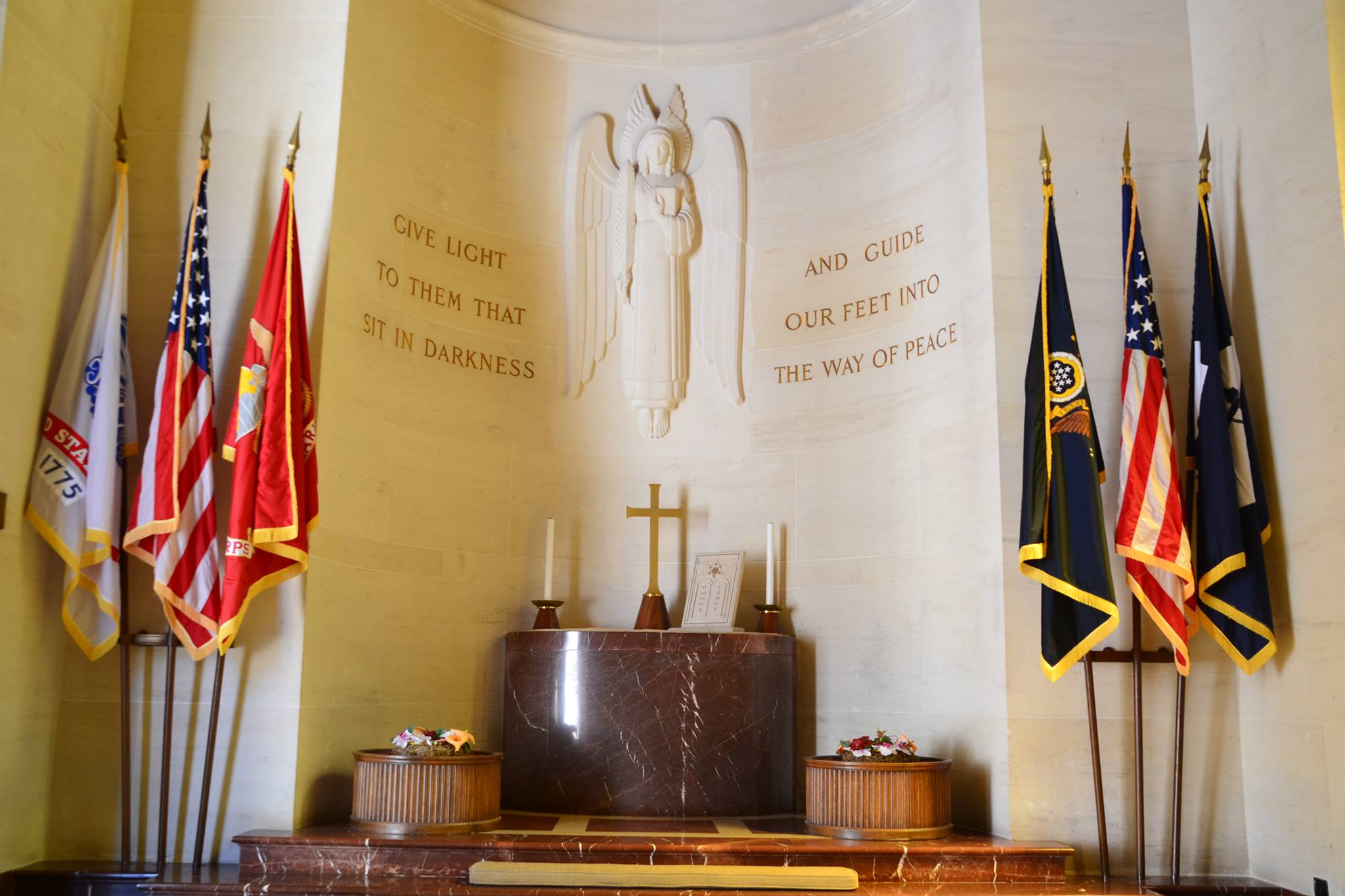


| This set of pictures is from the Epinal American Cemetery in France. |
| At left is the grave of Schuylkill Haven serviceman, George Mitchell, buried at Epinal and at right Rose decorates his grave with American and French flags. |
| The story below was first published here in 2010. Since that time my wife and I have had the pleasure of visiting Maud, Johan and Rose in Holland in 2014 and hosting them at our home in 2016. My son, Rich, and I visited them in 2017. We hope to return to Holland in 2018 to visit them. |
| Through the courtesy of relatives of Gustav "Fred" Anchorstar, I have paperwork detailing the plight he faced during captivity. He was removed from Stalag 9B and taken to the Berga, a sub concentration camp of Buchenwald. The stories below give you a shocking tale of what he and his fellow prisoners faced. |
| THE STORY OF GUSTAV "FRED" ANCHORSTAR, PRISONER OF WAR |
| This first installment is the case of Joseph D'Allessio vs. the Government of the Federal Republic of Germany, filed through the United States Department of Justice. He was one of the prisoners transferred from Stalag 9B to Berga. He was a fellow soldier of Gustav Anchorstar, also sent there. Their stories are the same. |
| PROPOSED DECISION The claim against the Government of the Federal Republic of Germany is for persecution by the National Socialist (Nazi) regime during World war Two. Through its Holocaust Survivors Claims Program, as authorized by Congress, the Foreign Claims Settlement Commission has jurisdiction to receive and determine the validity of claims by nationals of the United States against the Federal Republic of Germany covered by Article 2 (2) of the Agreement Between the Government of the Federal Republic of Germany Concerning Final Benefits to Certain United States Nationals Who Were Victims of National Socialist Measures of Persecution, which entered into force September 19, 1995. Congress has directed the Commission to decide those claims in accordance with "the criteria applied by the Department of State in determining the validity and amount of claims covered by and settled under Article 2 (1) of the Agreement. Based on the State Department's criteria the Commission has determined that prisoners of war (POWs) are eligible for compensation in the Holocaust Survivors Claims Program if they were interned in a concentration camp or sub camp recognized as such in the registry of the International Tracing Service of the International Committee of the Red Cross or listed on the so called "BGB1," roster of concentration camps. According to the claim form and supporting materials submitted to the Commission, claimant served in the U. S. armed forces during the war and was captured and held as a POW at Stalag 9B and at Berga. |
| Their story........... Stalag 9B was reputedly the worst of the Nazi POW camps. Mitchell Bard described the conditions there in Forgotten Victims: The Abandonment of Americans in Hitler's Camps: From 290 to 500 prisoners were jammed into one story wood and tar paper barracks divided into two sections with a washroom in the middle. Facilities consisted of one cold water tap and one latrine hole emptying into an adjacent cesspool that had to be shoveled out every few days. Each half of the barracks contained a stove. Throughout the winter, the fuel ration was two arm loads of wood per stove per day, providing heat for only one hour a day. Bunks, when there were bunks, were triple deckers, arranged in groups of four. 1500 men were sleeping on the cement floors. All barracks were in a state of disrepair; roofs leaked, windows were broken and lighting was either unsatisfactory or lacking completely. Some bunks had mattresses and some barrack floors were covered with straw, which prisoners used instead of toilet paper. The outdoor latrines had forty seats to accommodate the needs of 4,000 men. Every building was infested with bedbugs, fleas, lice and other vermin. A thousand men lacked eating utensils and ate with their hands out of helmets, old tin cans or pails. The meals consisted mainly of sugar beet tops and split pea soup. As many as fifteen men shared a loaf of bread. Breakfast consisted only of tea or coffee that was little more than stained water, which most prisoners used for washing or shaving. The POWs received only one shipment of Red Cross parcels during their imprisonment. The minimum ration an inactive man needs to survive is 1,700 calories and the POWs in Bad Orb received only about 1,400. Between February 8 and April 1, 1945, 32 Americans died of malnutrition and pneumonia. But as bad as Stalag 9B was, it paled in comparison to Berga. Berga, a sub camp of Buchenwald, was established in November 1944. On February 8, 1945, 350 American POWs were deported from Stalag 9B to Berga and assigned to a work detail there. That transport included all the identified Jews from Stalag 9B (approximately 80 men), about 150 others considered undesirables or trouble makers, and an additional 120 men, selected simply because they "looked Jewish," because they had "Jewish sounding names," because they were circumcised or because they were unlucky and were needed to fill the quota. After a five day journey, crammed sixty men to a boxcar (with little food and no provisions for sanitation), the POWs arrived at Berga. Research establishes that for most of their internment, the POWs were quartered in two cramped lice and vermin infested buildings in the same compound where the political prisoners were held. Initially, the 350 POWs were held in prefabricated wooden barracks, about a half hour march from the main Berga compound. They were moved to barracks in the main compound in early March. There were no washing facilities and the latrine was nothing more than a large tub in the bitter cold just outside the barracks door. Few of the men had warm clothes; most had only what they were wearing when they were captured, the same uniforms they had, by then, been wearing for months. And they were forced to subsist on meager rations, ersatz tea which was essentially hot, stained water, in the morning and watery soup made from turnips or beet tops in the evening, sometimes supplemented by sawdust like bread, a pat of margarine or an occasional bit of sausage. Notwithstanding their starvation diet, the POWs at Berga, like the political prisoners, were subjected to forced labor. Most of the POWs were part of the contingent of 3,000 (including political prisoners wearing striped suits and yellow triangles, as well as some German civilian workers) who slaved long hours excavating rocks from mine shafts, to support German construction of an underground factory, backbreaking work even for men in prime physical condition; for many of the half starved POWs it was lethal. Later the POWs were required to haul timber and lay rails. Yet the workers were allowed no breaks and were given no food or water during the workday. Moreover, the POWs were brutally punished for even the most minor "infractions;" they were beaten with rubber hoses, clubbed with rifle butts, jabbed with bayonets and had rocks thrown at them. After only six weeks at Berga, 24 of the American POWs were dead, victims of starvation and overwork, disease and physical abuse. In early April, the remaining POWs at Berga were forced onto a death march away from the rapidly approaching Allied front. Following behind the political prisoners from Berga, the POWs, now mere walking skeletons themselves, were marched from dawn until 10:00 p. m. or midnight every day, down a road spattered with blood and strewn with corpses of political prisoners executed because they were unable to maintain the grueling pace. The POWs were forced to sleep in barns and open fields; once a day they were given a loaf of bread to share among ten men and some weak soup with rotten vegetables. Men dropped like flies along the way. Some escaped en route. The rest were liberated on or about April 27, 1945. Their ordeal had finally come to an end. Of the 350 Americans originally sent to Berga, no more than 280 returned to the United States; and none weighed more than 90 pounds when liberated, many considerably less. At least 36 men died on the forced march. All told, the fatality rate at Berga (including the march) was almost 20%; and the 70+ men who were killed represented approximately 6% of all Americans who perished as POWs during World War Two. The Nazis represented that the POWs sent to Berga were administratively under the jurisdiction of Stalag 9C at Bad Sulza. In fact, the POWs at Berga were under the control of the SS (with support from Wehrmacht and German civilians). The POWs worked along side the political prisoners at Berga; their barracks were located at Berga, adjacent to those of the political prisoners; their food was prepared by the same kitchen and they were fed the same meager rations as the political prisoners. Moreover, both groups were under the supervision of the same so called "employer" at Berga, the SS. The SS controlled construction company in charge of the work at Berga, "Schwalbe 5," was ultimately responsible for both the political prisoners at Berga and the POWs interned there. The Wehrmacht captain nominally in charge of the POWs had no authority to override the orders of the SS. Numerous political prisoners who were held at Berga have described their encounters with the American POWs there, in testimony at the War Crimes trials, in books, and in letters to this Commission, attesting that the POWs were "part of the Berga concentration camp." One political prisoner, who was detailed as a teenager from Buchenwald to Berga while the U. S. POWs were there, has written to this commission. "The only difference between the POWs treatment and ours was that they kept their military uniforms. They were housed at Berga concentration camp separated by a barbed wire fence, worked together with other prisoners to build an underground factory. They received their meager food from our kitchen where I worked. In other words, they were treated just like us and were part of the Berga concentration camp." Another former political prisoner at Berga, Ernest Michel, wrote in his 1993 book, "Promises to Keep," The Americans were working right next to us, forced to do the same hard work. When I tried to speak to some of them in German, some, to my total surprise, replied in Yiddish. They were Jews, American Jews! American Jewish prisoners of war! During our meager lunch break, we learned that they had been captured and taken to a POW camp, where the commandant tried to separate the Jews from the non Jews." Hans Wrede, a former political prisoner at Berga, testified at the War Crimes trials that he saw American POWs at Berga and talked to them. Wrede also testified that all prisoners, POWs and political prisoners alike, were used on the same work and that their treatment was the same. John Marek (a/k/a Hans Munk) stated in his affidavit that American POWs worked along side Berga political prisoners and that he spoke to several of the POWs in Yiddish. It is clear that claimant here was one of the POWs enslaved at the Berga sub camp. Testimony at the War Crimes trial established that, on May 31, 1945, an American officer found a handwritten list in German, of the names of the POWs interned at Berga. That list, in the original German, and in an English translation, was admitted into evidence at the War Crimes trials. Each POW on the list is not only identified by name, but also by other descriptive data, including the POW number at Stalag 9B. Claimant's number is number 290 on this list of Berga prisoners. The file also includes a birth certificate documenting claimant's birth in Roseto, Pennsylvania, on October 7, 1925. In addition, medical records in the file indicate that claimant suffers from irritable colon and post traumatic stress disorder, as well as other medical conditions. Finally claimant has testified he has not previously received compensation from the Federal Republic of Germany for his internment. Based on the evidence in the record, the Commission finds that claimant was interned at Berga, a recognizable sub camp of Buchenwald concentration camp, for more than two months and, as a result of his internment, suffers from the medical conditions listed above. The Commission further finds that claimant was a national of the United States at the time of his persecution, and that he has received no prior compensation from Germany. Accordingly, the Commission concludes that claimant is entitled to an award as compensation for his internment (as set forth immediately above) and for the resulting damage to his health. The Commission finds that the remainder of claimant's internment is beyond the scope of the Holocaust Survivors Claims Program, as defined by Congress and the agreement between the United States and Germany, and thus is not compensable here. The Commission therefore makes the following award, which will be certified to the Secretary of State and the Secretary of the Treasury in accordance with 22 U. S. C. A. 1644c. |
| Next installment; some history, both prewar and post war of the Anchorstar family. |
| This letter was sent to Kurt Anchorstar, nephew of Gustav "Fred" Anchorstar, by Wally Skibinski, one of his fellow soldiers and fellow prisoner of war: Thanks to Kurt for permitting me to share the letter. |
| Dear Kurt, Received your letter of July 1, 2005 and was very much surprised to hear from someone after these many years. Although I am in my eighties, my recollection of serving in the Army with "Red" is still fairly clear. We did call him "Red" in our company. He happened to be one of my best friends in Headquarters Company together with Solly Stolov from Kansas City. We went through basic training at Fort Jackson, S. C. and then proceeded to go on maneuvers in Tennessee. While I was the chauffeur of our company commander, Captain Rodberg, I was temporarily transferred to the Military Police Company when we reached Murfreesboro, Tennessee. I was assigned to chase AWOLs at that time, which took me to most of the states on the East Coast. That did keep me from taking part in the maneuvers until our division was transferred to Camp Atterbury in Indiana. Returning back to our regiment at Camp Atterbury I was assigned once again to Headquarters Company and as the driver for Captain Rodberg. I have in my collection approximately 25 different books on the Battle of the Bulge and most of them bring out the truth about the injustice that was thrown on the 106th Infantry Division. The entire division, which was trained for combat duty on maneuvers, was broken apart. Many of the guys from the 106th who were trained for combat were transferred to different units across the country and we were infiltrated with "wash out" from different branches of the U. S. Army. When our division was brought back up to strength, we were then shipped to the East Coast, where we boarded the Queen Elizabeth to go to Europe. We landed in Southampton, England and then drove all of our equipment to Cheltenham, England where we set up for transport to France and engage in combat duty in Belgium. Please let me interject here some of my own memories of "Red" and Solly Stolov. The three of us were inseparable. We did everything together like the "Three Musketeers." We aways went to town on passes together, went to the same theaters and dance parlors and nightclubs. Although neither one of us danced, we did enjoy some of the best "Big Bands" sounds of orchestras from across the country. At one time, I wrote a letter to my Mom and asked her if I could bring Solly and Red home with on three day passes. At that time I was from Chicago, and of course my Mom wrote back immediately and offered an invitation for Red and Solly to join my family for a weekend. Being Polish you can just imagine the feast that my mother put out for a couple of guys she never knew. And of course the guys were amazed at what my mother did. There was the usual Polish food of Polish sausage and sauerkraut, fried chicken with all the trimming and especially one of here favorites was a salad of cucumbers, onion and mayonnaise. I think that Red, if permitted, would have eaten the whole bowl by himself. Even my Dad got into the act, by serving us the traditional Polish "shot and beer," even though we were underage. But only one and that was it. Polish hospitality plus. I then ran into a friend of mine who was the coordinator for the southeast side of Cook County for the Civilian Defense, Steve Bubacz, and he asked us if we would do him the honor of being the color guard at a block dedication. Of course, we jumped at the idea, and participated in the event and were treated royally by the people. And believe it or not, this is where I first met my wife. How could some G. I.s spot three girls, dressed in shorts and riding their bikes not get noticed by us? This was only one of the three times that Solly and Red came home with me to Chicago. But to get back to the original intent and story of the 106th Infantry Division. Upon arriving in Cheltenham, England, Red and I were assigned to drive the two and a half ton trucks and haul beer from Birmingham to Cheltenham. We did this for about two weeks and then were ordered to Belgium for combat duty. We landed in Rouen, France and then proceeded to drive through France, wildly greeted by the French, on our way to Belgium and eventually headquartered in St. Vith. If you have read any accounts of the 106th, you will remember that it was the coldest winter in forty years. The temperatures varied between 30 and 40 degrees below zero. We were not at all equipped for this kind of weather. I was fortunate enough to be assigned to haul gasoline on my truck for our tank battalion for three days, which incidentally did not arrive, kept warm from the heat of my truck engine. But after a few short days, all hell broke loose, we were completely surrounded by the Germans and had absolutely no way to escape. History will bear out the truth some day, that Eisenhower screwed up and all lines of communication were nonexistent. We heard that our Regimental Commander, Colonel Charles Cavender, a West Point graduate had made numerous attempts to secure air power and or artillery to back us up, but to no avail. I had never witnessed a grown man crying for his troops as I did that morning, when he informed us that we had no other choice but surrender. That will remain in my mind for the rest of my life. He was truly one of the finest men I have ever met. He was indeed a soldier's real commander. I am sure that you have heard about events that happened after our surrender. The march through heavy snow through the Black Forest, Cologne, the horrific train ride through Germany and finally reaching our destination, Stalag IX-B, Bad-Orb, Germany. Upon arrival there was nothing but chaos. The guards were just shoving us around and into our barracks. This is where we were separated with Solly and I in one of the barracks and Red ended up in the barracks next to us. We were told that there were approximately 65,000 prisoners in the camp. Next to us, separated by a barbed wire fence were Russian and Polish soldiers. Being Polish and able to speak it quite well, I made friends with some of the Polish soldiers who were getting more information about the war than we could get. The guard over our barracks could speak very good English. He went to Berlin before the war to study culinary arts and was drafted into the German Army. Believe me when I tell you that he was not a "happy camper." Before coming to Germany, he actually was a chef at the then Stevens Hotel in Chicago, which is now known as the Hilton. He was very good to us and at times would sneak extra bread for us and bring us any new information he could gather about the war. When we were liberated on April 2d, we all signed papers for the American Army not to treat him as a prisoner. Now, about Red being transferred to Berga. Here is the story that I can still recall to the best of my ability. It was in the middle of March that we were all rushed out of our barracks and told that an American was caught in the kitchen trying to steal some food. They made us stand out in the cold for hours and then told us that the G. I. apprehended in the kitchen was shot and killed. At the time we did not know who it was, but after a couple of hours we were told in our barracks that it was Red. I tried with Solly to try and find some proof of that, but could not get out of the barracks for several hours. We ran into Sgt. Walters, and he confirmed that it really was Red who got caught and killed. But then after a couple of hours, we had heard that he was taken from the kitchen alive and sent to another camp. Up until we were liberated, we could not confirm what really happened to him but we did not see him after our liberation. I had spoken to a number of other G. I.s from his barracks and they were convinced he was shot in the kitchen by the German guards. My question was where was he if that really happened because we had buried other American prisoners who died of malnutrition, so why was Red not buried. During that time period, some of the guards were already deserting the German Army, knowing that our liberation was fast approaching. This happened in the middle of March and the 42nd Division liberated us on April 2nd. Surely we thought someone would have the answer but it was not forthcoming. I am very sorry to say but the majority of us thought that Red was shot in the kitchen. I even questioned some of the Polish soldiers I had made friends with, and they were if the conclusion that he was killed in the kitchen and his body removed from the camp. My other questions at the time were, why and where would they take his body? We had discussed this matter even after we were flown out of Germany and into France for hospitalization. I hope that this might shed some light for you, but my memory is not what it used to be. I am very glad that you had contacted me and you can rest assured that while we were together, Red, Solly and I were the very best of friends. I miss them both terribly. Sincerely, Wally Skibinski |
| This letter was sent to Kurt Anchorstar, nephew of Gustav "Fred" Anchorstar, by Joe (illegible), one of his fellow soldiers, fellow prisoner of war, and fellow inmate at Berga concentration camp: Thanks to Kurt for permitting me to share the letter. |
| Dear Kurt Anchorstar, I looked up your address on the map and I see that you are north of Allentown. Your letter to Livingston was forwarded to us at Lakeville, Pa., where we have a summer cottage on Lake Wallenpaupack. My sympathy goes out to anyone connected to an American soldier who wound up in Berga, a sub camp of Buchenwald and a death trap. We worked in a mining operation without enough food to sustain us. Attempts to steal food was common but no one was shot for that. I was also in the 106th Division but I didn't know your uncle then, or as a POW. When I was liberated I weighed 85 pounds, my normal weight at that time was 135 pounds. You didn't actually die of starvation. What happened is that is such a poor state you developed a diphtheria or severe dysentery and that was the cause of death. We were liberated on April 23rd, so your uncle was within a month of getting help. My condolences to your father, Milton Anchorstar, concerning his brother, Fred. The two Nazi noncoms in Berga were prosecuted at Nuremberg and received prison sentences, not very long. We were the worst treated American prisoners of World War Two and Berga atrocities were hidden from the American public for years because the American Army wanted to use the Germans, and not offend them, against the Russians. I may have known Fred Anchorstar by sight. At any rate, if he was at Berga, he is my heartfelt buddy. Best wishes to you and your father. Sincerely, Joe (illegible) |
| The Call of January 12, 1945 LOCAL SOLDIER IS MISSING IN GERMANY PFC Gustav Fred Anchorstar, son of Mr. and Mrs. Milton Anchorstar of 130 west Main Street, is reported missing in action in Germany since December 21, according to a telegram his mother received from the War Department on Wednesday evening. PFC Anchorstar entered the service May 7, 1943 and received his basic training at Camp Shelby, Mississippi, where he qualified for aviation cadet training. He was then transferred to Miami Beach, Florida and then to the Lockbourne airbase in Columbus, Ohio. Later he was transferred to the infantry and sent to Camp Atterbury, Indiana. While there he qualified as an expert rifleman. Prior to entering the service he was employed by the Wright Aeronautical Company at Paterson, New Jersey. He is a graduate of the local high school class of 1942. His father is an aviation ordinance man Second Class Petty Officer in service somewhere in South America and also served in World War One. His mother had not heard from the missing youth for some time until she received a letter on December 27 dated December 12, stating he had just arrived in Belgium, that the channel crossing was very rough, but that he was warm and had plenty to eat and that she should not worry about him. She had received word from him when he was in England. He has a sister, Margaret, attending college at Geneva, New York and a brother, Milton Jr. at home. |
| The Call of March 2, 1945 FRED ANCHORSTAR PRISONER OF WAR PFC G. Frederick Anchorstar, who was reported missing in action on December 21, is now a prisoner of war. The telegram received by his mother stated he is a prisoner of the German government and that information concerning him would be sent later. Before entering the service PFC Anchorstar worked for the Wright Aircraft Company in New Jersey. He is a graduate of the local high school, class of 42. |
| The Call of March 16, 1945 SON CONTACTED THROUGH RED CROSS Mrs. Milton Anchorstar received a letter on Monday from her son, PFC Gustav Fred Anchorstar, who was reported missing in action in Germany since December 21 and was later reported as a German prisoner. He stated that he was well and not wounded and was treated as well as could be expected. He requested cigarettes and anything that would not spoil. Mrs. Anchorstar has been in touch with the Red Cross and is very much enthused about the Red Cross and what it is doing. Through their efforts she will be able to write to her son and send packages. She stated their efforts are untiring and that they get results very quickly and that they are doing almost impossible jobs very well. |
| The Call of July 20, 1945 G. FREDERICK ANCHORSTAR DIED IN GERMAN CAMP PFC Gustav Frederick Anchorstar, son of AOM 1/C and Mrs. Milton Anchorstar of 130 West Main Street, who had been a prisoner of the German government, died in prison camp on March 30 according to word received from the War Department. Later a letter was received from Brigadier General Edward F. Witsill, acting adjutant general, giving further information. The letter follows: "It is with deep regret that I am writing to confirm the recent telegram informing you of the death of your son. He was reported a prisoner of the German government. It has now been established from reports received in the War Department that he died on 30 March 1945 in Berga, Germany as a result of malnutrition. I know the sorrow this message has brought you and it is my hope that in time the knowledge of his heroic sacrifice in the service of his country may be of sustaining comfort to you." PFC Anchorstar was taken prisoner by the Germans during the Belgium breakthrough last December. He was first reported missing in action and on March 1 word was received he was a prisoner. The family received only one letter from their son while he was in a prison camp and he said he was not wounded and was being treated as well as could be expected. Since the capitulation of the German government, the parents expressed anxiety because no further word was received about him. An inquiry was sent to Congressman Ivor D. Fenton to seek his aid for further information and the word they received was through his efforts. PFC Anchorstar was a member of the 106th Infantry Division. His father, who is serving in the Navy, was overseas for 19 months and at present is stationed at Pensacola, Florida. He is now home on leave. PFC Anchorstar was known to be held a prisoner at Stalag 9B. |
| The Call of November 2, 1945 ANCHORSTARS GET WORD OF SON Mr. and Mrs. Milton Anchorstar have received a letter from James L. Prenn, Major, QMC assistant, giving the following information concerning their son PFC Gustave F. Anchorstar. "The official report of burial shows that the remains of your son were originally interred in an isolated grave but were later disinterred and moved to a more suitable site where constant care of the grave can be assured by our forces in the field. The remains of your son are now interred in the United states Military Cemetery in Margraten, Holland, Plot DD, Row 9, Grave 210. The cemetery is located approximately twelve miles northwest of Aachen, Germany and eight miles southeast of Maastricht, Holland.". They were told that the Adjutant General at Washington would inform them concerning the circumstances surrounding the death of their son and the Army he was with. |
| The Call of November 24, 1944 MILTON ANCHORSTAR GETS WRITE UP Milton Anchorstar, AOM 2/C, of town, who is serving in South America, was the subject of a special feature written by "The Roving Reporter" at his present location south of the border. The write up was sent to Mrs. Anchorstar by Tank Wilk, AOM 1/C, one of Milt's close friends who has been with him for seventeen months. It is as follows: SERVICE MAN OF THE WEEK Milton (Pop) Anchorstar, AOM 2/C, of Pennsylvania, has been unanimously voted the Service Man of The Week. Pop, the fighting ex-Marine fought in World War One during his four years in the Marine Corps (1918-1922). He enlisted at the age of 16 and long before he attained full manhood, he traveled on foreign soil. England, France, Italy, Russia and Africa have all passed beneath his feet. But Pop being a man with adventure in his blood wasn't satisfied with seeing only a part of the world, so when World War Two broke out, Pop, although a man of 40, enlisted in the Navy. Up to date he's realized only a small part of his worldwide travel, his visit and duty in South America was only the beginning of still unvisited countries. Now his greatest ambition is to go to China, India or some part of the Pacific. Pop is a man of very many talents, a sort of jack of all trades. He also possesses a fine imagination and during his spare time has given the shop several time saving ideas that also make work a great deal easier. His best idea which he contributed is the hydraulic bomb hoist for PV's. It's really a worthy gadget and Pop should receive a great vote of thanks for this achievement. I'm sure the boys in A. S. G. 145 really appreciate your work Pop. To the younger fellows Pop is an "Information Please" and "Mr. Anthony" all rolled into one. They approach him with all kinds of problems and questions. Girl troubles, marriage troubles, baby questions or what have you, and Pop is right there always willing to give his helpful advice, acquired through years of experience. Incidentally of you ever get an opportunity to catch him in the barracks, you will witness Pop in one of his reminiscing moods. You'll find him standing before a mirror, running a comb through an imaginary mop of hair. Oh, yes, Pop has had hair at one time during his life. If you doubt it, ask him to show you a picture that he carries around for proof. Too young for the last war, to old for this one, and yet he's been in both. Hats off to a real fighting man, a proud father of three children and a very good egg. |
| This group of newspaper stories chronicles the experience of the family of Gustav "Fred" Anchorstar as they seek to find out his status and the eventual sad ending. The story of his father, who served in both World Wars is also told through a newspaper account. |
| Excerpts from "The Soldiers of Berga" by Mitchell G. Bard In 1945, more than 4,000 American GIs were imprisoned at Stalag IX-B at Bad Orb, approximately thirty miles northwest of Frankfurt-on-Main. One day the commandant had prisoners assembled in a field. All Jews were ordered to take one step forward. Word ran through the ranks not to move. The non-Jews told their Jewish comrades they would stand with them. The commandant said the Jews would have until six the next morning to identify themselves. The prisoners were told, moreover, that any Jews in the barracks after twenty four hours would be shot, as would anyone trying to hide or protect them. American Jewish soldiers had to decide what to do. All had gone into battle with dog tags bearing an "H" for Hebrew. Some had disposed of their IDs when they were captured and others decided to do so after the commandant's threat. Approximately 130 Jews ultimately came forward. They were segregated and placed in a separate barracks. Some fifty noncommissioned officers from the group were taken out of the camp, along with the non-Jewish NCOs. The Germans had a quota of 350 for a special detail. All the remaining Jews were taken along with prisoners considered troublemakers, those they thought were Jewish and others chosen at random. This group left Bad Orb on February 8. They were placed in trains under conditions similar to those faced by European Jews deported to concentration camps. Five days later, the POWs arrived in Berga, a quaint German town of 7,000 people on the Elster River, whose concentration camps appear on few World War Two maps. Conditions at Stalag IX-B were the worst of any POW camp but they were recalled fondly by the Americans transferred to Berga, who discovered the main purpose for their imprisonment was to serve as slave laborers. Each day, the men trudged approximately two miles through the snow to a mountainside in which seventeen mine shafts were dug a hundred feet apart. There, under the direction of brutal civilian overseers, the Americans were required to help the Nazis build an underground armament factory. The men worked in shafts as deep as 150 feet that were so dusty it was impossible to see more than a few feet in front of you. The Germans would blast the slate loose with dynamite and then, before the dust settled, the prisoners would go down to break up the rock so that it could be shoveled into mining cars. The men did what they could to sustain each other. "You kept each other warm at night by huddling together," said Daniel Steckler. "We maintained each other;s welfare by sharing body heat, by sharing paper thin blankets that were given to us, by sharing the soup, by sharing the bread, by sharing everything." "Surviving was all you thought about," Winfield Rosenberg agreed. "You were so worn down, you didn't even think of all the death that was around you." He said his faith sustained him. "I knew I'd go to heaven if I died, because I was already in hell." On April 4, 1945 the commandant received an order to evacuate Berga. This was but the end of a chapter of the Americans' ordeal. The human skeletons who survived found no cause to rejoice in this flight form hell. They were leaving friends behind and returning to the unknown. Fewer than 300 men survived the fifty days they had spent at Berga. Over the next two and a half weeks, before the survivors were liberated, at least thirty six more GIs died on a march to avoid the approaching Allied armies. The fatality rate in Berga, including the march, was the highest of any camp where American POWs were held, nearly twenty percent, and the 70-73 men who were killed represented approximately six percent of all Americans who perished as POWs during World War Two. This was not the only case where American Jewish soldiers were segregated or otherwise mistreated, but it was the most dramatic. The U. S. government never publicly acknowledged they were mistreated. In fact, one survivor was told he should go to a psychiatrist. Officials at the VA told him he had made up the whole story. Two of the Nazis responsible for the murder and mistreatment of American soldiers were tried. They were found guilty and sentenced to hang, despite the fact that none of the survivors testified at the trial. Later, the case was reviewed and the verdicts upheld. Nevertheless, five years after being tried, the Chief of the war Crimes Branch unilaterally decided the evidence was insufficient to sustain the charges and commuted the sentences to time served, about six years. |
| From The Call of June 12, 1980 TRIBUTE TO A GOLD STAR MOTHER In reflecting on past Memorial Days, the Reverend Timothy Dewald, former resident of Schuylkill Haven, now pastor of Hill United Church of Christ in Cleona, wrote the following tribute to th elate Edna Anchorstar, a Gold Star mother. MRS. ANCHORSTAR DIED THIS SPRING Mrs. Anchorstar died this spring. I know that may not mean much to you, but somehow it does to me. I didn't know her, that is. I never met her, but I do think of her, especially at this time of year. Dad called long distance to tell me the news. We usually call each other Sunday after church. He tells me the latest about the family and, once in a while, what is going on in town. Toward the end of the conversation, he told me, "Oh, Mrs. Anchorstar died," and I knew what he meant. An era had passed, a time had gone by. Since I was a boy, I had watched the parades pass on Memorial Day. In every one of them, Mrs. Anchorstar had ridden by. My dad would always point her out and explain to me just who she was. Then it came my turn to march in the parades and I would see Mrs. Anchorstar riding ahead of us in the big limousine. Sometimes she would turn her head and I could see her face. I could see her thoughts were not here but far away in another time. You see, Mrs. Anchorstar lost a son in World war Two and she loved him very much. Now Mrs. Anchorstar is gone too. She no longer rides as a Gold Star mother with that pained smile. The parade goes on, however, much the same as it always has. It forms on Haven Street and travels down Dock Street. It reaches its crest on Main Street. Parents waved unashamedly at their children marching in the parade - the glamorous cheerleaders, the beautiful majorettes, the strutting band, the shy Brownies, the embarrassed Girl Scouts and the serious Explorers. But Mrs. Anchorstar dies this spring and somehow that parade means something else to me. |
| The Call of July 25, 1941 COLLECTION OF OLD ALUMINUM TO BE MADE ON MONDAY The nationwide collection of old aluminum for use in national defense will be conducted in Schuylkill Haven on Monday evening, beginning at six o'clock. The local aluminum campaign is under the direction of Chief Burgess Roy A. Scott, who is chairman of the local Defense Committee. Trucks will assemble at Town Hall before six o'clock and the systematic collection will begin from there. The door to door canvass in all parts of town will be made by Boy Scouts in uniform under the direction of the scoutmasters of the Schuylkill Haven troops. The drive is for old aluminum in any form; pots, pans, cooking pots, roasters, percolators or other miscellaneous kitchen or household utensils, that are not necessary. Local people are not asked to give any utensil that would have to be replaced by purchasing a new article. Only those items which are not in use or for which another not in use may be substituted, are wanted by the government. Instructions for the disposal of the aluminum after it has been collected will be made known by the Office of Production management. So far the instructions have not been received by Chief Burgess Scott but are expected within the next few days. |
| The Call of December 12, 1941 SUDDEN JAPANESE ATTACK DAMPENS CHRISTMAS SPIRIT A week ago Schuylkill Haven was busy preparing for the Christmas season. The biggest problem of the moment in addition to the annual hassle with the Christmas present question, was how the town was going to raise $35,000 to save the Miller Shoe Company. On Saturday night, children who had been through the stores and perhaps had seen Santa Claus, and mothers and fathers who had the added weight of Christmas savings Club money in their pockets and a lightness of heart caused by the knowledge that they had bought or were planning to buy gifts which would bring joy on Christmas Day, went to sleep with a smile of serenity and peacefulness upon their faces. On Sunday night, these same children, mothers and fathers did not drop off to sleep with that same smile. In its place was a ghastly war, a fear of war which they knew was inevitable, for on Sunday afternoon the radio conveyed the news to them that Japan had struck the Pacific Island possessions of the United States. Japan struck first and declared war afterwards. No one doubted what Monday would bring. Events occurred rapidly. On Monday the president addressed Congress. Congress declared war on Japan. Tuesday and Wednesday battles raged in the Pacific with japan having the advantage of her surprise attack. On Thursday Italy and Germany declared war on the United States. Thursday afternoon President Roosevelt sent a message to Congress and Congress declared war on Italy and Germany. On Wednesday, parents of boys in the armed forces in the Hawaiian and Philippine Islands received word of those who had first made "the supreme sacrifice for their country on the field of battle." Two county boys were among the first to give their lives, one from Mahanoy City and another from Tower City. No longer do the problems of Christmas buying and the Miller Shoe Company hold the upper interest. Youngsters in their way to school do not talk of the Christmas presents they have discovered or of those they expect to get on Christmas day. They talk about the bombs that will be dropped from the sky. They talk about how the United States will knock the stuffings out if Japan and Germany and Italy. For grownups, the involvement of the United States in the war has taken the joy from the approaching Christmas season. They realize there is more to war than dropping bombs and knocking the stuffing out of the other side. They see the war in the light of suffering, sacrifice and tears. Some of our local people have at this time visualization of the fruits of the war work into a state of near hysteria. We hear reports of persons who make wild statements about what should be done to protect Schuylkill Haven from bombers. Others, who have been listening to war reports all night and early morning have become jittery and on edge. A sudden noise causes them to jump. Admittedly, war is a terrible thing. But to let the thoughts of war bring us to a breakdown is foolish. Instead, let us give all our efforts, our best efforts to doing our work and to aiding in any way that we can in the defense measures of our nation. The local Council of Defense, with Roy A. Scott Sr., as chairman, will meet Monday evening. Instructions will be given the chairman by the state council and he will hand them down to his council, who in turn may call upon local citizens to aid in defense preparations. The American Legion is seeking volunteers to man the two aerial observation points in the vicinity of Schuylkill Haven. Shifts on the posts will be changed every three hours for the entire 24 hours of each day. The posts are located on the Lutz brothers farm below the Reedsville church and the Al Riegle farm below Landingville. Any persons, men or women, interested in aiding should get in touch with Ed Mengle or R. R. Sterner. A fine turnout greeted the organizers of the home nursing classes for women of town. When plans were made to hold the classes, the women in charge prepared to teach a class of about twenty. War came just before the meeting on Tuesday night and more than seventy women of the community came to receive training in nursing. This was a splendid showing. If Schuylkill Haven and the thousands of other communities in this country support as well every defense measure or duty presented by local, state or federal officials, and give their best in their daily work, the United States will be given powerful support in their war against the Axis. |
| The Call of January 30, 1942 WORKERS GIVE PORTION OF PAY FOR DEFENSE The employees of the Alpha Mills gave their support to Uncle Sam this week by generously pledging $192.50 every two weeks for the purchase of Defense Stamps for the duration of the war. The amount this week totaled $210.25 through the purchase of a defense bind by one of the employees. This splendid gesture of support of the government's defense measures was given by almost ninety percent of the employees. Of the 142 employees, 126 agreed to set aside a part of each two weeks pay for the purchase of Defense Stamps. At the present time the Alpha Mill is operating twenty four hours with three eight hour shifts, manufacturing T-shirts, sweaters and children's creepers. The purchase of Defense Stamps by Alpha Mill employees, mostly girls, brings the number of industries with a standing order for stamps to five. Other manufacturing companies already buying regularly are the Alberta Mill, Manbeck's, Schuylkill Haven Casket Company and the Ethel Maid Burial Supply. The newsboys of town, who had been selling $40 and $50 in stamps to their customers each week, placed an order for $75 worth last week. In addition to patriotic response by these individuals, others have been buying stamps and bonds individually at the post office and the local banks. Several of the other factories and business places in town are panning on following the procedure of the above mentioned factories in setting aside a part of each pay for the purchase of "democracy." |
| The Call of April 10, 1942 PRACTICE BLACKOUT TO TAKE PLACE THIS EVENING AT 6:15; LISTEN FOR RAID ALARM In preparation for the county wide blackout to be held on Sunday night, Schuylkill Haven will conduct a practice blackout tonight from 6:15 to 6:30 o'clock. The signal for the blackout will be four blasts on the fire siren. The all clear signal, one long blast, will be sounded fifteen minutes later. Chairman Scott of the local council of defense, announced that the purpose of the practice blackout tonight will be to find the weak points in the preparations that have been made and to have them corrected before the actual blackout in Sunday evening. Stress will be placed upon the procedure of the air raid wardens, the police, firemen and the other units of the defense setup rather than on having all lights turned out. For this reason, the practice is being held in the daylight hours. Motor police in a white patrol car will be present to observe the efficiency of the procedure. Plans this evening call for a demonstration of first aid and communication. The communication setup under William V. Young will have headquarters at the P & R station, from which point Boy Scouts will be dispatched with messages. The first Scouts sent will be instructed to fall and pretend injuries at designated spots in town. Second Scouts, following a short distance behind, will take the message of the injured messenger and continue with the delivery, leaving the injured Scout for the first aid crews which will follow. The first aid crews will care for the wounded messenger and take him to one of the "hospitals" which will be established in the East and South Ward buildings. There, the medical branch of the defense setup will give treatment of the wounded men. Air raid wardens, as soon as the air raid signal is given, will instruct all pedestrians to go indoors, and see that all motorists pull to the curb and go indoors. Any violators of this defense ruling will be reported to the chief of police. |
| IVAN PHILLIPS, A SCHUYLKILL HAVEN SOLDIER WHO MADE THE ULTIMATE SACRIFICE HIS LIFE IN PICTURES |
| Ivan Phillips was a typical young man, born and raised in Schuylkill Haven, graduating with the Class of 1943. He became a paratrooper during the war, being inducted into the Army just after graduation. He was killed in action during the Normandy Invasion in June 1944. His great nephew, Cody Jauss, has shared these pictures, which I believe makes the loss more poignant and personal. |


| With his sister, Phyllis |
| Ivan's graduation picture |
| Wearing his varsity sweater |
| In his paratrooper's uniform and his parachute school certificate |
| Ivan's Purple Heart |


| https://www.youtube.com/watch?v=nAtp-zUcncU |

| At left is Ivan's sister, Phyllis Brace and his great nephew, Ryan Youse, visiting the grave of Ivan Phillips at the Normandy American Cemetery in France where he rests. At right is a link to a wonderful video tribute, made for Ivan Phillips by Cody Youse, another great nephew. |
| LAST UPDATED: OCTOBER 29 |
| The Call of May 31, 1946 LT. ARLIN BUBECK, MARINE, AWARDED BRONZE STAR Second Lieutenant Arlin E. Bubeck, USMCR, 110 East Main Street, Schuylkill Haven, was awarded the Bronze Star Medal for heroism at Okinawa last Friday. The medal was presented to Bubeck, who is now on inactive duty, by Lieutenant Colonel William H. Lee, USMC, at a Marine review held at the Philadelphia Naval Base. Award of the medal was for his outstanding leadership in advancing his platoon despite a bad wound and in the face of enemy rifle and machine gun fire. Lieutenant Bubeck graduated from Muhlenberg College where he participated in track and swimming. He is now a graduate student at the University of Pennsylvania. In the occupation of Okinawa, he was twice wounded and in addition to the Purple Heart he was awarded the Presidential Unit Citation. He is married to the former Mary Ellen Taylor of Schuylkill Haven and his parents are Mr. and Mrs. Percy E. Bubeck, also of Schuylkill Haven. Lieutenant Bubeck has a daughter, Ellen Louise. The citation, signed by Major General D. Peck, USMC, reads: "For heroic achievement in connection with operations against the enemy while serving with the Marine infantry battalion on Okinawa, Ryukyu at a zone of action that necessitated an advance across a plateau swept by machine gun and rifle fire, to assist the advance of adjacent units, Lieutenant Bubeck, as platoon commander of a rifle platoon, by outstanding leadership and superb use of poor terrain, maneuvered his men into position. Despite a bad wound, he reorganized his men and strengthened positions before relinquishing command and returning to the aid station. Lieutenenat Bubeck's initiative and courageous leadership contributed greatly to the success of his unit and were keeping with the highest traditions of the United States Naval Service." Those present at the presentation were his wife and daughter, his mother, Mrs. Percy Bubeck, Eugene Bubeck, Mrs. Herbert Stump and Mrs. Glenn Whitfield of town and a roommate at the university, John Jacobs of Orwigsburg. |

| The Call of February 28, 1947 HONORED AT MEMORIAL CEREMONY - Body Of Charles Hand Removed To American Soil The following letter was received by John Hand, Headquarters Antilles department, concerning a memorial ceremony solemnizing the disinterment of the twelve United States war dead and their removal to United States soil, among of whom was Charles B. Hand, son of John Hand of 24 Charles Street and the late Mrs. Hand. Mr. Hand was a member of the National Guard and was killed in an accident while on maneuvers on May 25, 1942 in Curacao, West Indies. He was 20 years of age at the time of this fatal accident. The letter is as follows: Dear Mr. Hand, On the 6th of February, 1947, the United States Forces withdrew from the Dutch Islands of Curacao and Aruba. This withdrawal included a memorial ceremony, conducted primarily by the Netherlands Armed Forces and civilian organizations, solemnizing the disinterment of the twelve United States War dead and their removal to United States soil. The ceremony started about 11:45, local time, and consisted of a funeral cortege which started on the far side of the Willemstad harbor, proceeded across the swinging pontoon bridge and closed in the courtyard to the west of the Government House. From there the flag draped caskets bearing the disinterred United States dead were removed motor transports and borne by Dutch Army and Naval pall bearers to a black barge moored to an adjacent wharf. The caskets were banked with floral wreaths. A benediction was then spoken by a United States Army Chaplain, volleys were fired by a Dutch firing squad, and taps played by a United States Army man. The barge then moved into the harbor, concluding the ceremonies. The bodies were subsequently were removed from the barge and placed aboard the USAT Round Splice for transfer to San Juan, Puerto Rico. Private Charles B. Hand, 20329957, was one of those whose remains were moved from Curacao to San Juan, Puerto Rico, in order that he, as one of America's honored dead may rest ion American soil. I sincerely regret that it was impossible to have had you present with us for this beautiful memorial service. Pictures were taken of the funeral cortege and they are now being printed. As soon as these are available we will send a set to you. William W. Bessel Jr., Brig. Gen. U S Army |
| The Call of April 23, 1948 PAINTING BY A FORMER GERMAN PRISONER OF WAR IN THE CALL WINDOW On display in The Call window is a picture painted by a German prisoner of war while at Indiantown Gap and presented to Leroy Mauger of 14 Saint John Street as a Christmas present two years ago. The picture was painted by Hans Schultz, a young man in his early twenties while in the prisoner's stockade at Indiantown Gap. Mauger made his acquaintance and slipped him cigarettes. When he learned the young man painted, he secured a set of water colors and other supplies and gave them to Schultz to help pass away the time. He was pleasantly surprised the following Christmas to receive the painting as a gift from the artist. The painting, done entirely from memory, is of the old school in Danzig attended by the prisoner of war in his happier days. Most of the city, including the building, was destroyed in the war. In a letter to Mauger, the first communication he has had from the young German since he left Indiantown Gap two years ago, Schultz states that he wants to return for a visit when he can and to see the painting again. He regards it as something holy because it is of his beloved home to which he can never return again. He writes, "Two years have passed since we met and almost all of that time I was a POW in England. For four months now I am home again with my dear parents and sister. We are getting along as good as we can under the present conditions. We just have to fight our way through. As I mentioned already I often have thought about the wonderful time I spent in the states and I remember you so well and see how you were making yourself at home and drinking your cup of coffee. And each time you presented a cigarette to all of us. How nice was that. Do you still have the picture I painted for you dear Philip? If I return to the states I shall come over to you and pay you a visit and I surely want to see that painting again. It is something holy to me as it was my old beloved home country into which I can't return anymore. The souvenir you handed to me (an ash tray and cigarette container) was brought home by me. I had many troubles with it but I was always able to recover it somehow. The British were especially after it. Now it decorates one corner of my writing desk and it reminds me all the time of you. It is not used for its specific purpose but it is a container for little necessities like pens and rubber. Tobacco and cigarettes are nothing but just words to us, which we remember from the good old days. "It is too bad that I am not able to write as I would like to. If you would be here only fourteen days and would have to exist on our rations, all you people over there would be ripe for a mass burial. I am really surprised that I am alive yet. My father is feeling very bad since yesterday again, and he got the final touch when he was in Russia as a POW. Since then he doesn't feel well anymore and it is a small wonder at our small food rations. You should really see how I am looking now. The wind is blowing through my ribs. I really should like to ask you dear Philip for a little care package but I don't know whether your finances are permitting it. Maybe you are feeling bad about it when I am asking you for that so suddenly. But I can't help it, Philip, the distress over here forces me to act like that. So I thought I might try it and you must look at it that way. Please press your thumbs that I am permitted to come over there and then we won't have to write anymore. I'll start a new life over there then." Before the letter, which was typewritten in English, was mailed, he wrote on it in German that his father had died two days later. He is now living in Wilhelmshaven, in the English zone of Germany. |
| The Call of June 4, 1948 ROEDER TO REST IN ARLINGTON PFC Eugene P. Roeder, 20, son of Mr. and Mrs. Rufus Roeder of 483 West Columbia Street, Schuylkill Haven, will be laid to rest in Arlington National Cemetery. The deceased was killed in action on Luzon on January 15, 1945. An infantry soldier, he was inducted June 4, 1943, trained at Camp Wheeler, Georgia, and after a short leave he was sent to Fort Ord in California where he lefty for overseas on November 14, 1943 being stationed at New Caledonia, New Zealand, Australia and New Guinea before Luzon. A 1943 graduate of the Schuylkill Haven high school, he was a member of Christ Lutheran Church. Surviving are his parents, a brother, Merlin, and two sisters, Mildred, wife of Wilbert Newcomer and Lorraine, all of town. |
| The Call of January 21, 1949 BODY OF ROBERT IMBODEN IS BEING RETURNED The body of PFC Robert E. Imboden, son of Ira and the late Jennie G. Imboden of 22 Center Avenue, is one of the 163 Pennsylvanians enroute to this country from the Pacific area aboard the United Sates Army Transport Sergeant Jack J. Pendleton. He was killed in action on Okinawa on May 12, 1945. PFC Imboden enlisted in the Marine Corps on September 10, 1943 and trained at Parris Island, South Carolina and Camp Pendleton, California. He went overseas in July of 1944 where he was a member of an amphibian tractor unit. During the invasion of Peleliu, he was wounded in action for which he received the Purple Heart. He landed on Okinawa on Easter Day in 1945 and was killed when bomb fragments from Japanese planes penetrated the hut in which he and several other Marines had taken refuge. Prior to his enlistment he was employed at Kimmel's grocery store, he attended the local high school and was a member of the First Evangelical and Reformed Church. Surviving in addition to his father are his sister, Mrs. Russell Brown of town, and three brothers, Lawrence, a member of the high school faculty of town, Walter of Reading and Stanley of Buffalo, New York. |
| The Call of July 2, 1948 BODY OF RICHARD DIETRICH RETURNED HOME The body of World War Two soldier Sergeant Richard Dietrich of Schuylkill Haven will reach New York in the near future, one of many including other county soldiers. His remains will arrive in town on Friday. Sergeant Richard R. Dietrich, son of Robert F. Dietrich of 2310 Center Avenue and the late Mrs. Edna (Bohr) Dietrich, was killed in action on May 29, 1944 in Surrey, England at the age of 25 years. He was a turret gunner and the plane was completely demolished while practicing very dangerous flying. He entered the service in July of 1943 and trained at Shreveport, Louisiana and Florida. He went overseas to Africa in February of 1943. He participated in many campaigns before being stationed in England. Prior to entering the service he had been employed in a shipyard in New Jersey. He was graduated from the Pottsville high school in 1936 as a four letter man and was a member of Trinity Episcopal Church, Pottsville. Surviving are his father, his stepmother, and two brothers, Walter of Woodbury, New Jersey and Bobby at home. Funeral services will be held on Saturday from the D. M. Bittle Funeral Home at the convenience of the family. The Reverend Cyril Stone, pastor of the Episcopal Church in Pottsville will officiate and burial will be made in the Union Cemetery. |
| The Call of July 2, 1948 BODY OF HARVEY HEFFNER RETURNS HOME The body of Private Harvey G. Heffner, 19, son of Harvey Heffner of East Liberty Street in Schuylkill Haven will return home in the very near future as the government continues to repatriate those who gave their lives overseas. Private Heffner was killed in action in France on September 20, 1944. He entered the service on June 5, 1943 and trained at Camp Meade, Maryland. Prior to participating in the invasion of Europe he served in Ireland. A native of Friedensburg, he =graduated from Cressona high school in 1943 and was a member of the Friedensburg Evangelical Church. He is survived by his father, a brother, Harold of Auburn; and five sisters, Mrs. Joseph H. Manbeck and Mrs. Charles L. Croneberger of Schuylkill Haven; Mrs. Harry Stewart of Harrison, New Jersey; Mrs. Lybrandt Mease and Mrs. Nathan Butz of Auburn. |
| The Call of July 9, 1948 BODY OF BERGER TO ARRIVE MONDAY The body of PFC Donald Berger, 26, son of Mr. and Mrs. Warren Berger of 107 Parkway, who was killed in action on Sicily on July 16, 1943, will arrive in Schuylkill Haven on Monday at 1:20 p. m. PFC Berger was an infantryman and participated in the entire North Africa campaign. He entered the service in January of 1942 and went overseas in August of the same year. His basic training was received at Camp Wheeler, Georgia, Camp Blanding, Florida and Fort Benning, Georgia and Indiantown Gap. He then left for England and later for North Africa and took part in the African invasion. He landed on Sicily on July 11. He was a graduate of the class of 1935 of the Schuylkill Haven high school. He was a member of the Saint John's Evangelical and Reformed Church and had been employed at Walk In Shoe Company prior to entering the service. Surviving are his parents, two brothers, Marlin of Schuylkill haven and Orville of Philadelphia; his grandmother, Mrs. Annie Felty of Pine Grove R. D. and his grandfather, Milton Berger of Schuylkill Haven. Military funeral services will be held from the D. M. Bittle Funeral Home on Saturday, July 31st at 1:30 p. m. Interment will be made in the Union Cemetery. |
| The Call of April 15, 1949 BODY OF LEON LINS RETURNING HOME The body of Technical Sergeant Leon E. Lins, 34, son of Francis and Laura Schappell Lins of 629 Leonard Street and wife of the former Arlene Reed of town, is enroute to Schuylkill Haven. Technical Sergeant Lins was in a B-24 when it crashed at Matsuyana Airfield in Formosa. He was the only one identified of a crew of eleven men. His remains were buried there at the airfield and later reinterred at Shanghai in China. His body was then sent to Hawaii and place in a mausoleum at Schofield Barracks and upon its arrival here will be buried in the Greenwood Cemetery in Hamburg. A military funeral will be held. He was born in Hamburg and attended the Schuylkill Haven high school. He had been an outstanding baseball player while living here. Also surviving is a son, Leon Francis Lins. |

| The Call of May 8, 1942 FURNITURE DONATIONS SHOULD BE SENT TO MECK FACTORY Donations of furniture, games, books and other forms of entertainment and recreation room equipment to be used in furnishing recreation halls at Indiantown Gap for the soldiers will be accepted at the Meck factory building on Main Street on Monday, Tuesday and Wednesday from 7:00 a. m. until 5:00 p. m. The articles are being secured by the Red Cross through the efforts of Mrs. Melvin Bamford in Schuylkill haven and by other chairmen in the towns in the Southern Schuylkill Chapter of the Red Cross. Among the articles desired are: books, book cases, card tables, writing tables, small tables, chairs (not stuffed), settees, lamps, ping pong tables, pool tables, games, radios, Victrolas with records, ashtrays, metal ash stands and any other odds and ends that could be used in a recreation room. Any large pieces of furniture which cannot be taken to the collection place will be picked up by truck if the persons contributing the articles telephone The Call, number 2, or Mrs. Bamford, number 366. After the articles donated by local citizens have been brought to the Meck building, they will be sorted and sent to Indiantown Gap by truck. |
| The Call of February 26, 1943 RIVALRY DEVELOPS IN SILK DRIVE Considerable rivalry developed the [past week between the Girl Scouts of Troops 1 and 2 along with 3 and 4. To Lenore Althouse goes first honors thus far in collecting 1541 stockings. She belongs to Troop 1. Mary Jane Evans from Troop 3 has collected a total of 1043 stockings. In the window of Gordon D. Reed's insurance office is displayed prizes which will be given to the five highest Girl Scouts belonging to either Troop 1 and 2 and five to the highest in Troop 3 and 4. The prizes thus far have been donated by the following: Price the Jeweler, Mayor Paul Haldeman, Bonnie Jean Shoppe, the Rose Shop, The Call, Rio Theatre and two Lions Club members. |
| The Call of February 26, 1943 LIBERTY HOSE COMPANY DEDICATES HONOR ROLL An honor roll was dedicated on Sunday by the members of the Liberty Hose Company, Schuylkill Haven, honoring their members who are serving in the armed forces. Honorable Judge G. E. Gangloff and Honorable Judge Vincent Dalton, Chief Burgess Paul Haldeman and Reverend F. D. Eyster participated in the service. The high school band under the direction of Professor Unger rendered several musical selections prior to the beginning of the service. A service flag with twenty four stars was unfurled during which time the band played the national Anthem. The program was closed by the band playing America. The honor roll is the first one of the present war to be displayed ion this and surrounding communities and shows the thoughtfulness and loyalty to its members in the armed forces from the members of the Liberty Hose Company. Each speaker stressed this fact and brought out very strongly the fact that those on the home front are not doing nearly enough and not sacrificing enough when our boys and girls in the service are giving their all, their very life if necessary that we may remain a free country. They asked that all pledge themselves now to buy more bonds and stamps, save more scrap, cooperate wholeheartedly with the ration board and in all rationed items and do everything in their power to hasten the day when the war will end and all may again live peacefully with our loved ones by our side. |
| The Call of March 19, 1943 MORE GROUND FOR GARDENS Additional land has been made available to the Lions Club committee as use for Victory Gardens by the people of Schuylkill Haven. The Rowland plot of ground extending from Haven Street to Grant Street will be under the personal direction of Harry A. Moyer, who is proportioning the various plots to the applicants as they seek garden plots. The second large plot given in the past week is located in the Edge wood section and was donated by Mrs. Joseph Fisher of Huntingdon. As the applicants receive their plots for their Victory Garden, they will be staked off so that each gardener will know where their lot is located. Though the weather will not allow plowing for several weeks, it is not too soon to put in your bid. Once that is done your gardening prospects are assured. You still have plenty of time before the planting season begins and applications can be made to any member of the Lions Club Garden Committee or phone 700 for your plot. |

| The Call of April 23, 1943 FACTORY SECURES GOVERNMENT CONTRACT FOR PARACHUTES parachutes and Navy shirts are now being manufactured by the Lebanon Knitting Mills, located in the Coldren Building in Schuylkill Haven. An additional 125 workers will be needed for the parachute section and when the working force is complete, the factory will employ around 500 employees. The present plants in Lebanon and Schuylkill Haven employ approximately 800 workers. Prior to the war the factory produced ladies slips and underwear. The Lebanon Knitting Mills is justly proud of its war record for the Navy and recently completed an important contract with the Ordnance Department. Mr. Joseph Asner, the manager, stated the workers take pride in being able to deliver the goods to our armed forces. The employees have been contributing 100% in payroll deductions towards War Bonds and the company has been sponsoring billboards on the main highways helping toward the sale of bonds. Mr. Asner states, "When the peace is won, we will be back on our old work manufacturing ladies slips and rayon underwear with the same care and workmanship as we are putting forth for our armed forces." |
| The Call of April 30, 1943 100 VOLUNTEER BLOOD DONORS ARE NEEDED With slightly less than three hundred persons already volunteering to give a pint of their blood to help save lives on the battlefront, about one hundred more volunteers will be needed for the Red Cross blood bank in Schuylkill Haven. The project is being sponsored by the Lions Club on Monday and Tuesday, May 17 and 18. Volunteers may register with any member of the Lions Club, with Chairman William Boussum of Cressona, at Stine's Drug Store, at Gordon D. Reed's office or at The Call. Those who agree to give a pint of blood will be notified by the Red Cross when to appear and in order that the blood letting may proceed smoothly and on schedule, all volunteers must be prompt in keeping their appointment. The organization of the operation was completed this week. The blood bank will be set up in saint Matthew's Lutheran Church. The Senior Women's Club will have charge of the registration and the Junior Women's Club will prepare the drinks and sandwiches for the donors. Transportation will be provided by Lions members. Because of the large number of volunteers who work during the day and would be able to give their blood only after working hours, the hours of the blood bank have not been definitely established but will be announced in next week's edition of The Call. |
| HONORING OUR NATIVE SONS |
| I have had the honor and privilege over the past year to visit American military cemeteries in Holland and Belgium, burial sites of four men from Schuylkill Haven who made the ultimate sacrifice in World War Two. Last October, my son, Rich, and I went to the Netherlands American Cemetery in Margraten, final resting place of Jack Kremer and Gustave "Fred" Anchorstar. This year I returned to that cemetery with my wife, Judy, and also visited the Henri-Chapelle American Cemetery in Belgium, final resting place of Sterling Knarr and the Ardennes American Cemetery near Liege, final resting place of Charles Peel. |


| NETHERLANDS AMERICAN CEMETERY |
| These photos were taken in October 2017 when my son, Rich, and I visited the cemetery with our Dutch friends, Maud, Johan and Rose, who are caretakers of the grave of Gustave "Fred" Anchorstar, Schuylkill Haven soldier who died in the Berga concentration camp as a POW. Jack Kremer, another Schuylkill Haven soldier, is also buried there. (Click on each picture for a better view) |
| ARDENNES MILITARY CEMETERY |


| These photos were taken in July of 2018 when my wife, Judy, and I visited the Aredennes Cemetery in Belgium, while visiting our friends in Holland. It is the final resting place of Charles Peel, Schuylkill Haven soldier killed in action in France. |
| HENRI-CHAPELLE AMERICAN CEMETERY |
| These photos were taken in July of 2018 when my wife, Judy, and I visited the Henri-Chapelle American Cemetery in Belgium in July of 2018. Schuylkill Haven soldier Sterling Knarr is buried there, having been killed in action near Aachen, very near the location of this cemetery. |


| NETHERLANDS AMERICAN CEMETERY |
| In July of 2018, I returned to the American Cemetery in Margraten, Holland with my wife, Judy and our Dutch friends. I will have a permanent connection to Gustave "Fred" Anchorstar from our connection to Maud, Johan and Rose, learning Fred's tragic story, meeting his family and having the privilege of visiting his grave twice, along with that of Jack Kremer, also of town. |
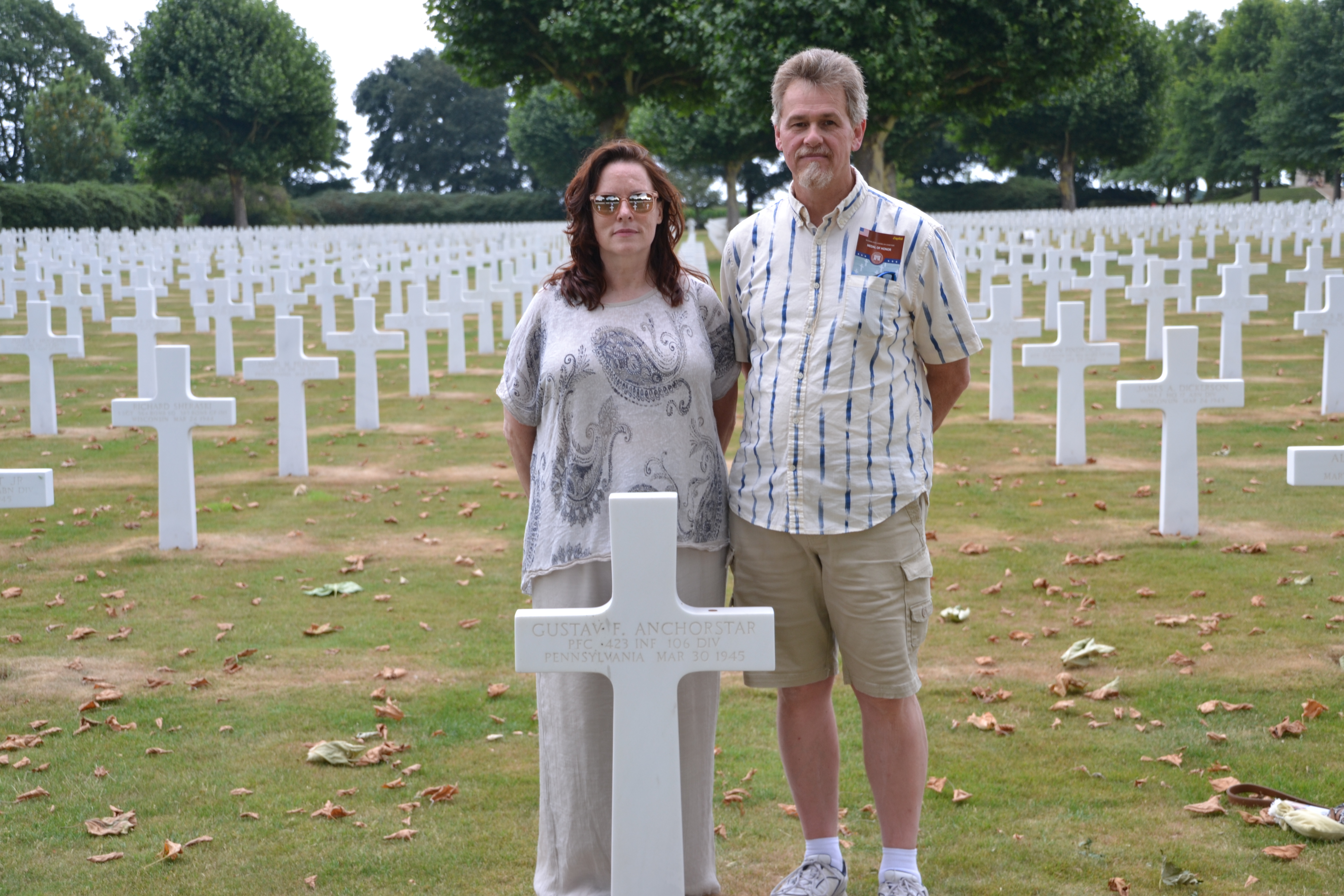


| The Pottsville Republican of October 13, 1943 SCHUYLKILL HAVEN SEAMAN'S BROKEN LEG CHANGED COURSE OF TROOP CONVOY A broken leg which Seaman Second Class Harlan F. Mullins, son of Mr. and Mrs. Claire Mullins of 504 East Main Street in Schuylkill Haven, is nursing at Saint Alban's Naval Hospital on Long Island, New York, changed the course of a convoy enroute overseas with troops on August 22. Mullins broke his leg in an accident aboard his ship, one of those in the convoy, and in order to give him the proper treatment it was necessary to transfer him to a destroyer. His mother has just received a clipping of the story, written by Tom Hanes in the Ledger Dispatch, but is unable to say in what city this newspaper is published. Hanes tells the story in part as follows: "Fanned out on the rim of the horizon a fleet of destroyers speed eastward forming a screen for a convoy of troop laden transports. Aboard a warship in the center of the group, the senior medical officer handed a message to the task force commander. The message was simple. It just said that a man aboard one of the \destroyers had broken his leg and received other injuries in an accident. He needed better medical attention than his ship could provide. "Would it help if we brought him aboard" asked the captain, who already knew the answer. Neither the captain nor the surgeon who answered in the affirmative knew the man's rank. Signals flashed, miles away destroyers maneuvered intricately until one detached from the reformed screen and sped toward us. Reduce speed signals flapped in the breeze and the entire convoy slowed down, keeping perfect alignment like a herd of trained elephants. From their decks thousands of eyes rested on the big wagon as the little tin can, running a parallel course, narrowed the gap separating the two warships. "Wrapped in sheets like a papoose, the injured seaman lay in a basket stretcher on the forecastle. A boatswain's pipe sounded and a massive crane on the battleship's deck swung out its strong arm from which dangled a heavy steel hook. It shaved the swaying bridge of the destroyer forcing men to duck for cover before finally coming to rest directly above the stretcher. Lines swished to the destroyer's decks where eager hands grabbed them. A heavy swell pulled the ships apart but seaman on the destroyer hung on to their lines, one determined lad clinging so tenaciously that he was being dragged over the side until shipmates forming a human chain pulled him back to safety." "As the ships swung toward each other again the boatswain's pipe peeled. The hook dipped quickly. Fast moving sailors snapped on the stretcher lines. An injured man swung out over the ocean and soared toward his new home. As the stretcher glided to a safe landing on the larger ship's decks, men on the destroyer burst into applause and the other ship's crew joined with lusty enthusiasm. Thus it was that eighteen year old Harlan F. Mullins, seaman Second Class, of Schuylkill Haven Pennsylvania, came aboard a large warship at sea. "Captain this is unusual, isn't it,? he asked. "What's so unusual about it?" "It seemed unusual to me to see many ships and thousands of sailors and soldiers affected just because a second class seaman got hurt." "Rank, said the captain, doesn't mean a damn thing out here." He has two brothers in the service, PFC Francis Mullins, stationed at the Holabord Ordnance Motor Base and Ensign Rayfield, somewhere in the Mediterranean. He is married to the former Frances Wisner. |
| The Call of March 17, 1944 MARINE EXPLAINS HIGH COST OF PHOTOGRAPHY IN WAR Among the letters to the editor was one from a Marine in a branch of the service which is little known to most of us at home. The letter was from Private John R. Trout, who is attending the Navy school of photography at Pensacola Florida. In it he gives much interesting information about the photographic equipment used in war. His letter reads: Naval School of Photography March 7, 1944 Dear Sirs: I have received the copies of The Call regularly for the past few months. I think that's a very appropriate idea and will be remembered long after the war is over by those servicemen like myself who have been away from home and who know only through The Call what happens in the old home town. I haven't met anyone from the town as of yet by I met two Warrant Officers who are from Reading, Pennsylvania. The base and the Florida weather are okay. They have every kind of sports imaginable here. We use quite a lot of equipment in this type of school. Only now do I realize what the war is actually costing. It costs $200 an hour to fly one of us four hours a day. We are using cameras valued at costs from $5,000 to $75,000, one is a movie camera fixed for technicolor and sound pictures. I like to also take the opportunity to thank all those who sent Christmas cards to me at Christmas time. I received 217 and that really made this Marine feel swell. Well as time is so precious I have very little left before lights out so again as I close, I'd like to thank you ever so much for the copies of The Call. Enclosed is a picture I had taken. It gives you an idea of one of the smaller cameras we use. So in closing I wish you all the best of luck and may God bless you for the fine job of morale boosting you and your paper are doing so well. Your constant reader, A Marine Serviceman Private John R. Trout. |

| The Call of March 31, 1944 SGT GEORGE EILER CITED FOR PERILOUS MISSION Sergeant George E. Eiler in a letter to the editor enclosed a clipping from the Stars and Stripes telling of an entire fortress group being cited for a costly attack on the Messerschmitt factories at Brunswick Germany. Sergeant Eiler modestly writes merely that he is proud to be with the unit. The writeup goes into more detail, however as follows: "Fighter attacks and flak sent all but one of the planes in Thorup's (the leader of the mission) group home with battle damage. On the Fort's first approach to the target, the main objectives were not clearly identified, so the group executed a 360 degree turn through waves of German rocket firing fighters to make a second run on the important objective. This time the group let loose their bombs on the target area and 73 percent of their bombs landed within a thousand yards of the aiming point. Without fighter escort most of the time, outnumbered three to one by enemy fighters for much of the way home with a loss of seven planes. They were credited with destroying eight enemy fighters. Through a display of extraordinary heroism and of exemplary devotion to duty above and beyond that of all other units participating in the same engagement, the citation read in part, this group rendered a truly great service which reflects the highest credit on itself and the USAAF. The citation to the group means that all men involved will be allowed to wear the unit citation award. It is the only Army decoration of its kind worn over the right breast pocket." Sergeant Eiler is the son of Mrs. Harry Eiler of 741 Garfield Avenue. |
| The Call of July 21, 1944 LOCAL BOY IS CHIEF OF FAMED BOMBER Tech sergeant Vernon L. Heim of Schuylkill Haven is crew chief of the "Pink Lady," one of the ships of the "Black Death" Marauder group commanded by Colonel Gerald E. "Gerry" Williams which has won a half dozen commendations from the supreme commanders of Allied air and ground forces in Europe. The group has completed an even one hundred combat missions against the enemy in the scant period of 125 days and enjoys the distinction of having been selected to fly a combat mission fifteen days after arrival, a feat unparalleled in the history of Allied operations and a demonstration of the high level of training in the group. The "Pink Lady" has seventy eight missions to her credit and has never had a mechanical failure in that time, testifying to the engineering skill of her ground crew and Heim. |
| The Call of July 21, 1944 LT FLORENCE LAUBACH KEPT BUSY AS NURSE IN SOUTH PACIFIC The following story about Second Lieutenant Florence L. Laubach, Army nurse, was received from the public relations office of General Headquarters in New Guinea: SOMEWHERE IN NEW GUINEA In the course of her eighteen months in New Guinea as a member of the Army Nurse Corps, Second Lieutenant Florence L. Laubach of Schuylkill Haven has attended hundreds of patients from forward areas and combat zones. She has been assigned to a station hospital constructed primarily by its own personnel and completed shortly after the fall of Buna. Lieutenant Laubach recalls her first hectic months on the tropical islands beginning in December of 1942. Upon arrival, the Medical department group composing her unit selected a site for the hospital and immediately transformed themselves into contractors, carpenters and bricklayers. Confronted by the urgency for haste imposed by heavy casualties at Buna, they completed buildings in time to be caring for patients on Christmas day. These first few patients were the beginning of hundreds who entered the hospital in the coming weeks, requiring Medical Corps officers, nurses and enlisted men to work feverishly for long hours. During the first half of 1943 the organization survived several enemy air raids. On May 12th, 1943, one hundred Japanese planes attacked, their bombs barely missing the hospital area. Today the hospital operates in comparative peace. Lieutenant Laubach joined the station hospital at Camp Claiborne, Louisiana in May of 1942. In the same month she was crossing the Pacific in a large American liner converted into a troop transport. Arriving in Australia in June, she was on the Australian mainland for six months before her unit moved to New Guinea. Twenty five of her twenty seven months on active duty have been spent overseas. Born in Pottsville, Pennsylvania, Lieutenant Laubach is a graduate of Schuylkill Haven high school in Schuylkill Haven Pennsylvania and Northeastern Hospital Nursing School in Philadelphia. Her father, Mr. A. N. F. Laubach now live in Pottsville at 6 South Center Street. |


| This heart wrenching letter was sent by Mrs. Edna Anchorstar to the Army seeking information about her son, Gustav "Fred" Anchorstar" who died in the Berga concentration camp March 30, 1945. |
| The Call of July 24, 1942 TWO VIOLATIONS IN BLACKOUT The blackout on Wednesday evening was executed in Schuylkill Haven efficiently, with only two violations reported. On Dock Street a pedestrian refused to leave the sidewalk when ordered to take cover, and on Centre Avenue an automobile driver refused to stop. The license number was taken and prosecution will be made. The state wide blackout came at an unannounced time, starting at 9:15. Within a few minutes the entire town was darkened. Several residents had to be reminded of lights burning in the house but on the whole cooperation was immediate. Chief Air Raid Warden Frank S. Lewis was again on the job after his recent hospitalization and reported to the county officers a perfect blackout with the exception of the two violations. Nineteen casualties were staged. Particularly noticeable in this blackout was the speed of the first aid corps in taking care of the injured and the lack of confusion that was present at the previous blackouts. Schuylkill Haven now has a smooth working defense set up. |
| The Call of August 14, 1942 TOWN TO SEND MONEY BELTS TO SERVICE MEN Representatives of the American Legion, Legion Auxiliary, Rotary, Lions Club, and Civic Club met on Wednesday evening at the legion home to decide on an appropriate gift to be given each man and boy from Schuylkill Haven in the service of the country. After considering several proposals, it was finally decided that a money belt would be the most useful. The gift selected is a water proof money holder attached to a web belt which goes around the body. Considering the number of reports of money being stolen from soldiers, this gift will serve a useful purpose. An order for 500 money belts was made through George Gray, local men's clothier, who offered to supply the gifts at cost. A telegram received last evening stated the belts would arrive next week. John McGuire, commander of the Robert E. Baker Post of the American Legion, reported that these belts will be placed at various places in town and the public will be able to pay the purchase price and have the belt sent to a soldier. The belts will sell for sixty five cents. Each money belt will contain a card, stating that the gift is from Schuylkill Haven and at the bottom will have the name of the person who purchased the belt. Purchasers will not be permitted to ask that the belt purchased by him be sent to one particular soldier. The belts, with the name of the purchaser inside, will be sent at random to the soldiers, sailors and Marines from town. All town organizations will be asked to support this project, and the citizens of the community will be expected to aid by purchasing the belts. Announcements of the plan will be made on the screen at the Rio Theatre and the ministers of town will explain the plan at their services on Sunday. The names of the servicemen will be given by The Call. The mailing list of The Call is almost complete. Parents of boys in the service, whose names have not been given to this newspaper are asked to send in their names in order that they receive this gift from the town. This is a town project - let everyone support it. |
| The Call of September 18, 1942 OLD STREET CAR RAILS WILL BE TAKEN FOR WAR DUTY The old street car rails embedded in the streets of Schuylkill Haven will go to war as scrap, by action of Borough Council on Monday night in accepting the plan of the government for their removal. According to the wording of the agreement, the rails will be removed and the street repaired at government expense, and the town will be required to donate the money received for the rails as its part of the project. Actually, the government is removing the rails and repairing the street at no cost to the town. |
| The Call of December 11, 1942 TOWN TO GET SERVICE FLAG Plans are now being made for a ceremony in Schuylkill Haven on parade and service flag presentation on Friday, January 1. The service flag, measuring four by six feet and containing a blue star upon which changeable numbers can be placed, will be presented to the town by the Lions Club at a patriotic program to be held at the high school auditorium at ten o'clock in the morning on January 1. A prominent speaker from the county will deliver an address. The parade, which will precede the ceremony at the high school, will consist of the high school band and the service clubs and organizations of the community. It will form on Parkway and move to the high school building on Haven Street. |
| The Call of December 11, 1942 RATIONING HITS POST OFFICE Owing to the decrease in gasoline allotment for the post office truck, Postmaster J. H. Brownmiller announces that starting Monday there will be no evening collection of mail and in the outlying sections of town there will be only three deliveries of parcel post a week. The usual monthly need is sixty five gallons of gasoline. During the month of December when more trips are needed for deliveries and collection of mail, more is required. The truck has been allotted sixty five gallons for December and already thirty gallons have been used and the busiest time of the month is yet to come. After the first of the year, the gasoline ration will be reduced to seventy six gallons for a three month period. |


| Ads like these began to appear in The Call in 1942 and continued for the duration of the war. |


| The Call of August 6, 1943 The five Donati boys pictured are all sons of John Donati of 136 Broadway. Paul was inducted into service eight months ago and is somewhere in Australia for the past seven months. James, somewhere in Africa, enlisted three years ago and is married to the former Helen Merlino. Raymond has been with his brother, James, all during his three years of service. The boys went across together and remained together in Africa until a month ago when James was moved to another barracks. Raymond recently received his promotion to sergeant. Leo, the only one of the brothers still in the country, is attending MP school at Lee Hall in Virginia. He was inducted four months ago. He is expected home on a furlough shortly. Mr. Donati lives with his eldest son, Mario, and his family. Mario is doing his part to keep his soldier brothers supplied by working in a defense plant. |

| The Call of August 13, 1943 Earl or "Spark" as his friends know him, is an aerial engineer gunner and is located somewhere in Africa, having arrived there in April, not by boat but by plane. He is a son of Mr. and Mrs. George Lord of 17 Eaton Street and is a 1937 graduate of the local high school. Prior to his entering the service on February 18, 1942, he had been employed at Reider's Shoe Company. A brother, George Jr., is stationed in Louisiana where he is attending an MP school. In a letter to his parents he mentioned the fact that he shot down a German plane on July 4 and that it is a thrill to see a plane come down, especially if you are the one responsible for it. He stated most of the raids are on the water, so land looks mighty good when they come back. He enjoys the short period of excitement but says it becomes monotonous between raids, that they seldom encounter evening pursuits and have only seen pursuits on two or three trips. He told his parents not to worry about him as he was not having it too hard. |

| The Call of August 20, 1943 A brother of Mrs. James Donati is the son of Mr. and Mrs. Fred Merlino of 37 Jacques Street. His wife is the former Margaret Feeney of Pottsville. He has never seen his baby daughter Anne Marie. He is in active service somewhere in Africa and has been overseas nine months having first been in England. His people have received quite a number of articles which he sent from Africa including 10 and 20 francs in French money and native shoes for the baby which are made of a woven fabric. |


| The Call of August 20, 1943 These soldiers are the sons of Mr. and Mrs. Frank E. Clark of 11 east Main Street. Edward who enlisted in 1940 is a member of the 213th Coast Artillery and is somewhere overseas. Jay is in the infantry stationed at Shreveport, Louisiana. He was inducted November 11, 1942. Harry is a member of the Air Force Corps and is staioned in Pocatella, Idaho. He entered the service August 11, 1942. |

| The Call of September 3 Paul Sterner, son of Mr. and Mrs. George Sterner of 122 Broadway returned to Camp Polk, Louisiana after spending a sixteen day furlough with his parents. He has been in the service fourteen weeks and prior to that time he had been employed at the Walkin Shoe Company. He expressed his thanks to those making it possible for him to receive The Call weekly. |

| The Call of September 3 Kenneth Sausser, serving in the medical department of the U. S. Navy has been recently been promoted to the rank of Pharmacist Mate Embalmer. For the past several months he has been stationed at a Naval Base hospital somewhere in the Caribbean area. He is a son of Mr. and Mrs. Robert L. Sausser of 316 East Union Street and is a graduate of the Eckels College of Embalming of Philadelphia where he was also certified as a laboratory technician. Prior to his enlistment in the Navy on December 11, 1942, he was serving his apprenticeship with a prominent Schuylkill Haven funeral director. |
| The Call of September 3 These two are the sons of Mr. and Mrs. Joseph A. McCormick of 218 Dock Street, Schuylkill Haven. Both are serving in the U. S. Navy. Their father was a World War One veteran and served in France. John entered the Navy March 8, 1943 and is stationed in Chicago where he is attending school. He is a 1940 graduate of Schuylkill Haven high school and prior to entering the Navy was employed as an instrument maker at Mitchell Field, New York. Leo is in the Navy since May 7, 1943. He received his boot training at Sampson, New York and was then sent to Pleasanton, california. He is a graduate of Saint Ambrose parochial school, class of 1942 and had been employed as a mechanic at Indiantown Gap. Another brother, Joseph, is a defense worker at Middletown. At present he is attending school in Indiana but will again return to Middletown. |

| The Call of September 17, 1943 Thomas J. Carlin, son of Mr. and Mrs. Frank Carlin of 17 West Liberty Street is somewhere in Sicily. His mother just received a letter from her son stating that he has just been discharged from a hospital in North Africa where he recovered from an attack of malaria. He is now feeling fine and is waiting to be returned to his company in Sicily. He went back to Africa by plane and said it was the biggest thrill he ever received. Sergeant Carlin is a tank driver and has been over there since the invasion last November. |


| The Call of September 17, 1943 Francis Sterner, son of Mrs. Vera Sterner of Broadway is stationed with the Seventh Army inn Sicily and has been in action several times. He sent his thanks for The Call which he receives regularly and enjoys immensely. He is a graduate of Saint Ambrose school and prior to entering the service he had been employed as assistant manager at the A & P store. |
| The Call of September 17, 1943 John Hulett, also known as Buddy, who volunteered February 16, 1943 to leave with the next induction group, which left February 23, is with a utilities company somewhere in Sicily. He is the son of Mr. and Mrs. John M. Hulett of 41 Broadway. |


| The Call of September 24, 1943 Merchant Seaman Lester E. Wise is spending a short leave at the home of his parents at 116 Dock Street. He has returned to the United states after 21 days convoy duty in the Dutch West Indies and the North Atlantic and will leave for New York City on Monday to be enrolled in a special war shipping training program. |

| The Call of October 8, 1943 The promotion of Robert O. Rollman, of Schuylkill Haven, from First Lieutenant to Captain, was announced recently by Brigadier General Frederick L. Anderson, Commanding General of the Eighth Air Force Bomber Command. Captain Rollman, 22 years of age, is the engineering officer of a Flying Fortress squadron. His parents, Mr. and Mrs. R. S. Rollman live at 540 West Columbia Street in Schuylkill Haven. He attended the local high school where he participated in all major sports. Captain Rollman left a job with Jay Jewelers in Pottsville to enter the service on September 30, 1940. He was commissioned a second lieutenant August 6, 1942 and was promoted to first lieutenant January 27 of this year. |

| The Call of November 5, 1943 Ensign G. Robert MacMinn, son of Mr. and Mrs. George MacMinn, of Avenue B, was graduated last week from the United States Merchant Marine Academy at King's Point, New York. A graduate of Schuylkill Haven high school class of 1939, Bob enlisted after war was declared in the Merchant Marine at Hoffman Island, New York. Finishing his course there, he was given an appointment by the government to the officers training school at King's Point, New York. During his training there, Bob made three successful trips to England, South America and Africa. It was on his African trip that he witnessed the first bombing of Casablanca. After receiving his commission as ensign, he successfully passed his examinations and received his license as third assistant engineer. After spending a short vacation at his home, he will return to his new studies. |

| The Call of November 19, 1943 Second Lieutenant Kenneth H. Dunlop, recently graduated from Officers Training School at Miami, Florida, following four months training. Lieutenant Dunlop enlisted in June 1942 in the Air Force and was promoted to Staff Sergeant in the intelligence section and completed an administrative course and specialized in military tactics and camp operations. Upon graduating, he was assigned to salt Lake City, Utah, from where he will be assigned as adjutant of an air base. He is the son of Mr. and Mrs. George Dunlop of Dock Street, his mother being the former Miriam Ehly. He is a graduate of the local high school and Duke University. |

| The Call of November 26, 1943 Ivan Charles Quinter Jr., of the United States Naval Reserve, is the son of Mr. and Mrs. Ivan C. Quinter of 30 Fairview Street. He was graduated from the local high school in 1943 and enlisted in the Navy on June 23. He received his boot training at the Sampson Naval Training Station where he qualified for advanced training and was sent to the Naval Training Station at Richmond, Virginia. He was graduated from there with the rating of Motor Machinist's Mate third class. Later he was transferred to the naval base at Boston. |

| The Call of December 31, 1943 Seaman Second Class William H. Hill, who has completed his boot training at United States Naval Training Station at Sampson New York, is spending a week at the home of his mother. Bill, as he is known to his many friends, is the son of Mrs. Almeda Hill and the grandson of Mr. and Mrs. M. L. Wenrich of 113 Avenue B in Schuylkill Haven. Bill enlisted November 8, 1943. |

| The Call of January 14, 1944 Private Michael Shadel Jr., better known as Chuck, enlisted in the service August 23, 1943. He received his training at Parris Island, South Carolina. At present he is at an Ordnance School at Norman, Oklahoma. He is the son of Mr. and Mrs. Michael Shadel Sr., of 414 Hess Street and is a graduate of the local high school class of 1943. While at school he played on the football team. |

| The Call of January 14, 1944 Raymond McKeone received a V-mail letter from his son, Sergeant Charles P. McKeone, in which he stated that he had been wounded in action in Italy but that he was alright and his father should not worry about him. He has been awarded the Purple Heart and was promoted to First Sergeant the first of December. He saw action at Pearl Harbor, North Africa, Sicily and Italy. |
| The Call of February 4, 1944 Corporal Sterling E. Kramer, better known as "Doney," arrived somewhere in England. He entered the service January 25, 1943. He received his basic training at Fort Jackson, South Carolina and was sent to Ordnance School at Aberdeen, Maryland. Later he was on maneuvers in Tennessee and Georgia. Sterling is the son of Mr. and Mrs. Henry Kramer of 307 Dock Street and has four sisters and one brother. His wife is the former Leatrice Brinich of town.. |


| The Call of February 18, 1944 Private First Class Richard E. Grover is the son of Mr. and Mrs. William Semmet of 22 West Main Street. He is 18 years of age. He entered the service on June 16, 1943 and received his basic training at Parris Island, South Carolina. From there he went to Cherry Point, North Carolina and Jacksonville, Florida and is now stationed at metalsmith school in Norman, Oklahoma. Before entering the Marines, he was a student at the local high school. He has two sisters at home, Lucyle and Catherine. |

| The Call of March 17, 1944 These three soldiers are the sons of Mr. and Mrs. John W. Mengle of 9 Eaton Street. John was inducted April 25, 1941 and received his basic training at Camp Croft, South Carolina and Camp Livingston, Louisiana. He has been stationed at a Chinese-American training center somewhere in India since May of 1942. He graduated from the local high school in 1935 and is the husband of Dorothy Mengle of Pottsville. Russell was inducted October 1942 and received his basic training at Camp Atterbury, Indiana. At present he is stationed with an anti tank camp at Camp Breckenridge, Kentucky. He graduated from the local high school in 1939 and had been employed by the Bashore Knitting Mill. Robert was inducted May 1943 and received his infantry training at Camp Shelby, Mississippi and was sent to Africa in November 1943. Official word was recently received that he was wounded in Italy and had been awarded the Purple Heart medal. He attended the local schools and had been employed by the Reading Railroad. They have the following sisters and brother: Grace, wife of Edward Standiford, Long Run; Arlene, wife of Robert Moyer, Jean and Charles at home. |

| The Call of March 24, 1944 Two Weiser brothers are serving in the Army. Edward is stationed somewhere in England. He is in good health and receives The Call regularly for which he sends his thanks. Like the others in the service, he is glad to hear what is happening in his old home town. Leonard entered the service January 25, 1943 and is stationed at Roswell, New Mexico. He reports the place as dusty and dry and says the cactus plants, which are in full bloom, are very beautiful. The two boys are sons of Edward G. weiser of 14 Saint John Street and Mrs. Mary Weiser of 309 Center Avenue. There are two other brothers, Kenneth, who is employed at the Acme store at Hamburg and Laverne. There is also a half sister, Mrs. Stanley Angst. |
